Country:

 City:
City:


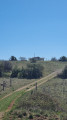
From the D9, take the access road to the Cantercel site: on the right when coming from La Vacquerie-et-Saint-Martin-de-Castries. Just after the junction, you will find a small car park for walkers with space for two or three vehicles.
(S/E) Leave the car park and follow the tarmac road towards Cantercel.
(1) Continue along the road, leaving the access path to the Goutal spring on your right; this will be your return point; from there, the path is a little stony
(2) Leave the road and turn left onto the path that forms part of the GRP® Grande Traversée de l'Hérault: marked with yellow and red signs. Follow this path, which runs parallel to the road.
(3) Turn right to join the GR®7 (marked in white and red): pass behind the architectural workshop at the Cantercel site. The path, which is fairly visible, winds its way through numerous dry-stone enclosures that are now abandoned.
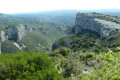
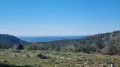
(4) After crossing a small valley with a huge stone-built embankment, take the path on the left, leaving the GR®7 which veers off to the right. Follow a path that is somewhat indistinct at first, but which then becomes a well-marked mule track on the hillside, and reach the Aven de Vitalis. Warning : access to the old cellars inside the karstic cave is, in principle, dangerous and prohibited, even though there are no signs to this effect. Enjoy the view across the southern part of the Larzac plateau.
(5) Return to the previous junction and rejoin the GR®.
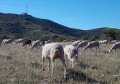
(4) Go straight on to follow the trail and reach the Tédenat sheepfold.
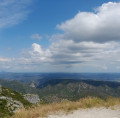
(6) Continue straight on, leaving the sheepfold on your right. Just past the sheepfold, on the hill, you’ll notice the unusual sight of a sailing boat named Noë, brought there a few years ago. You can approach it but not climb aboard. From this spot, the view is almost 360°. Follow the path that goes round the hill and joins a route called “the water path”: blue markings.
(7) Turn right and continue down the hillside until you reach the access road to Cantercel. Follow this road downhill for about sixty metres.
(8) Take the path on the left across the moor to follow “the water trail”. There is a marker with a hollowed-out metal arrow to help you find your way, followed by a fairly discreet blue marker; you will then quickly find yourself on a clear path through a fairly dense scrubland. Reach the source of the Goutal. Enjoy the coolness of the oasis that forms around the spring, where an information panel recounts the history of the site.
(9) Continue on to rejoin the starting route.
(1) Turn left and return to the car park near the D9 (S/E).
 Visorando Member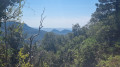

 Moderate
  Difficult
 Very difficult