Country:

 City:
City:


From Pont-de-Montvert, follow the road (marked as difficult and dangerous, so take care) towards the hamlets of Le Mazel (3 km away) and Villeneuve (4.5 km away); continue past the latter hamlet. There is a car park about 1.2 km further along the roadside, just before a bridge, with around ten parking spaces.
(S/E) Cross the road bridge, then take the path on the right; this quickly approaches the River Tarn as it descends.
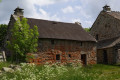
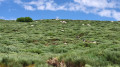
(1) Leave the return path, which crosses the Tarn, on your right. Cross a large meadow, keeping to the left of the ruin, then head uphill towards the woods. As you emerge from the woods, you’ll find yourself on a lovely path lined with broom, leading to the hamlet of L’Hôpital.
(2) Walk through the hamlet to the right, then head up to L’Hôpital-le-Haut, crossing via the main street lined with a row of fairly similar houses.
(3) Take the track on the left, which is also used by vehicles to reach Mas Camargues.
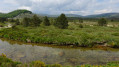
(4) At the car park, turn left to follow the interpretive trail, details of which are available on the Cévennes National Park website. The trail is marked by 17 information boards, which this route follows in reverse order. The trail runs alongside the River Tarn.
(5) Cross the River Tarn and enter a beautiful forest; follow the irrigation channel that used to carry water to the Mas Camargues mill.
(6) Take the track on the left, running alongside the farmhouse, towards the hamlet of Bellecoste.
(7) Explore the hamlet, then retrace your steps to the entrance to the hamlet.
(7) Take the barely visible path on the left; look out for a metal gate. Cross a meadow through the broom; the path is still hard to make out.
(8) Cross a ford, then enter a woodland to reach a track.
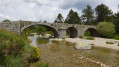
(9) Head off to the right towards the Pont du Tarn. Do not take the path that crosses the bridge, but do feel free to walk across it.
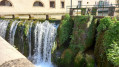
(10) Take the GR®72 which runs alongside the Tarn, passing the Caguefer water intake (where swimming is prohibited).
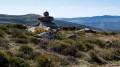
(11) Take a small, barely visible path that descends to the right into the forest; the path is marked by a cairn. Once you reach the Tarn, there are two planned crossings: thefirst is reserved for animals, whilst thesecond allows you to cross the Tarn without getting your feet wet, thanks to large granite boulders. Return to the junction you passed on the way out.
(1) Head back up to the road, following the reverse route of the outward journey, to return to the car park (S/E).
 Visorando Member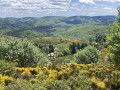
 Easy
Easy 
 Very difficult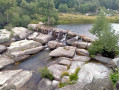
 Difficult