


Refine your search for walks in Aigue Agelle (rivière) - Affluent du Guil
Aigue Agelle (rivière) - Affluent du Guil walks


 The Pic de Caramantran
 Visorando Member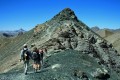
 4.02 mi
 +1,457 ft
 -1,447 ft
 3h 05
3h 05
 Moderate
 Departure from Molines-en-Queyras (Hautes-Alpes)
Set off to climb the Pic de Caramantran, one of the easiest 3,000-metre peaks in the Queyras Regional Nature Park, and enjoy transalpine views of Italy and the Saint-Véran valley from its summit.
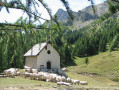
The Col des Prés de Fromage
 7.31 mi
+2,362 ft
-2,336 ft
5h 25
Moderate
Departure from Molines-en-Queyras (Hautes-Alpes)
7.31 mi
+2,362 ft
-2,336 ft
5h 25
Moderate
Departure from Molines-en-Queyras (Hautes-Alpes)
This forest and mountain pasture trail offers a fascinating glimpse of the valley and some of Europe's highest villages, including Saint Véran.
The Bucher Summit
 7.09 mi
+2,156 ft
-2,146 ft
5h 10
Moderate
Departure from Saint-Véran (Hautes-Alpes)
7.09 mi
+2,156 ft
-2,146 ft
5h 10
Moderate
Departure from Saint-Véran (Hautes-Alpes)
In Queyras, at this time of year (late October), the ubiquitous larch forests colour the mountain landscapes with shades ranging from yellow to red, and the snow-capped peaks further enhance this feeling of fulfilment.
The proposed hike takes place in this atmosphere above the highest village in Europe: Saint-Véran.
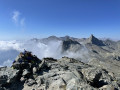
Pic de Caramantran and its lakes from Agnel
 7.09 mi
+2,621 ft
-2,631 ft
5h 35
7.09 mi
+2,621 ft
-2,631 ft
5h 35
 Difficult
Departure from Molines-en-Queyras (Hautes-Alpes)
Difficult
Departure from Molines-en-Queyras (Hautes-Alpes)
A border route to tackle the Pic de Caramantran (3,025 m), take in a host of 3,000-metre peaks: Mont Viso, Pain de Sucre, Tête des Toillies, and discover three magnificent lakes: Blanchet Supérieur, Blanchet Inférieur and Lac de la Blanche.
Pierre Grosse Saint-Véran circular
 6.90 mi
+1,234 ft
-1,250 ft
4h 15
6.90 mi
+1,234 ft
-1,250 ft
4h 15
 Easy
Departure from Molines-en-Queyras (Hautes-Alpes)
Easy
Departure from Molines-en-Queyras (Hautes-Alpes)
A pleasant little circular to discover the highest village in Europe. Starting from Pierre Grosse, cross the hamlet of La Chalp. No great difficulty. Magnificent views of the Queyras peaks.
Tour of the hamlets of Aigue Agnelle
 4.13 mi
+538 ft
-538 ft
2h 20
Easy
Departure from Molines-en-Queyras (Hautes-Alpes)
4.13 mi
+538 ft
-538 ft
2h 20
Easy
Departure from Molines-en-Queyras (Hautes-Alpes)
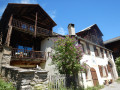
On the Col Agnel road leading to Italy, there are three hamlets in Molines that are inhabited all year round: Pierre Grosse, Le Coin and Fontgillarde. These hamlets have preserved their traditional architecture (stone, wood, sundials) as well as numerous fountains, mission crosses and the coexistence of temples and churches.
In winter, see: Practical information.
The Saint-Veran observatory and the Pic de Château-Renard
9.11 mi
+3,422 ft
-3,422 ft
7h 10
Difficult
Departure from Molines-en-Queyras (Hautes-Alpes)
This route in A/R takes you through enchanting surroundings to the beautiful Saint-Véran observatory, where you can then flirt with the 3,000 m mark (2,989 m) by climbing to the Pic de Château Renard for one last effort.
Friendly marmots will accompany you along the way, guaranteed to steal your heart.
The Pic de Caramantran circular
 5.39 mi
+1,906 ft
-1,906 ft
4h 10
Difficult
Departure from Molines-en-Queyras (Hautes-Alpes)
5.39 mi
+1,906 ft
-1,906 ft
4h 10
Difficult
Departure from Molines-en-Queyras (Hautes-Alpes)
The Pic de Caramantran is an extraordinary destination! This hike takes you on a circular route that also allows you to discover the Col de Saint-Véran. You may see ibex and numerous marmots along the way.
Longet Pass
 4.61 mi
+2,211 ft
-2,211 ft
4h 05
Moderate
Departure from Molines-en-Queyras (Hautes-Alpes)
4.61 mi
+2,211 ft
-2,211 ft
4h 05
Moderate
Departure from Molines-en-Queyras (Hautes-Alpes)
A round trip to Col de Longet, along a wide, very pleasant valley.
The climb is steady, passing through forest and mountain pastures before reaching rocky terrain.
Variations: see § Practical information*
This hike can be done on snowshoes up to (3). See § Practical information**
 The Saint-Simon Chapel at the start of the Rua
4.22 mi
+1,949 ft
-1,926 ft
5 hrs
Moderate
Departure from Molines-en-Queyras (Hautes-Alpes)
There are many high-altitude chapels in Queyras. This one above Molines, located in a large cirque, is particularly worth a visit.
Between Molines-en-Queyras and Saint-Véran
 5.19 mi
+997 ft
-1,001 ft
3h 15
Moderate
Departure from Molines-en-Queyras (Hautes-Alpes)
5.19 mi
+997 ft
-1,001 ft
3h 15
Moderate
Departure from Molines-en-Queyras (Hautes-Alpes)
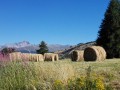
A short circuit from the hamlet of Pierre Grosse through the ski slopes to reach and discover Saint-Véran.
Astragales Circular Loop
 4.72 mi
+1,427 ft
-1,440 ft
3h 25
Moderate
Departure from Château-Ville-Vieille (Hautes-Alpes)
4.72 mi
+1,427 ft
-1,440 ft
3h 25
Moderate
Departure from Château-Ville-Vieille (Hautes-Alpes)
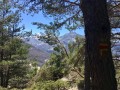
Overlooking the south-facing Guil valley, two high-altitude hamlets, Les Meyries and Rouet, are well worth a visit, especially in winter. To reach them, simply take the Sentier des Astragales and continue the walk along theGR®®58.
Tour du Queyras
 56.34 mi
+22,976 ft
-22,575 ft
7 days
Moderate
Departure from Château-Ville-Vieille (Hautes-Alpes)
56.34 mi
+22,976 ft
-22,575 ft
7 days
Moderate
Departure from Château-Ville-Vieille (Hautes-Alpes)
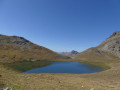
The Tour du Queyras, labelledGR®58, is adaptable. The route described, starting from Château Queyras and completed in a group in September 2008, will take you through this natural park, skirting and climbing some 3,000 metres. You will discover the beautiful villages of this park with their well-known names: Ceillac, Saint Véran, Abriés... What's more, in summer the weather is almost always fine. The bright blue sky the next day will quickly make you forget the storm of the previous evening.
Saint Véran - Col Agnel
 8.02 mi
+3,468 ft
-1,683 ft
6h 45
Difficult
Departure from Saint-Véran (Hautes-Alpes)
8.02 mi
+3,468 ft
-1,683 ft
6h 45
Difficult
Departure from Saint-Véran (Hautes-Alpes)
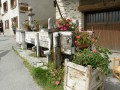
The fourth stage takes you towards the Italian border, offering beautiful views of Mont Viso.
From Rouchas Frach to the Agnel refuge via the new Aigue Agnelle path
 7.56 mi
+1,391 ft
-1,375 ft
4h 40
Moderate
Departure from Molines-en-Queyras (Hautes-Alpes)
7.56 mi
+1,391 ft
-1,375 ft
4h 40
Moderate
Departure from Molines-en-Queyras (Hautes-Alpes)
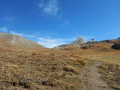
A family-friendly route to explore the Oratory of Notre-Dame du Berceau, a short stretch of the Rouchas Frach Canal and then the Aigue Agnelle, a charming, winding little stream. Beautiful views of the Pain de Sucre and the Pic d’Asti. Marmots, edelweiss…
Astragales Route
5.75 mi
+1,847 ft
-1,837 ft
4 hrs
Moderate
Departure from Château-Ville-Vieille (Hautes-Alpes)
Visit the villages of Meyriés and Rouet, perched facing south above the Guil.
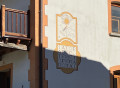
Sundials and fountains at the start of the walk in Molines-en-Queyras
 6.87 mi
+951 ft
-928 ft
4h 00
Moderate
Departure from Molines-en-Queyras (Hautes-Alpes)
6.87 mi
+951 ft
-928 ft
4h 00
Moderate
Departure from Molines-en-Queyras (Hautes-Alpes)
As part of the Queyras heritage, this is an unmissable walk starting from Molines-en-Queyras. The sundials, fountains and log-built houses will captivate young and old alike throughout this walk.
 Pic de Château Renard – Col du Longet
 15.46 mi
+3,573 ft
-3,570 ft
2.5 hrs
Difficult
Departure from Molines-en-Queyras (Hautes-Alpes)
15.46 mi
+3,573 ft
-3,570 ft
2.5 hrs
Difficult
Departure from Molines-en-Queyras (Hautes-Alpes)
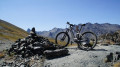
A high-mountain ride taking in Saint-Véran, the highest inhabited village in Europe. A beautiful climb up to the Pic de Château Renard observatory, with magnificent views. To finish, a lovely technical descent from the Col du Longet.