Sightseeing tour of Vitré

Explore the historic heart of Vitré, a town of art and history, with its streets and alleyways dating back to medieval times.
Stroll and wander in search of hidden gems with this route taking in all the must-see sights.
A real getaway into the heart of history and the Vitré way of life! Finish the walk with a visit to the medieval castle.
Follow the step-by-step guide rather than the GPX track for ease of use.

Details

32079473
Creation:
Last update:
Last review:
  • Walking
    Activity: Walking
  • ↔
    Distance: 5.34 mi
  • ◔
    Average duration: 2h 40 
  • ▲
    Difficulty: Easy

  • ⚐
    Back to start: Yes
  • ↗
    Ascent: + 243 ft
  • ↘
    Descent: - 217 ft

  • ▲
    Highest point: 374 ft
  • ▼
    Lowest point: 213 ft
  • ⚐ Country: France
  • ⚐ City: Vitré (35500)
  • ⚑
    Start/End: N 48.121964° / W 1.214109°
  • ❏
    IGN map(s): Ref. 1318SB
  • Hour-by-hour weather

Photos

Description of the walk

Start at the footbridge at the PEM (multimodal transport hub), where there is a free car park with 600 spaces.

(S/E) From the car park, go up to the footbridge a and start the walk with a panoramic view of the medieval town of Vitré and its castle. Then cross over the railway line and go down the other side. Once at the bottom, turn right towards the station b.

(1) Head towards the roundabout, then turn left and walk to Place Saint-Yves. Next, walk up Rue d’Embas c , taking the time to admire the many half-timbered houses, notably the Hôtel du Bol d’Or d at no. 10.

(2) Continue straight ahead along Rue de la Poterie, where you will find the Maison de l'Isle e, easily recognisable by its island-like layout. At the end of the street, turn right and walk down Rue Duguesclin to the end.

(3) Turn left into Rue de la Borderie. After the post office, on the left, stands the Tour de la Bridole, which, together with another tower (now gone), defended the Porte d’En-Haut, situated at the south-east corner of the citadel. You can still see the parapet walk, the arrow slits and the embrasures.
Then continue straight on and walk down Rue Bertrand d’Argentré. Pass in front of Saint-Martin Church, then over the railway line and continue to the next roundabout.

(4) Cross over and walk up Boulevard des Rochers. Turn right at the next roundabout, then, at the end of the boulevard, turn left just after the McDonald’s. Follow Boulevard de Châteaubriant to the entrance of the Jardin du Parc g, just past the Boulangerie du Parc.

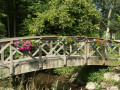
(5) Enter this garden, much loved by the people of Vitré, and head to the right. Walk past the bandstand, then take the first path on the left. Cross a small bridge, then turn right at the end of the path. Continue straight ahead to leave the park.
Turn left as you leave and walk to the roundabout. Continue straight on, then turn right almost immediately into Rue des Viviers. Once at the junction, take the middle street (Rue des Castors) and walk up to the roundabout. Then turn left onto Rue de Paris h and follow it.
At the end of the street, turn immediately right towards Place de la République. At the end of the square, turn left, passing a house with mosaics beneath the windows and under the roof. You’ll reach a crossroads with a red wrought-iron gate on your right.

(6) Turn right and go through the gate. Walk down the Promenade de la Vilaine, then, once at the bottom, turn right and then left 100 metres further on. Continue straight ahead, cross the street to head down towards the banks of the Vilaine, then turn left to cross the bridge over the river.

(7) On the other side, head left along the riverbank to discover the Pré des Lavandières i. Follow the path until you reach a second bridge. Cross it, then turn right and continue to Rue du Val.

(8) Turn right once, then right again at the end to enter Rue Pasteur j. Ignore the bend and continue straight ahead, then take the first left. Head up Chemin des Tertres Noirs k for a magnificent view of the town, then take the first right just before the junction. Turn right again 20 m further on. Turn left again and head back along Chemin des Tertres Noirs in the opposite direction. At the end of the path, continue straight on into Rue du Puits Pèse.
Head down the first street on the right, then, once at the bottom, turn left and walk up Rue de Fougères to no. 36. Turn right immediately afterwards and walk down the path to Pont Marin. Turn right and follow the path towards the Vilaine.

(7) Cross the Vilaine, then turn right immediately on the other side to join the Promenade du Val, which runs alongside the ramparts of the old walled town as far as the Pré des Lavandières. Continue to the Poterne Saint-Pierre and go through it to return to the old town and reach Place Notre-Dame.
Walk past the Church of Notre-Dame, behind which lies the Benedictine Priory, and turn left onto Rue Notre-Dame. Walk past the Hôtel Ringues de la Troussanais , then turn right and head down to the junction with Rue de la Borderie.

(3) Turn right and walk down to a square with a fountain. Then turn right and take Rue de la Trémoille on the left. At the junction, turn right and walk up Rue de la Baudrairie o, rejoining Rue de la Poterie.

(2) Cross Rue de la Poterie and continue straight ahead. At the top of the street, turn left to reach the square and Vitré Castle , the last, but by no means least, monument on the tour! Walk past the castle, then turn left and continue along Rue Saint-Louis until you reach Rue Garengeot.

(9) Turn right to go down this street. After the right-hand bend, go round the roundabout and head back to the station.

(1) Turn left, walking alongside the station, then take the footbridge to return to the starting car park (S/E).

Waypoints

  1. S/E : mi 0 - alt. 292 ft - Multimodal transport hub
  2. 1 : mi 0.13 - alt. 292 ft - Gare de Vitré
  3. 2 : mi 0.37 - alt. 299 ft - Rue de la Poterie
  4. 3 : mi 0.52 - alt. 312 ft - Rue de la Borderie
  5. 4 : mi 0.79 - alt. 318 ft - Roundabout
  6. 5 : mi 1.35 - alt. 351 ft - Entrance to the Jardin du Parc
  7. 6 : mi 2.55 - alt. 335 ft - Red wrought-iron gate
  8. 7 : mi 2.79 - alt. 220 ft - Vilaine (fleuve)
  9. 8 : mi 3.22 - alt. 249 ft - Rue du Val
  10. 9 : mi 5.1 - alt. 312 ft - Rue Garengeot
  11. S/E : mi 5.34 - alt. 292 ft - Multimodal transport hub

Notes

Car park and toilets at the starting point.
Toilets are available at the tourist office, the station, the Jardin du Parc, the Champ de Foire, the Pourtour Saint-Martin and Rue Notre-Dame.
There are numerous hotels and restaurants in the historic centre and near the Jardin du Parc.

Worth a visit

The PEMFootbridge: High above the railway line, the footbridge at the Multimodal Transport Hub (PEM) offers a panoramic view of all Vitré’s monuments, giving you a glimpse into the town’s rich history. On the promontory facing the castle, a timeline helps you place each monument within the town’s history. At night, they reveal themselves from an unforgettable vantage point. Nearby, you’ll find the former fur factory, which now houses the Jacques Duhamel Cultural Centre. In short, treat yourself to an exceptional 360° view.

b Vitré Station__: A symbol of the town’s revival in the 19th century and built by Victor Lenoir (architect of the former Montparnasse station in Paris), it was inaugurated in 1857 by Emperor Napoleon III. At the time, it was one of the stops on the Paris-Brest line. Today, it offers a direct connection to the centre of Rennes in 20 minutes and to Paris in under two hours.

c Porte et Rue d’Embas__: The gate has disappeared, but you can see its former location in the cobblestones. As you walk up the street, take the time to admire the many half-timbered houses. Symbols of the flourishing hemp cloth trade from the 14th to the 16th century, some of these houses were built by members of the Confrérie des Marchands d'Outre-Mer. Today, restaurants and bars have replaced the old merchants’ shops, much to the delight of your taste buds!

d Hôtel du Bol d'Or__: At the top of Rue d’Embas, stop at number 10. This 16th-century building is one of Vitry’s most unusual mansions: the Hôtel du Bol d’Or is imposing in size and astonishing in its architecture. Built of stone, the polygonal tower and the beautifully decorated slate roofs make it a real curiosity. To take the time to admire this magnificent residence and savour the art of living the Vitré way, the terraces of the nearby cafés are the ideal spot.

La Maison de l’Isle: Easily spotted thanks to its island-like layout, it dates from the 16th and 17th centuries. This residence is one of Vitré’s most photogenic sights. In Rue de la Poterie, discover numerous old merchants’ houses with porticoes: their upper floors project out over the street, forming a covered walkway ideal for trade. Today, they house shops to the delight of shopaholics.

f Saint-Martin Church: The bell tower, situated in Saint-Martin Cemetery, is the sole remaining part of the old church in the suburb. In the 19th century, the arrival of the railway and the subsequent establishment of the 70th Infantry Regiment led to the construction of new neighbourhoods to the south of Vitré, which required a larger church. This was built between 1868 and 1893 by the architects Mellet, in a Neo-Romanesque style. Listed as a Historic Monument, it features floor mosaics created by Odorico senior. His son, meanwhile, embellished certain new bourgeois villas in the neighbourhood with his beautiful Art Deco-style mosaics.

g The Parc Garden: This garden, much loved by the people of Vitré, was part of the former Château-Marie estate, a manor house built in the 17th century by the Barons of Vitré (visible from Place du Champ-de-Foire) on the site of the medieval castle. Purchased and redeveloped by the town at the end of the 19th century, the former park is now a pleasant place for play and strolls, with romantic paths lined with exceptional trees such as its giant California thuja.

h Rue de Paris__: Located to the east of the walled town, it has preserved beautiful houses with porches and half-timbered facades (at nos. 15, 19, 21, 26, 30), some of which bear witness to the craftsmanship associated with slate work. It was then part of the Faubourg Saint-Martin.

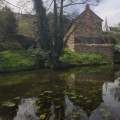
i Le Pré des Lavandières__: On the banks of the Vilaine, this little green spot is the ideal place for a bucolic break right in the heart of the town. Here, take the time to admire the castle and watch the Vilaine flow by, now peaceful since the construction of upstream reservoirs. A new 3km-long development allows visitors to rediscover the Vilaine valley, upon which Vitré was built. You will also spot the former 19th-century Bouin Tannery there.

j Rue Pasteur and the Rachapt district: The wash house at the start of Rue Pasteur is reminiscent of the many others that once dotted the banks of the Vilaine. This one is curved, following the river’s course, and offers a unique view of the castle. Rue Pasteur features pretty, colourful half-timbered houses as well as a former tannery, a reminder of the river-related leather trade. At the end of the street stands the Gothic apse of the Monastery of Saint-Nicolas, founded in the 17th century. This is where the steep Rue du Rachapt begins; the street gave its name to the neighbourhood, which in turn derives from its repurchase from the English during the Hundred Years’ War. From the 16th to the 20th century, it was renowned for its knitters who, working outdoors, produced stockings and slippers from linen thread, by hand and for just a few pennies. At the very top, discover the Chapel of the Three Marys, which overlooks this neighbourhood where time seems to have stood still.

k Les Tertres Noirs__: You’ll have to climb a little further to get there (from the middle of Rue du Rachapt), but it’s well worth the effort! From here, you can take in the whole town at a glance: the Château des Barons, the ramparts, the station, the Trémoille barracks, the Jacques Duhamel Cultural Centre, not to mention the bell towers of the three churches: Notre-Dame, Saint-Martin and Sainte-Croix.

l The Saint-Pierre postern gate: Located to the north of the ramparts, the Saint-Pierre postern gate, dating from the 12th and 15th centuries, offers a lovely view of the right bank of Vitré. The only gate preserved of the four that once existed, it allowed pedestrians and horsemen to enter the fortified town. The other three gates were the Porte d’Embas to the west, the Porte de Gâtesel to the south and the Porte d’En-Haut to the east.

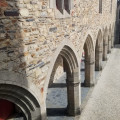
m Notre-Dame Church and the Benedictine Priory__: Built in the 15th and 16th centuries, Notre-Dame Church was flanked to the west by a cloth hall and to the north by the Benedictine Priory. As its south façade was the most exposed, its construction was given greater attention and richly decorated in the Flamboyant Gothic style: on the pinnacles, the external pulpit and the doors. It bears the marks of the so-called ‘Overseas Merchants’, who, as traders in hemp cloth and travellers, contributed to its funding. To the north, the Benedictine garden offers a unique view of the Vilaine and its valley, whilst the former cloister houses the Maison des Cultures du Monde, which is dedicated to the preservation and promotion of intangible cultural heritage.

n The Hôtel Ringues de la Troussannais__: Built in the Renaissance style, this former mansion was constructed in the 16th century opposite the Church of Notre-Dame by Étienne Ringues, Sieur de la Troussannais. The social status of this hemp merchant is evident from the building itself: its L-shaped layout, stone construction and location right in the heart of the city.

o Rue de la Baudrairie__: This cobbled alleyway with a medieval feel, whose name recalls the leather craftsmanship of the baudroyers, features large corbelled houses that are well worth a look. Looking up, the roofs sometimes seem to touch one another. This pretty alley is a must-see for history buffs and lovers of fine stonework and carved details.

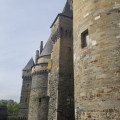
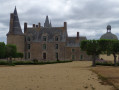
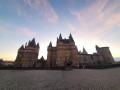
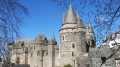
p Vitré Castle__: Built in the 11th century on a rocky promontory and rebuilt between the 13th and 15th centuries, this castle is a sight to behold! Having played a part in the defence of the Duchy of Brittany (which remained independent until 1488) and later serving as the residence of the Barons of Vitré in the Middle Ages, it has a long history to tell. You can also explore its architectural evolution via the digital model and enjoy a wide range of events throughout the year. The museum, housed within the castle’s interiors, traces the town’s history across more than five centuries.
Opening times and prices at: https://chateau.vitre.bzh/infos-chateau-...

Reviews and comments

4.3 / 5
Based on 2 reviews

Reliability of the description
4 / 5
Ease of following the route
4 / 5
Route interest
5 / 5
KGBD
KGBD

Overall rating : 5 / 5

Date of your route : Apr 17, 2025
Reliability of the description : ★★★★★ Very good
Ease of following the route : ★★★★★ Very good
Route interest : ★★★★★ Very good
Very busy route : No

A lovely way to explore the town. A very pleasant stroll. Well worth a go 😉

Machine-translated

Bounty14
Bounty14

Overall rating : 3.7 / 5

Date of your route : May 04, 2023
Reliability of the description : ★★★☆☆ Average
Ease of following the route : ★★★☆☆ Average
Route interest : ★★★★★ Very good
Very busy route : No

A lovely, pleasant walk in Vitré, taking in Old Vitré and the countryside.
The end of the walk was a bit unclear after leaving the river; we got lost twice.

Machine-translated

Other walks in the area

For more walks, use our search engine .

The GPS track and description are the property of this route's author. Please do not copy them without permission.