Country:
 City:
City:


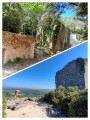
Coming from Saint-Restitut on the D218, follow the signs for "Caves cathédrales" and "Belvédère". Use the car park at the belvedere or the Caves cathédrales du Mas Théo car park, passing under the archway at the entrance.
(S/E) Go to the end of the car park and read the information boards showing two maps of the site and colour-coded routes marked by concrete markers numbered B1 to B12. The route shown on the right-hand board is often marked on the enamelled markers, which are still legible.
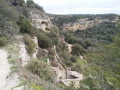
Start the circuit by going down the rutted path at the foot of the signs. Enter the woods and look through the gaps for views of Saint-Paul-Trois-Châteaux and the Tricastin nuclear power plant. Follow the recent dark green markings, which will confirm the description on certain parts of the route. Walk along the edge of the hill with the Rhône and the A7 motorway below.
(1) At the enamelled marker B5, continue straight ahead. 50 m further on, there are two paths on the right. A green cross indicates that you are leaving the path leading to the troglodyte village, but you can make a return trip on the path that climbs up to the Château de Barry. Please note that these are unsecured ruins and access is prohibited. You can walk around them.
Take the path marked in green. Further on, ignore the B2 signpost and the path that branches off to the left, and stay on the main path lined with restanques (a Provençal term used to describe terraces built on sloping ground using dry stone walls to retain the earth).
Continue downhill for about 150 m along a path carved into the rock with regular notches resembling rails (perhaps used by vehicles transporting stones from the quarries?).
On the left, you will see the first ruined wall (if you are careful, you can go around it to see the hollow in the rock below, which is evidence of a former dwelling).
Take the path in the rock and continue downhill.
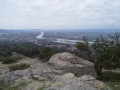
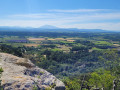
(2) At the "Croisement des tombereaux" signpost, you can see the remains of a troglodyte dwelling on the right. Climb up onto the rock above the "Table d'orientation" sign to the left of this dwelling. Keep left to descend towards the south-western tip where you will find the orientation table. Enjoy the panoramic view of the Rhône valley, Bollène, its lock and the wind turbines.
Return to the green signpost. From this signpost, descend straight ahead on the path carved into the rock opposite the wind turbines. Continue downhill, the path makes a hairpin bend to the left and then to the right.
Caution: at the first "Accès village interdit" (village access prohibited) sign, do not take the path that descends. Following several rockfalls, this part of the village is very unstable.
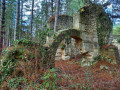
The hairpin bend on the right runs alongside the wall of a large ruined house. Continue downhill. At the end, on the right, in the rock, are the remains of a large troglodyte dwelling with traces of a paved floor outside.
Returning to the marked path, you will see a green cross painted on the trunk of an oak tree. Beyond this cross, you will get a better view of the large ruined house you passed earlier. Be careful! There is a risk of falling rocks!
Follow the green markings down to the left below the house. Walk along a dry stone wall.
At the end, there is a second sign saying "Accès village interdit" (village access prohibited). Here, stop following the green markings and stay on the track that will take you below the village. Follow the sign, staying on the track without entering the ruined village.
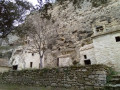
This is undoubtedly the most impressive part of the village, especially since some of the buildings were restored a few years ago.
Be careful not to leave the path to explore the houses! There is a risk of falling rocks.
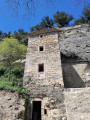
After passing the wash house fountain, you will come to some wooden palisades, the result of a new phase of work to preserve the site. From the Notre-Dame-d'Espérance Chapel (1682), you will come to a series of restored houses that make for a beautiful souvenir photo.
You will arrive at a barrier. Opposite, in the cliff, are new cave dwellings, but recent rockfalls have made it necessary to block access with wire fencing. This blocked access used to lead up to marker B4. You can reach it by going around the site of an ancient oppidum.
Turn right onto the paved road. About 150 m after the barrier, on the left, you will see that the embankment has been climbed to reach the dwellings despite the fence, but it is steep, particularly rugged and dangerous. Continue to the next barrier.
At the signpost "Parking de Barry ait.195m", follow the dark green markings towards "Source de Beaudieu" (also indicated by small signs). Follow a wide track parallel to the tarmac road for about 400 m.
As the track turns sharply left to reach the spring, leave the green markings and the signs for the spring and take a path slightly above on the left, carved into the rock. On this path, you will find double tracks (dump trucks? tanks?) deeply carved into the stone like rails. This will be your landmark for reaching marker B4.
Climb up following this recognisable path. The passage narrows between the rocks, sometimes dividing and then coming together again. Beyond the large rocks (view of the ruins of Chabrières Castle), continue climbing, keeping an eye out for the "rails" in the rock. Just before reaching marker B4, a path on the left leads to a promontory from where you can see the entire village dominated by Barry Castle. You will arrive at the enamelled marker B4.
(3) From there, a careful return trip along the upper part of the blocked access at the bottom of the hill reveals an incredible path carved into the hillside that served the troglodyte dwellings. You can also see the remains of other access points of this kind higher up and imagine the work involved in establishing a network of paths in the rock.
Climb down carefully to a cave with a small window. Below, you can see the steep access point on the embankment from the road.
Take the path from B4, following the notches in the ground again, and climb straight up to a flat area where you will find the enamelled marker B3.
(4) At marker B3, take the path on the right and then, at the next intersection, take the path on the left (ignore the barely visible trails). Please note: only this path is visible on the IGN map. The intersection is not shown.
(5) You are now on mountain bike trail 8-9 (but going in the opposite direction). A small red triangle on an oak trunk on the right (remnant of an old trail) indicates "Château de Chabrières". About 400 m further on, ignore the path that descends to the right and continue straight ahead until you reach a fork that is also not shown on the IGN map.
At this fork, there is an unnumbered marker with the inscription "Retour vers village troglodytique" (Return to the troglodyte village). Turn right onto the path that goes uphill. Looking back, you can see the weather radar at the top of the hill. Continue until you find marker B10.
(6) Please note: the route on the IGN map is inaccurate: the fork where marker B10 is located is not marked and is located shortly after a path that branches off to the left (ignore it) and just after a well that is clearly visible at the left-hand corner in the woods (caution: it is not secure). Continue right, following the green markings to marker B11 towards the Château de Chabrières.
At marker B11, leave the green markings and make a loop instead of going back to the château:
Take the path on the right through the woods marked with a green cross. Stay on this main path until you reach rocks protruding from the ground and come to a crossroads blocked by a large rock opposite.
Turn left in front of the rock, with a clear view of the promontory where the ruined castle stands
.
Continue, keeping an eye out for the entrance to the castle about 300 m further on the right. You can go around it by following the remains of the ramparts built on the rock on the right. Then descend in front of the tower on the left (caution: access to the interior is prohibited due to the risk of falling rocks). There is a viewpoint in front of the collapsed entrance.
Then rejoin the access path and continue to the right where you will find the green signposting. At the next T-junction, turn right. Stay on the main path (green signposting) until you reach marker B12.
(8) At the signposted marker B12, with the map of the marked trails, turn left.
To complete the loop back to marker B11, follow the green markings and mountain bike trail 8-9. Turn right at the next fork, then right again at another marker B12 marked in ink. Turn left at the next ink-marked B12 marker and finally right at the marker marked "Vers B12". Continue until you reach B11.
(7) You have now completed the loop that took you to the castle. Continue towards B10.
(6) At marker B10, continue to the right. The path soon becomes a wide track that runs alongside a cultivated field on the right. At the next junction, turn left onto the track. Cars have access to this part of the circuit and can park there.
(9) At marker B8, leave the track that turns right and go up into the woods opposite, on the path marked with a green cross. Keep right at the next two forks. 300 m further on, take care when walking along the cliff edge above the old quarries on the right.
At the end of the path, you will reach the track that leads to the weather radar. Cross it to the right of the transformer to reach the car park (S/E).


 SEE THE UNDERGROUND PASSAGE UNDER THE CHATEAU DU BARRY / AT LEAST THE ENTRANCE. SEE THE WEATHER STATION / THE CATHEDRAL CAVES / THE VILLAGE OF COURSE / AND THE VIEW OF THE RHONE CANAL AT THE ORIENTATION TABLES.
 Visorando Member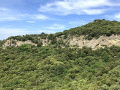
 Easy
Easy 
 Tourist office