Country:
 City:
City:


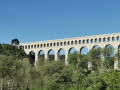
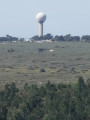
Park in the car park at the Parc Départemental de la Tour d’Arbois.
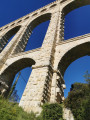
(Start/Finish) Walk through the area displaying a map of the region and a scale model of the park. At the Fork in the road, choose either the steep, short climb to the right or the longer, easier path to the left. In any case, all these initial paths converge to cross the TGV bridge. Once you’ve crossed the bridge, you may catch a glimpse of the Marseille Canal on the left. Look out for a junction with a footpath (300 m after the bridge) which allows you to descend and join the Marseille Canal.
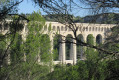
(1) Leave the path via the track on the left which leads down to the canal. Cross it and follow the bank on your right. The canal is marked with red markers. You’ll reach the canal at around marker 339. Follow the banks until you reach marker 350.
The canal passes under the TGV line and goes through a few small tunnels which you’ll need to go round. Each one is preceded by a path that climbs up, allowing you to cross over the embankment. These tunnels, as well as the footbridges spanning the canal, give you the chance to alternate between the right and left sides of the canal and enjoy varied views on your walk. You can leave the canal banks either on the right or on the left. Reach marker 350, which marks the end of the route along the canal.
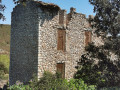
(2) Just after marker 350 and as you approach a small tunnel, take the path that climbs above the canal and follow the track to the right marked PRV 697.6. Continue along this track, which climbs and passes over the TGV line. Carry on straight ahead to the ruins at a place called La Bastide Neuve.
(3) Walk round the ruins from the south (on your right-hand side). North of the ruins, do not take the first small path (IGN map) which heads north but quickly becomes impassable due to the vegetation. Continue round the ruins and take thesecond path heading north. When you reach a T-junction, turn right and then, after about a hundred metres, take the path on the left. Continue until you reach an X-junction.
(4) Turn left towards the north-west. After a few hundred metres, and having passed a path branching off to the right, you’ll come to a T-junction.
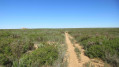
(5) Carry on straight ahead along a narrow track – not shown on IGN maps – which joins a well-defined path after a few metres. Take this path on the left. After about a hundred metres, turn right at the Fork in the road.
At the end of a long straight stretch, ignore the first path branching off to the left and continue along the path which, after 50 m, also turns left (the two paths join up anyway). Carry on straight ahead, passing under the high-voltage power line, until you reach the main path. Continue along this path for 200 m.
(6) Look out for an even wider path running parallel on the left, which you can easily join, particularly at a red fire hydrant.
Alternative route: To shorten the walk, continue along the path and, after 50 m, turn right onto a path that leads directly to the ruins of the hamlet of Mion; this halves (roughly) the walking time, but you’ll miss the views of the Étang de Berre.
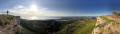
Otherwise, join this very wide path, take a few steps to the left to cross it, and continue straight on to reach the western end of the Arbois plateau. At the edge of the cliff (take in the view), take the path on the right. Follow this path for about 600 m until you reach a Fork in the road.
(7) This fork in the road between two small paths offers two options:
- to the right (the route and distance suggested in this guide): the path joins a wide track after a few metres; this track moves away from the cliff but still leads to the edge of the plateau, allowing you to enjoy all the superb views,
- to the left (route not tested but which follows an IGN path): at this point, the cliff takes a detour southwards, adding a good kilometre to the suggested route.
Once the two paths meet, follow the main path or a track that runs alongside the cliff; both head northwards until they reach the watchtower after one km.
(8) Leave the watchtower and the path that follows the cliff by taking the central path heading east. After passing under the high-voltage power line, turn right at the Fork in the road and, after just under a hundred metres, turn right onto the path. Keep an eye out on the left, after barely a hundred metres, for the start of a path, which is hard to spot at first.
(9) Here, begin the descent towards the Mion valley. To do this, take this narrow path which descends and gradually widens. Continue straight on after a good hundred metres when you reach a crossroads with another path. Carry on for about 800 metres until you reach another crossroads.
(10) There are two options, neither of which makes much difference:
- either turn left onto a path, which is less clearly marked at the start and crosses the valley. This path, which is easier, follows the valley floor and leads to the ruins of the hamlet of Mion.
- or carry on straight ahead along the path and continue along the right-hand side of the hill.
This also leads to the ruins of the hamlet of Mion. The suggested route stays to the right of the valley.
(11) At Mion Farm, the path appears to be blocked by a gate. The ruins are in fact fenced off with wire mesh and access is prohibited. However, a track to the right allows you to rejoin the path whilst crossing the farm.
Follow this path down to the bottom of the farm and continue down the valley to the right. After a long straight stretch, do not continue along the path leading uphill but turn left. The path passes by a car park for hunters called ‘Les Noisetiers’. Continue to the right, descending the valley. The valley curves in an S-shape and the path runs along the left-hand side before reaching a junction marked by a small hunters’ hut on the right.
(12) Leave the main path, which heads uphill to the left, and carry on straight ahead along a slightly narrower path. Continue down the valley. At the Fork in the road, take the path that climbs to the left (the view is nicer and the path on the right may be muddy during wet weather). The path gradually turns into a track and then joins the Canal de Marseille.
(1) Turn left, cross the canal and follow the same route as on the way out but in the opposite direction to return to the car park at the Parc Départemental de la Tour d’Arbois (S/E).





 Visorando Member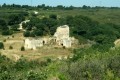

 Easy
Easy 
 Association / Club / Walk leader
 Difficult