Country:
 City:
City:


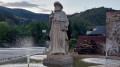
(S) From your campsite on the LE-142, head south-west and quickly leave the tarmac road on your left to take the slightly downhill stony path. Continue until you reach the LE-142 again.
(1) Cross the road and continue along the path opposite, marked by a signpost informing you that there are 238.4 km left to Santiago. Continue the climb to reach a rest area and a viewpoint by the roadside.
.(2) Stay on the path and complete the climb to reach the highest point of the stage at Monte Pena de la Escurpia.
(3) Begin a long descent down the barren hillside with magnificent panoramic views of the surrounding area, continuing to follow the LE-142 at varying distances. Continue to the marker near the road.
(4) Continue your descent to the junction with the LE-142.
(5) Cross the road and continue the descent to a viewpoint known as the Mirador el primer banco del bierzo
(6) Carry on and navigate the hairpin bends before reaching a bend in the road at the village of El Acebo de San Miguel.
(7) Turn left to walk through this typical mountain village with its slate roofs and carved wooden balconies. Pass several hostels and continue down to the fork.
(8) Turn right and continue to the junction at the village exit sign.
(9) Turn right and head north. Continue along the stony path, running alongside the LE-142. Carry on until you get close to the road.
(10) Continue along the grassy path until you reach the LE-142 and cross it again.
(11) Continue straight down the slope, passing under a power line and a small stream before running alongside the LE-142 once more and arriving at the village of Riego de Ambros.
(12) Turn left to cross the village, following the yellow arrows, pass the Hermitage of San Sebastián and continue down the pretty cobbled street lined with typical stone houses. Go past Plaza Paz.
(13) First turn right then left to continue north-west along a stony path on the edge of the woods and carry on until you reach the fork.
(14) Continue down the slope towards the west until you reach the junction with the LE-142.
(15) Turn left, carry on to the bend and turn right onto the slightly uphill track. Follow a high-voltage power line on your right. At the fork, turn left until you reach the next fork.
(16) Stay on the main track, which narrows. After two hairpin bends, you’ll reach a viewpoint overlooking the Los Ruiseñores valley.
(17) Continue westwards, then northwards to reach a hairpin bend. Carry on to the Mirador de Molinaseca viewpoint.
(18) Continue down the hill to join the LE-142 at the entrance to Molinaseca.
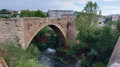
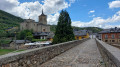
(19) Pass the Ermita de Nuestra Señora de las Angustias before crossing the medieval bridge over the Rio Meruelo a little further on.
(20) On Calle Real, where you can stock up on supplies, pass through this little village, whose beauty seems so unreal that it looks like a postcard. Continue to Plaza Santo Cristo, near the fountain.
(21) Turn left to continue on the LE-142 and leave this pretty village. Stay on this road for just under 1 km until you reach the football pitch and tennis courts.
(22) Turn right onto the Camino de Santiago and, at the bend, head north-west. At the junction with the LE-159/7, by a high-voltage pylon, first turn right then left and continue along the path until you reach the LE-142.
(23) Turn right, then cross the road carefully and continue along the small path on the left, which slopes gently downwards, running alongside the Patricia Campo neighbourhood. Continue until you reach the fork.
(24) Turn left and continue downhill to reach the village of Campo.
(25) Continue straight on through the village, following the clearly visible signposts, and carry on until you reach the fork.
(26) First turn left then right and continue to the fork.
(27) Continue left towards the west and make your way through the dry meadows to a Stop sign, located at the junction with the LE-5228.
(28) Turn right to stay on the main road and continue to the stop sign at the junction with the Los Barrios de Salas road, opposite the rugby ground.
(29) Turn right to enter the town of Ponferrada. Continue to the roundabout.
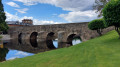
(30) Go straight ahead, then cross the River Boeza via the old medieval bridge with its Romanesque arches, and continue to the roundabout.
(31) Take the road on the right that goes uphill to cross over the railway line and continue to the roundabout.
(32) Take the first exit and walk along the pavement on the right to turn right onto Rue Obispo Camilo Lorenzo and continue to the motorhome park next to the Albergue de Peregrinos San Nicolás de Flue (E) to ask if you can camp in the garden. If this isn’t possible, there are several hostels in the area.
 Visorando Member

 Very difficult