Country:

 City:
City:



Pass Arrens-Marsous and continue on the Route d'Aste (D105) towards the Tech Dam (pronounced "tèche"), along the Gave d'Arrens.
Pass the dam, continue for a few hundred metres and park at Plaa d'Aste (altitude 1400) in the car park on the right before the Migouélou hydroelectric power station.
(S/E) The trail starts from the car park next to the Pyrenees National Park signs.
The ascent begins immediately with numerous short hairpin bends!
After about forty hairpin bends, the trail enters the park. On the rocks on the right, you will see the characteristic red markings on a white background with a chamois head and the letters PN (Parc National).
(1) At around 1600 m, continue on the most obvious and clearly marked trail, without taking the purple trail on the IGN map to the left, which leaves the National Park and makes a detour.
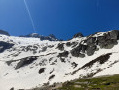
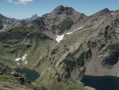
At an altitude of 1773 metres, you enter the mineral landscape of La Mouic, bordered to the north and north-west by a ridge and its scree and breaches (including the Brèche de Peyralagor).
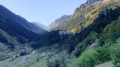
The trail continues to climb in switchbacks, overlooking the deep Arriougrand ravine on the left, the spillway of the Migouélou Dam, cluttered with granite boulders. In summer, the ravine is completely dry.
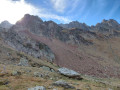
On the left in the background, the peak proudly rising up is Pic Cadier (2,676 m). It is not the highest in the area. Le Courquaou rises to 2,691 m, but is hidden behind it and cannot be seen.
At around 2,100 m, the trail gradually slopes westwards, without any switchbacks, overlooking a pretty gorge of a tributary of the Arriougrand and crossing a huge scree slope where the trail is well stabilised.
At around 2,200 m, above the end of the gorge, you can clearly see the Migouélou power station in the valley.
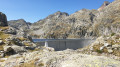
From there, you begin to see the first buttress of the dam. Continue west-southwest to the dam.
(2) (''To the right, the trail continues towards the Col de l'Hospitalet, before descending towards the Tech Dam'').
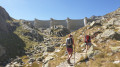
Once you reach the dam arches at around 2,250 m, the path slopes southwards, running along the foot of the arches.
(3) Leave the return path on your left. Continue straight ahead to the Migouélou Refuge. Several marmots have been spotted here.
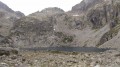
(4) At the refuge (2,278 m), there is a beautiful view from the terrace over Lake Migouélou and the surrounding peaks.
This is a good place to take a well-deserved break, especially if the refuge is open and staffed (from 15 June to 15 September approximately).
Retrace your steps to elevation 2271.
(3) Two options:
- The return journey can usually be made by retracing your steps.
- Alternatively, for a more enjoyable but unmarked route, follow the Vallon de Masseys penstock, following the description below.
Off the marked trail: GPX track or IGN map at 1:25,000 scale essential.
Descend to the right, onto the platform along the large building. Pass between this building and the small square refuge and descend into the bed of the Ruisseau de l'Arriougrand stream.
Pass by the round stone tower (access to the gallery marked "Anc. mine", probably a chimney for visiting the hydroelectric facilities).
Continue eastwards along the small, barely marked path, indicated by a few cairns. The area is desert-like, almost lunar, with its granite rock formations eroded by water and ice and the marshy stream.
After about ten minutes, the path slopes southwards and becomes wider. The path surface is made of stone blocks covering orange electrical cables. From here, it follows the old EDF railway line.
(5) You will arrive at the foot of a metal footbridge on the old railway line, which is very well preserved.
On the right, you can access Lake Lassiédouat, its small dam and its control valve.
It is the perfect place for a secluded swim.
Cross the footbridge and continue along the old railway line, where the wooden sleepers are still almost all visible.
(6) You will reach a terrace at the start of the overhead section of the penstock. A small building visible from afar, housing the balancing chimney, overlooks the site.
Continue along the path, which begins to descend, first towards the foundations of an old stone service building. This must have been one of the living quarters for the workers who built the facilities in the 1950s.
On 14/09/2020, we unintentionally disturbed two ptarmigans ("partridges") resting in a copse.
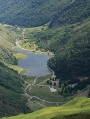
(7) About a hundred metres from the old building, a flat area at the edge of a precipice allows you to admire (safely) Lac des Touest and its small lake below. The view is remarkable.
The path, marked by numerous cairns, then descends to the south-east, then to the east, then to the north-east, following the natural slope along which the penstock spreads its small piles.
NB: Given the good visibility of the trail, it is not necessary to follow all the bends shown on the IGN map; in fact, the OpenStreet World map does not show the same route.
Several viewpoints allow you to admire the lake up to an altitude of 1936 metres. A little lower down, at 1940 metres, a path even branches off to the right to reach the shores of the lake (see: During the hike or nearby, below).
(8) At around 1750 metres, the path crosses to the other side of the penstock and enters the Bois des Masseys.
The descent continues steadily through wooded terrain and then temporarily leaves the woods.
It is here, on 14/09/2020, on the left side of the path, at the edge of the rocky ridge that plunges into the Ravin de Lassiédouat, that we encounter a female izard and her kid, who are not disturbed by our close presence (100 m) and watch us continue our descent.
(9) At the edge of the forest, we leave the National Park and find a more marked trail leading off to the left and right.
Turn right and walk horizontally through a fairly damp area. Pass close to a drain. You can see the power station clearly below through the trees.
(10) Less than fifty metres further on, leave the horizontal path and take a path that descends rapidly into the heart of the coniferous forest. There is no path marked on the map, but it does exist on the ground!
Pass behind and to the west of the power station, near the spillway canal.
Exit the woods and continue towards the car park until you reach the road, then the car park (S/E).


 I will add the mention of the tap! Kind regards
 Visorando Member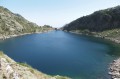

 Very difficult
 Moderate