Country:

 City:
City:


Start in the centre of Aurillac, Hôtel du Département (opposite Le Gravier).
(S/E) Go around the Hôtel du Département on the right, heading south, following Rue Paul Doumer. Follow the Jordanne as closely as possible on its right bank, first on the street, then on a path alongside the Jordanne. After passing a large car park, cross the Jordanne on a footbridge. Continue on the left bank in the direction of the current (Promenade Pierre Laroque, south-west).
Cross a fairly busy street and go under the railway viaduct. Continue to follow the Jordanne as closely as possible, in the direction of the current (south).
(1) Leave the paved road and take the wide footpath that follows the Jordanne, still heading south. Ignore the footbridge that leads to the opposite bank. Stay on the left bank for now.
(2) (See possible alternative below). Ignore the tarmac road straight ahead (Rue Louise Michel) and cross the Jordanne on the right via a footbridge. Walk upstream along the Jordanne for 600 m. Cross the Jordanne again via a footbridge to return to point ::1::.
(1). Continue straight ahead uphill. Pass under the railway line through a narrow tunnel closed to cars. Continue uphill and take a staircase on the right a little further on. Go around a residence on the right uphill. When you reach Rue Aristide Briant (D117), which is very busy, turn right, keeping on the right-hand side, which is vaguely marked for pedestrians.
(3) Cross at the pedestrian crossing and climb towards a relay antenna. Follow the signposted path to Puy Courny (light blue signs). There are numerous information boards.
(4) Take the small fork to the left towards the old quarry and its pond. A small, discreet staircase on the left allows the more motivated to admire them from above. Return to the main path and continue on the right-hand branch. A short but steep climb, slippery in wet weather, leads to Puy Courny, following the light blue markings. The path passes through the trees, then goes around a meadow on the right and finally climbs straight up. Trail and steps. Cows and horses may be present. Close the gates behind you. Reach the cross at the top of Puy Courny and enjoy the view of the town (west). The information panels show how the town has expanded over time. There is also a view of the Chaîne des Puys in the distance (north-east).
(5) Here, you can either turn back and retrace your steps, or take the more adventurous route suggested below (not signposted).
Continue along the heights, following the obvious ridge towards the northeast. Cross a few dirt tracks. There are electric fences, so be aware of livestock.
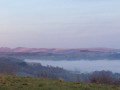
Continue to follow the ridge towards the northeast. The landscape becomes wilder and the view more beautiful: to the left, Aurillac and the Jordanne valley; to the right, the Mamou valley. At each small summit, the Chaîne des Puys becomes clearer and clearer in front of you.
Still following the north-eastern ridge, pass under the power line and join the tarmac road at the Col du Croizet.
(6) At the fork at the Col du Croizet, take the road that climbs to the left (northeast). Shortly afterwards, on the left, you will arrive at the entrance gate to the private property of Monroucou. Follow the path (somewhat hidden, marked for mountain bikes) just to the left, heading northwest, which descends in the shade of the trees.
At the hamlet of Gaubert, join a paved road and follow it downhill. A little further on, you will reach the hamlet of Roussy; continue right on the paved road downhill, heading first northwest, then southwest. You will reach a picnic area.
(7) Continue down the paved road, which gradually becomes more urbanised; stay on the steepest slope and you will reach the former monastery of Le Buis.
(8) Keep descending to return to the left bank of the Jordanne. Return to the starting point by passing through the medieval town centre, taking the nearest bridge to the right bank. Alternative: return to the starting point by following the left bank of the Jordanne. (S/E)

 . I don't know if there was a better way, but perhaps more details should be added about this section. The path itself is not very well used, so it's difficult to rely on traces on the ground. Otherwise, it's true that the hike is original... but it did result in a few scratches!
 Visorando Member

 Moderate