Country:

 City:
City:



(S/E) To start the hike, park as soon as you pass the first houses in the village, then walk to the path that branches off to the left towards Soubreroche. Signs along the way will remind you that you are going in the right direction.
After crossing the Charonnière and passing an old farm, the path turns sharply westwards through a series of grassy clearings. The path, which tends to become overgrown, joins a forest track which you cross.
The beautiful paved slanting street climbs through the woods to a place called l'Échelle, where it begins a series of hairpin bends, supported by dry stone walls of exceptional heritage value, before arriving at a grassy plateau.
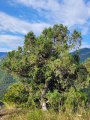
Take a moment to admire the remarkable orientation table provided by the municipality of Boulc. Botanists will also notice the beautiful thujus growing nearby. Continue on your way until you reach the entrance to Soubreroche ( sometimes also written Souberoche).
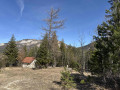
(1) At the first houses, there are two fountains with several basins, evidence of their former use for washing sheep's wool. Just behind the beautiful house at the entrance to the hamlet, you can see a small building, most likely the old bread oven, set slightly apart from the other buildings due to the fire hazard associated with its use. Turn right onto the gravel forest road to leave the village, heading uphill.
(2) As soon as you come out of the right-hand bend, take a small path on the left, marked by an observation marker on a large stone. After a right-hand bend, then a second left-hand bend, look for the faint path that branches off to the right between two dry stone walls: two protruding stones form a marker (a kind of cairn). Further on, other cairns have been built at intervals to help you find your way through the pine forest. Unfortunately, this path has not been maintained for a long time and nature has reclaimed it. A few trees have fallen across the path and you will have to go around or climb over them. With your GPS, you can trust the route we have mapped out.
(3) The trail joins another uphill trail, which you should take to the left. It is lined with small numbered signs. Passing between pine trees, boxwood and common junipers, the trail leads to an old ruined sheepfold.
(4) Continue in the same direction: you will notice a few trees marked with two horizontal white lines before coming to the end of a wide track that branches off to the left.
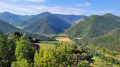
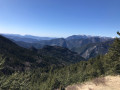
(5) The landscape changes dramatically, and the view opens up onto the Tatins valley and towards Boulc. The track is wide, almost horizontal and completely grassed over, probably not used by motor vehicles for years. This brings you to the Col Lacroix.
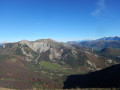
(6) Take the gravel forest road on the right that follows the ridge line. On the left, the view extends towards the Gâts valley, the hamlet of Reychas surrounded by pastures and the heights of Glandage and Jocou; on the right, towards Ravel, Miscon and the Boulc and Bonneval valleys. This brings you to a crossroads of forest tracks and roads, at a pass (altitude 1,242 m).
(7) Take the hairpin bend to the right, continue along this path and go around a bend where you will see the striking rock formation forming the upstream slope. You will reach the crossroads at Combe Charonnière, near a sand quarry. Continue downhill for about 100 m along this very good path that heads towards Soubreroche. Look out for the start of a small path on the left.
(8) Take this path, which zigzags down the slope (its direction differs slightly from that shown on the maps) but is not particularly difficult at this point. It joins another, almost horizontal path, which you take to the left without crossing the combe.
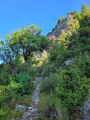
Just before it, take the narrow path on the right and keep going in the same direction. This part of the route, which sometimes overlooks the bottom of the valley, presents some technical difficulties (a few rocks in the form of steps and a short passage through marl, where horizontal wooden supports have been placed to improve the passage). Follow the path naturally as it descends (the path markings on the maps in this little-used area are somewhat unreliable; always stay on the right-hand side of the valley).
(9) When the trail reaches the bottom of the slope, on a flat section at the edge of the forest where it becomes scrubland, with a few rocks that have fallen from the cliffs above, take the track that branches off to the left and ford the river (no particular difficulty, except during periods of high water). This is a forest track that is currently abandoned, which climbs up the opposite slope. (This counterintuitive route was chosen because the path downstream, which one would naturally tend to follow, is blocked by fences and scrub, and it is impossible to reach a ford to cross the river). Go up a few bends. The route on the map takes a shortcut, but it is better to follow our route, which takes a grassy section and passes near a beautiful dry stone wall, which was once used for terraced farming. At the next bend, a path branches off to the right, at a level marked by two cairns. Do not take this path, but take the next one, about 20 metres further on (an old logging track).
(10) Follow this track, which continues as a path through the woods and comes out onto a large meadow. Go around the bottom of the meadow until you reach a track almost opposite (do not try to go back up the meadow).
(11) The entrance to this track is marked by a large pile of stones, on top of which stands a beautiful cornerstone. Cross a wooded area for about 100 metres. The route then crosses a wide path that descends, but continue in the same direction, following the gently sloping path, which is not very visible as it is overgrown with grass.
(12) When you reach the Ravin de la Combe (where there is a drinking water catchment area supplying the hamlet), do not look for the bottom of the ravine but take the path that descends towards the houses. Due to the occasional overgrowth, you will need to leave the path near the houses and walk along the edge of the meadow to continue descending and reach the centre of the village.
(13) Note the mountain architecture of the hamlet, particularly the beautiful square tower dovecote. Then follow the small paved road to return to the starting point (S/E).

 Visorando Member

 Difficult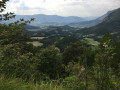
 Easy
Easy