Walk through the history of the Earth in Saint-Didier-en-Velay

This is the story of a 4.7 km route representing the 4.7 billion years of our planet's history. One kilometre corresponds to one billion years and, therefore, one metre (one large step) to one million years. Based on this symbolism, 21 panels have been placed along the route. The location of each panel, and therefore the corresponding period, recounts a major event that changed the course of Earth's evolution. This route, which follows the paths of Saint-Didier-en-Velay, is designed to be fun, historical and original.

Details

87446364
Creation:
Last update:
Last review:
  • Walking
    Activity: Walking
  • ↔
    Distance: 4.68 km
  • ◔
    Average duration: 1h 40 
  • ▲
    Difficulty: Easy

  • ⚐
    Back to start: No
  • ↗
    Ascent: + 114 m
  • ↘
    Descent: - 87 m

  • ▲
    Highest point: 844 m
  • ▼
    Lowest point: 755 m

Description of the walk

Start from the Stade la Péchoire hut, at the "zero" (P0) sign on the trail.

(S/E) Go around the stadium and the fitness trail before going up into the small wood to the left of the stadium to the campsite entrance. On this part of the route, look for signs P0 to P5.

(1) After passing the campsite entrance, take the path slightly to the left, then turn left to leave the village and climb the steep concrete and dirt slope that runs alongside the campsite.

(2) At sign P6 , take the grassy path slightly to the right until you reach the Route des Cèpes crossroads. Cross it and take the Chemin des Morts opposite.

(3) Take the path on the right, passing under the village of Beaumat, with meadows on the left and houses on the right, to reach the P8 sign in the centre of the village. Then take the path passing under the large green canvas shelter, then the small passage at the edge of the forest with a series of beehives below on the left. You will then arrive in front of an old, recently renovated farmhouse, then on a small tarmac road in the village of La Montsubeyre. Take this road on the right until you reach the junction with the D45. Follow it to the left for a few metres. On the right is a group of rocks, with a circle of stones in the centre that could be mistaken for a megalithic formation.

(4) At the P9 sign, cross the D45 and take the tarmac road towards the village of Le Mont. Cross the village, turning right, still on the road. On the left is a recent wooden house. Continue along the road, which becomes a dirt track. Look out for "Le Crapaud" (the Toad), long considered to be a menhir split by lightning. Begin the descent at sign P10 . At this point, cross the small tarmac road and continue straight ahead, passing an isolated farm at Le Verdier on your left. Pass sign P11 and climb up to the first houses of Saint-Didier, passing signs P12, P13 and P14. Cross the D45.

(5) Walk up alongside the car park to the Jeanne d'Arc secondary school, where you will see signs P15 and P16, then enter the village. Pass the cinema on your right.

(6) Take the Petit Charreyron at sign P17 on the left, pass signs P18 and P19 and finish at Place Foch (E) with signs P20 and P21.

Waypoints

  1. S : km 0 - alt. 798 m - Sign P0 - Cabane du stade La Péchoire
  2. 1 : km 0.98 - alt. 792 m - Intersection
  3. 2 : km 1.45 - alt. 844 m - Start of the trail
  4. 3 : km 2 - alt. 817 m - Crossroads before Baumat
  5. 4 : km 2.8 - alt. 817 m - Crossing the D45
  6. 5 : km 4.36 - alt. 815 m - Large car park at Jeanne d'Arc secondary school
  7. 6 : km 4.57 - alt. 827 m - Entrance to Petit Charreyron
  8. E : km 4.68 - alt. 827 m - Place Foch

Notes

Sign P0: Introduction to the walk

Sign P1: Birth of the Earth - 4.6 billion years ago

Panel P2: Formation of the moon - 4.5 billion years ago

Panel P3: Formation of the Earth's crust - 4.4 billion years ago

Panel P4: Appearance of water - 4.3 billion years ago

Panel P5: Emergence of life - 3.8 billion years ago

Panel P6: First Continent - 3.2 billion years ago

Panel P7: Photosynthesis - 2.9 billion years ago

Panel P8: Huronian glaciation -2.3 billion years ago

Panel P9: Eukaryotes -2.0 billion years ago

Panel P10: Sexual Reproduction - 1.2 billion years ago

Panel P11: Cambrian explosion -541 million years ago

Panel P12: Emergence of Life on Land -470 million years ago

Panel P13: The Carboniferous period -359 million years ago

Panel P14: Pangaea -350 million years ago

Panel P15: The Great Extinction - 252 million years ago

Panel P16: Appearance of Dinosaurs - 230 million years ago

Panel P17: The heyday of the dinosaurs - 100 million years ago

Panel P18: Extinction of the Dinosaurs - 66 million years ago

Panel P19: The Proconsul ape -23 million years ago

Panel P20: Lucy -3.2 million years ago

Panel P21: Homo erectus, Homo sapiens

To return to the starting point, we recommend passing through the centre of the village of Saint-Didier-en-Velay with its various historic buildings (Romanesque church, fountain, market hall, tounes, etc.), which we will describe in the "Things to see" section. Then simply take the Faubourg de la Péchoire, which starts between the Dolto primary school and the Jeanne d'Arc primary school, and walk down it. It will take you back to the starting point.

Worth a visit

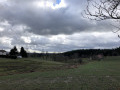
Once you have crossed the point (2), you will be on the plateau with magnificent views of Saint-Didier-en-Velay and the Monts du Velay (Meygal, Mézenc, Lizieux).

And of course, after your walk, take a stroll through the old streets of Saint-Didier. You will be surprised to discover a very beautiful village, completely overlooked when following the D500 road.

Saint-Didier is an ancient village: prehistoric axes and the remains of a 2nd-century farm have been found here. A castle protected the inhabitants from the 10th century onwards. Its lord, Guillaume de Saint Didier, is mentioned in a papal bull issued by Pope Alexander III in 1165.

The church dates from the 12th century. It is organised around elements (central bay and north aisle) built between 1150 and 1200. Some traces of an ancient church built around the 8th century were discovered during archaeological work. Some of the column capitals are remarkable: originally polychrome, they represent a version of the battle between vices and virtues. Upon entering the church, you will see two capitals: lust is represented on the right and insolence on the left. Further into the church, there is a capital reminding the faithful that angels and saints are there to help them triumph in this battle.

The Church of Saint-Didier contains a rare series of four coats of arms of ladies (early 16th century) carved at the base of the ribbed vault of the former choir. All are ladies of the La Fressange family, a lineage whose coat of arms is a spread eagle. It adorns two keystones of the church. The oldest (early 15th century) is in the south bay, under the bell tower.

From the end of the 15th century, the main square (not that big) was lined with the houses of the wealthiest landowners. The market was held there every Wednesday. Capital punishments and official proclamations took place there. A large fountain was built in the middle of the square. Covered passageways provided access to it.

The market hall, built in 1880, stands on the site of the grain market that had been there since the 13th century.

From 1648 onwards, the Augustinian convent housed cloistered nuns. Little remains of the buildings constructed at that time. Although partially hidden by the media library building, the façade of a Baroque chapel built in 1649 can still be seen today. A large garden on the other side of the street completed the complex. The nuns accessed it via an underground passage, the remains of which can still be seen under the Boulevard des Jardins. After serving as a prison during the Revolution, the convent now houses the Jeanne d'Arc school.

If you take the old road to La Séauve, you will pass in front of the Saint-Roch Chapel, built in the 17th century on the plague cemetery established in 1585. The plague ravaged the town several times, particularly in 1585 and 1640.

Finally, one of the oldest bridges in the Haute Loire spans the Semène at a place called La Clare. Believed to be a Roman bridge, it was in fact built in the 12th century. It is a jewel of Romanesque civil architecture, providing a comfortable crossing of the Semène for those wishing to travel from Saint-Didier to Monistrol-sur-Loire. Popular belief has it that King Henry IV used this bridge.

Other walks in the area

For more walks, use our search engine .

The GPS track and description are the property of this route's author. Please do not copy them without permission.