Country:

 City:
City:


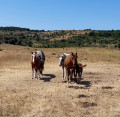
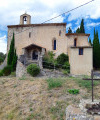
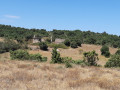
In Massac, follow the signs to the car park and park in the designated area on the edge of the Torgan.
YellowPR® markings
(S/E) On leaving the car park, do not head back up to the village but continue along the stream on the tarmac path. When you reach a junction, turn right to cross the bridge and continue to the next bridge, located about a hundred metres further on.
No markings
(1) Do not take this path but keep to the right on a wide track, half grass and half gravel, which climbs gently up the hillside. After crossing a meadow, the slope becomes steeper then the track levels out again before reaching the Col de Canoles.
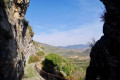
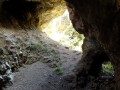
(2) Turn left onto a stony track that winds lazily down a gentle slope, offering beautiful views of the Torgan valley and a small rocky gorge on the left.
(3) Take a sharp left, pass the ruins of an old sheepfold, then immediately turn right to fords the Torgan, making use of the few stones available.
The trail on the ground becomes less distinct. Follow the stream on your right, pass the metal arches of an old greenhouse, and come to a stone wall that supports a path higher up. Facing the wall, head to the right then cut back to the left to make your way through some bushes and reach the path, which you follow to the right until you reach the first houses of Dernacueillette. Then head down the tarmac road to the right, which leads to the village square.
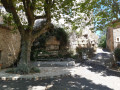
(4) This lovely square, shaded by plane trees and featuring a small waterfall and an old trough, is the perfect spot for a break. Alternatively, head towards the information panel at the end of the trough, which details the Petite Vadrouille walk known as “Le cep, landscape architect”.
YellowPR® markings
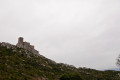
Head up Rue de la Cascade, go round the castle and follow the steep path which curves to the right. About thirty metres further on, don’t miss the start of the path on the left, fortunately marked by a wooden post with a sign.
This path leads further up to another cross-path, which you should follow to the right to reach the D10 after passing through a metal gate, which should be closed carefully.
(5) Walk along the road to the left for about twenty metres, then cross over to rejoin the signposted path opposite. This path winds its way through kermes oaks and the ‘skeletons’ of box trees ravaged by the box tree moth, ascending the valley of the Ruisseau de Lacamp, which was dry when I passed through. Once out of the tree cover, you’ll reach a junction with a cross-path.
(6) Turn right and continue to the next junction, where you should turn left for about twenty metres until you come to a wide track coming in from the right.
Signposting:PR® Yellow +GR® White and Red
Follow this track to the left for about a hundred metres.
Markings:GR® White and Red
Let thePR® trail branch off to the right and go straight on until you reach a signpost (on the ground as of August 2020), where you should turn left. Further on, ignore a path on the right and continue straight ahead: a short distance away, the imposing ruins of an old sheepfold serve as an excellent landmark.
No markings
Just as the path curves to the right towards these ruins, leave it by turning left onto a wide grassy track and head for a four-way junction at the foot of a climb.
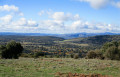
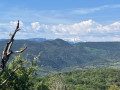
(7) Turn left and begin the traverse along the side of the Plateau de Lacamp, which offers fine views of the Montagne du Tauch to the left and the jagged ridges stretching out far ahead towards Cucugnan, Peyrepertuse and Quéribus.
(8) Ignore the track branching off to the left towards La Jasse and continue straight on. After a sharp left-hand bend, the path becomes extremely rutted and you must take care to use the raised path on the left to proceed safely. You will reach a grassy clearing with a view of the ruins of La Borde de Bonnet.
Tricky junction: at a solitary shrub surrounded by the remains of a metal fence, take a sharp right-hand bend, aiming for a wooden stake and the telephone line poles. Soon, the trail on the ground becomes distinct again and, after a left-hand bend, descends towards a concrete structure, passing by the rusted wrecks of three vehicles abandoned to their fate, which mar the landscape. Continue to the ruins of a building on the right, buried beneath the vegetation.
(9) A very tricky junction where I have placed a cairn: leave the wide path and take a track on the left that is overgrown with scrub and very difficult to make out. This soon turns into a clearer path that is easier to follow: heading south-east, it disappears about 200 m further on.
Then veer right towards the valley floor and then left , taking care not to descend too far so as not to end up in the scrub and gorse where the path becomes impassable. As you approach a line of shrubs, find a clearer track that leads to a wide path.
(10) Turn left. Further on, cross an electric fence and walk a few metres.
YellowPR® markings
(11) Turn right. Stop briefly at the dolmen known as the Table des Morts, situated on the left and of little interest given its condition, then continue along the path which climbs up to the Arquette and levels out before leading to a junction (very old wooden post: dolmens 2 and 3).
Turn left to reach the Cioutat promontory and enjoy the 360° view.
(12) Turn back to the previous junction and head straight on. Reach the D1610 just after passing through a metal gate.
(13) Cross with care to take a wide path opposite and to the right of the road. Ignore a path on the right and go straight on, making sure to spot the start of the trail which begins on the left at the start of a slight bend to the right.
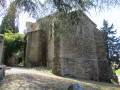
(14) Take this path, which serves as a shortcut, to rejoin further down the track you have just left; follow this to the left until you reach the D1610. Turn right towards the village of Massac until you reach the chapel and the adjoining cemetery.
(15) Leave the road and take the grassy path on the right that cuts across the bend. Back on the tarmac, cross over and follow the concrete path opposite, which joins a narrow lane; follow this to the left to reach the village centre. Cross the Grand Rue and head opposite towards the car park (S/E).

 Visorando Member
 Easy
Easy 
 Difficult