Country:

 City:
City:


Park in the car park next to Le Torgan.
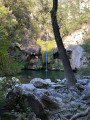
(S/E) Follow the tarmac road: yellow markings. Continue to the sharp bend on the right and leave the road to take a path on the right that runs alongside the Torgan. You’ll reach a picnic area with a small pond.
(1) Walk along the right-hand side of the pond and you will soon reach a fork in the path.
(2) Turn right to see the ruined mill at L’Ermitage: this dates from the 17th century and you can still see the millstone. Below, you can also see a rainwater collection cistern, which is difficult to access.
(3) Return to the fork.
(2) Take the track on the right and join the D10. Follow it to the rightwith care for about 200 m.
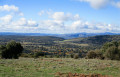
(4) Take the path on the left, which climbs steadily: there are lovely views of the valley and the village. Continue the climb, following the yellow markings, until you reach the first dolmen, which is on the left near the path. The Dolmen des Escoumes, as it is known, dates from the late Neolithic period, around 2500 BC. On its slab, broken in two and lying on the ground, you can see some fine cup marks.
(5) Return to the path and resume the route to the left, continuing to follow the yellow markings. A cairn soon indicates the second dolmen, situated on the right on a small slope that is easy to climb. This is the Dolmen de la Table des Morts: its slab is broken in two and lies on the ground.
(6) Return to the path and continue to the right until you reach a T-junction.
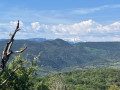
(7) Turn left to reach La Cioutat, a lovely viewpoint over the valley and Mont Tauch.
(8) Return to the T-junction.
(7) Continue left for about 300 m and follow the sign for the dolmen on the right: this is the Tres Peyros dolmen. The top slab has disappeared and it resembles a double, semi-buried chest. The burial chamber contained grave goods, pottery, pendants, and carved and polished stones.
(9) Return to the path and head right. Cross the D1610with care and take the path opposite, which climbs steadily. Reach a junction, go straight on for a few metres, then take the path on the left running alongside a canyon. You will reach the remains of a cylindrical tile kiln situated at the top of the extraction shaft.
(10) Follow the signposting back to the track. Follow it to the left, negotiate the hairpin bend to the right, then leave it to take a path on the left that serves as a shortcut. Return to the track and turn left to reach the D1610.
(11) Turn right. Then take the path on the right running alongside the church and the cemetery before returning to the road. Cross over to join the path opposite. Then cut left between the houses and emerge onto the D10. Cross with care to follow the small road opposite leading to the starting car park. Leave it on your right, cross the bridge and walk almost straight ahead for about a hundred metres until you see a stone engraved with a Maltese cross.
(12) Retrace your steps and return to the car park (S/E).

 Visorando Member
 Moderate
 Difficult