Country:

 City:
City:


By car: in the village of Saint-Pierre-d’Entremont, head north towards Entremont-le-Vieux, cross the Guiers Vif bridge and turn immediately right onto the D45C towards the Cirque de Saint-Même. At the first junction, leave the D45C and turn left towards Les Varvats. At Les Varvats, during the summer months, parking spaces are scarce, so it is best to arrive early.
(S/E) From the Les Varvats car park (1,042 m), follow the well-marked yellow trail (south-east), which climbs steeply before becoming undulating.
(1) At the signpost (alt. 1,110 m), continue straight on along the track towards the Alpette de la Dame, marked in yellow and red, and leave the path to Saint-Même d’en Haut on your right. The path becomes narrower and steeper.
(2) At the signpost (alt. 1280 m), ignore the path on the right towards the Alpette de la Dame and take the path on the left towards the Chalet de l’Alpe (Yellow), which winds its way up a small rocky escarpment via a few hairpin bends and, at a junction, joins the GR®9 (White/Red)
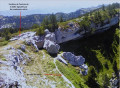
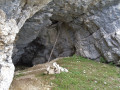
(3) At the sign for “Pré de Pratcel” (alt. 1,450 m), ignore the right-hand branch towards Alpettaz and, taking the path opposite, cross the clearing towards the Pas de l’Échelle. After another exposed stretch, the path splits in two. Ignore the left-hand path, which passes a gate. Continue to the right to reach a junction about a hundred metres before the Pas de l’Échelle, at the foot of the first rocky outcrop overlooking a rock shelter, at an altitude of around 1,600 m. Photo: rock shelter,
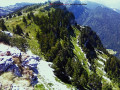
(4) Leave the GR®9 and take a path to the left marked by a cairn and a Yellow Cross. Photo: Path towards the Sangle de Fouda Blanc, then pass the rock shelter (orange arrows). The track continues for 1 km (westwards) along the edge of the slope and through scrub to reach the south-western spur of the Roche de Fitta, from where you can see the Sangle de Fouda Blanc, approximately 1.6 km long, which climbs gradually to an altitude of 1,840 m. The route becomes increasingly exposed and often very precarious, but the path is wide with few steep descents, well-marked on stable, stony ground free from rockfalls, and rarely grassy. Nevertheless, be wary of loose stones which can cause dangerous slips.
(5) You’ll come across the Pas de Fouda Blanc path. Photo: Pas de Fouda Blanc – which you’ll take on the way back. It can be identified by blue markings on the rock. Continue along the path known as the Sangle du Pinet, following a narrow grassy track.
The Sangle du Pinet, also 1.6 km long and almost entirely level, is slightly less exposed to the air but more precarious due to unstable, earthy sections with rockfalls caused by runoff; furthermore, if the grass is damp, there is a risk of slipping. It is therefore recommended to walk this route during dry periods, equipped with a walking stick to help regain your balance. When you can see the summit topped by a cross, there are still five cirques to cross before reaching it. The exit couloir is directly below the summit: memorise the position and topography of the area so that you can spot it more easily as you approach.
(6) Just before the start of the north-eastern spur of Le Pinet, there is a scree cone marked by a cairn. Photo: end of the Le Pinet ‘sangle’. Do not continue along the path that turns onto the north face.
From the cairn, follow the ascending track (south-east) through a rocky couloir. At the top, it curves back to rejoin the Pinet traverse. Climb up to the left of the grassy slopes towards a rocky overhang. Follow the track to the left beneath this overhang. After a short climb to the right between the rocks, you reach the ridge. The summit is about twenty metres to the left (north).
(7) At the summit of Le Pinet (alt. 1,867 m), the view opens up to a magnificent panorama of the Alps. Photo: Mont Blanc as seen from Le Pinet. The descent follows a path, marked by cairns, which runs along the ridge without straying too far from it, for 1.6 km towards the south.
(8) From the ridge, 20 m below, you can see the ‘sentier du sangle’ in a cradle-shaped cirque containing a scree slope. The Pas de la Fouda Blanc is situated in the centre of this cirque. Continue for about 150 m until you reach a large, chaotic rocky area.
(9) Look carefully around the area to spot a large, tabular rock outcrop about 2 m high, cut by faults. It is roughly situated along the axis of the Pas de Fouda Blanc. On its north-eastern side, look for a fault that is wider than the others. Photo: Fault leading to the Pas de Fouda Blanc. Cross this winding narrow passage; at the exit, on a rock, the word ‘Fouda’ is inscribed in faded orange, accompanied by blue markings. Photo: Exit from the fault. The path on the right runs flat for 50 m to a large, gnarled, dead pine tree. Climb down a rocky step to follow a path going in the opposite direction, which descends overhanging a rocky ridge.
(10) Once you reach a flat area, climb down a slightly overhanging chimney (grade 3) and continue the descent via a few switchbacks which cross the sling path taken on the way up (5) and end, further down, at a small rocky outcrop.
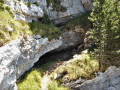
(11) Note, on the left in a recess , a cavity fitted with a ladder. Photo: Grotte à L’Echelle, entering a cave naturally named Grotte à l’Échelle. Photo: Exit from the Grotte à L’Echelle.
At the bottom, take the path to the right (north) which gradually turns back (south) towards the scree slope. Head down it, then head into the woods on the left and climb down a rocky outcrop using small natural steps. Continue the descent either along the scree slope, which becomes narrower, or along its edges
(12). At an altitude of around 1,650 m, you have a choice.
- Either leave the scree slope to the left, following a faint, level track that crosses a steep slope for 500 m, then, after a hairpin bend, joins the forest to complete the descent in a wide 180° curve, reaching a crossroads (alt. 1,300 m)
- Or, as shown on the map, continue the descent down the scree slope, which cuts a swathe through the forest (west). When the forest closes in on the scree slope, follow it a few dozen metres to its left, off the path and without difficulty, through a forest without undergrowth, carpeted with dead leaves. After about 400 m, you will reach a wide track (alt. 1300 m) bordered by a high, steep embankment.
- The first option presents difficulties in locating the path, which branches off into numerous trails that gradually disappear, and the steep slope slows progress. Although the descent is off-trail, this second option has the advantage of being clearly marked.
(13) Take this track to the left (south-east), which climbs to an altitude of 1,340 m, descends to the right, passes a hairpin bend and arrives at a junction (alt. 1,290 m). Ignore the overgrown path to the right and follow the track opposite (south-east) back up to reach a crossroads (alt. 1,300 m).
(14) Ignore the path leading in the opposite direction to the right, the path on the left coming from the first alternative at point (12) and the track opposite. Take the path on the right leading down (south) into the hollow of a small valley. Join the track from the start and, keeping to the right, after 300 m, you will reach Les Varvats (S/E).


 Visorando Member

 Moderate
 Very difficult
 Difficult