Country:

 City:
City:


Park at Le Truel (12430), in the car park running alongside the River Tarn, past the toilets and the children’s playground.
(S/E) From the car park, head right and make your way to the bridge over the Tarn; cross it and take the road (D200/D31) on the left.
(1) After about a hundred metres, once you’ve passed the stopover lodge, take a path leading diagonally uphill to the right. Begin a fairly steep climb through the woodland on a path that is sometimes very rutted.
(2) You’ll come out onto a road; follow it to the left. At thefirst junction, turn right into the village of La Romiguière, heading towards the viewpoint. Climb the winding road to reach a junction (viewpoint, cross).
(3) Turn left and walk past the church. At the junction, turn right and then immediately left.
(4) At the road, veer left onto a concrete track. About a hundred metres further on, turn left onto a grassy track. Enter a woodland and head slightly downhill. Further on, turn right and head more steeply downhill. Cross a small stream and head back uphill. You’ll emerge onto a small road at a place called Le Roujac.
(5) Continue a few metres to the right along the road and immediately turn left onto a path between two hedges. After about 150 metres, turn left and head downhill. At the bottom, cross a track and then the Ruisseau de Geneve via a concrete crossing. Head back uphill to the D31.
(6) Follow the road to the left for 300 metres, then turn right, after a rock-filled embankment, onto a wide, ascending track.
(7) At thefirst fork in the road, turn right. Take a right-left hairpin bend and continue the climb through the forest. Note a small terraced vineyard on the left and the view over the Tarn. Continue along the path until you reach a tarmac road.
(8) Follow the road to the right and pass through the hamlet of La Fosse. Stay on the road, pass under the high-voltage power lines and reach the Raspes station (a stop on the road train that runs in summer, with a viewpoint). Then take the path diagonally to the left to reach the site of Notre-Dame du Désert.
(9) Continue straight on for a few dozen metres, then walk around the site in either direction. Pass by the Notre-Dame-du-Désert Chapel and return to the junction.
(9) Next to the sign saying ‘Welcome to Notre-Dame-du-Désert’, turn left onto the narrow path which descends steeply and winds through lovely woodland. You’ll come out onto the D200 road; follow it to the right.
(10) After about 250 m, turn left onto the Verdalle suspension bridge, which crosses the River Tarn. Continue along the road and take thefirst right towards Verdalle. Follow the road as it winds uphill and enter the hamlet. After thefirst few houses, turn left onto a grassy path. Soon ignore a track coming from the right and you’ll reach a junction.
(11) Turn sharply right and continue uphill through the forest. After skirting a cultivated field, you’ll reach a track. Follow the track to the left until you reach a road.
(12) Follow the road to the left and, after about ten metres, as you come out of the bend, turn left onto the path leading down into the forest (Blue marker).
A few metres further on, turn left again (Blue dot andPR®® arrow).
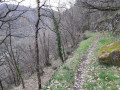
Follow a very old path, which is in places badly worn and stony, running alongside ancient moss-covered low walls, and descend to the Ruisseau de Coudols. Cross it via a wooden footbridge.
After a steep, rutted climb of a few metres up the embankment, you’ll reach the D510 road.
(13) Follow this road to the left and descend to the River Tarn (note the Rocher de Cambras on the left). Just before the bridge, take a path to the right (yellow markings; picnic table). Immediately turn right into the rocky terrain. Carefully follow the yellow markings on this gradual, stony climb which takes you up Roc Saint-Jean. Towards the end, a wooden staircase leads to the lovely viewpoint on the summit plateau (a magnificent view of the confluence of the Tarn and the Ruisseau de Coudols, and, opposite, of Notre-Dame du Désert).
(14) Leave the viewpoint and head north towards the village of Ayssènes, keeping to the right onto a path marked by wooden barriers. Walk through the village (with its beautifully renovated houses, a chestnut drying shed, and the Chestnut and Religious Arts Museum). Walk past the church on your left.
(15) Turn diagonally left onto the small road signposted ‘Moulin d’Ayssènes’. Head downhill to reach the Ruisseau de Vernobre. Cross the stream and, immediately afterwards, follow the path on the left which climbs into the woods.
(16) You’ll come to a road; follow it to the left. Ignore the path on the left heading towards the Roc du Cavalier and walk past the Oustals crémats. About thirty metres further on, after the bend (cross), take a grassy path to the left. Walk straight across the middle of the meadows, with lovely views to the left. Then veer left and descend gently into the forest. Cross a stream and head uphill. You’ll reach Le Pouget (a 14th–15th-century fortified house) and follow the road to the right.
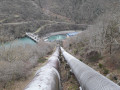
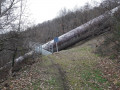
(17) At the houses, take the track to the left. The path, running along a ledge above the Tarn, is mainly through woodland but occasionally offers fine views to the left. A footbridge takes you over a double penstock that supplies the Pouget hydroelectric power station situated below.
Continue along this magnificent path until you reach thefirst houses in Le Truel. Then follow the D31 road to the left.
Walk past the church and, just after the cemetery, turn right onto the small street leading to the car park (S/E).


 Visorando Member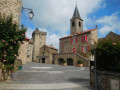
 Easy
Easy 
 Association / Club / Walk leader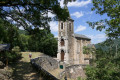
 Moderate
  Tourist office

 AONB
AONB