Country:

 City:
City:


The trail starts next to the car park and the farmers' shop, located in the old cooperative winery that was built in 1931 and closed in 1998.
(S/E) Cross the road carefully and follow the "little orange donkey" signs opposite, which run alongside a pine forest and then fields.
(1) Take the small path that branches off to the left and go around Pech Rigaud. Below, you can see the village from a new angle, with the fortified castle at its heart.
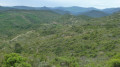
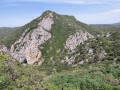
The path winds through the pine trees, then overlooks the small canyon of the Ruisseau du Bac du Four, which plunges down to the left, offering a view of the Gourgines gorges in the distance, the holm oak forests and the steep rocks. You will come to a small road.
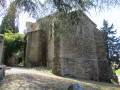
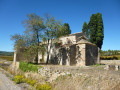
(2) Turn left and then cross a small stream. At this point, you will pass by the Chapel of Notre-Dame des Champs Bons. It is always open and is dedicated to the Virgin Mary, who is believed to protect crops, farms and livestock.
A few metres further on, begin the ascent to the great heaths, following a wide, red-soiled track heading north-west. Now is the time to let your child ride the donkey if they wish.
The steep climb is challenging on the winding track, but once you reach the top, take the opportunity to take a short break and admire the view.
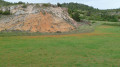
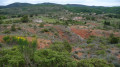
(3) From here, there is a beautiful view overlooking the village, which appears compact and clustered in its valley. The red earth, which gave the village its name, creates beautiful contrasts when the broom is in bloom.
The Termenès region also witnessed the terrible history of the Cathars.
Next, follow the main track, lined with a few old telephone poles, until you reach a fork.
(4) Turn right, continuing to follow the orange donkey markings
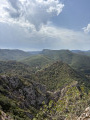
Further down, the silhouettes of the mountains and hills merge towards the setting sun, to the west on the left.
Opposite is the Serre (rocky ridge) of Blanes.
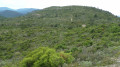
Here, nature is completely wild and sometimes even hostile. A few ancient ruins bear witness to a pastoral past. Broom, blackthorn and aphyllanthus cover the surrounding moors: this is the ideal hunting ground for the golden eagle.
As you follow the gently sloping track, you can see the Recompatot farm on your right. You may come across a herd of free-roaming goats. Watch out for the dog if you have one!
(5) At this point, you can shorten the hike by continuing straight ahead on the track and rejoining the route two kilometres further on.
But if you choose to continue following the orange markings, you will need to leave the track and take a more winding path that climbs to the left towards the Chapelle Saint-Martin chapel.
In spring, several species of orchids can be found here, and it is common to see a hare or even a short-toed snake eagle flying over the heath.
Through the arid and fragrant heath, the path leads, after ten minutes, to a plateau where the modest Saint-Martin Chapel stands at the foot of Pech de Blanes. Today, it can also be used as a refuge.
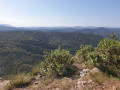
(6) From this spot, at an altitude of almost 500 metres, you can enjoy a beautiful view of the Corbières, the wine-growing plain, the Montagne d'Alaric and, in the distance, the Montagne Noire to the north. The Pyrenees and the Hautes Corbières can be seen when you look south.
Turning your back on the chapel, follow the path to the left, which is part of theGR® 36A trail and winds its way through juniper and rockrose bushes, descending towards the village below.
Be careful, the path is narrow, so children will need to dismount!
You will eventually come back to the track, which you should follow to the left for about 500 metres.
(7) Once again, take the track to descend directly to the right, across the red earth, towards the village. The colour of the soil is due to iron oxide deposits; be careful, as the crumbly soil and dry earth can be slippery. You will also see the ruins of the old windmills, which were still used to make flour in the 19th century.
You will reach La Plaisance, once fertile arable land that provided fodder and cereals. Turn left and follow the track to a crossroads where you turn right at the cross.
This takes you down towards the village of Villerouge-Termenès; pay attention to the signposts that will lead you to the castle. To do this, at the entrance to the village, keep right on Chemin du Pla Marty, then turn left at the crossroads and immediately right.
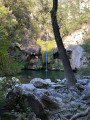
(8) The small village of Villerouge-Termenès, crossed by the Lou river, is home to stone houses huddled together around its ancient fortified castle. At its foot is an old wash house and a fresh spring.
Cross the small stream on the right and walk up through the gardens towards the fields seen at the start of the walk.
(1) Retrace your steps, cross the main road and return to the car park (S/E).


 Visorando Member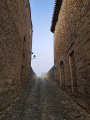

 Difficult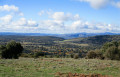
 Easy
Easy