Tour of the ramparts of Bibracte

The ancient oppidum of Bibracte was the largest city of the Aedui, a very powerful Gallic people one hundred years before our era. The largest rampart dates from the2nd century BCE, is 7 km long and was built before the smaller one, which is 5 km long, thus reducing the space. It was built on the principle of the murus gallicus, a construction made of earth solidified by interlocking layers of horizontal beams with a dry stone facing, an architectural technique admired by Caesar. This beautiful walk gives a glimpse of the grandeur of this ancient city as you follow in the footsteps of the Gauls through the majestic forest of Mont Beuvray.

Details

91687092
Creation:
Last update:
Last review:
  • Walking
    Activity: Walking
  • ↔
    Distance: 6.85 km
  • ◔
    Average duration: 2h 35 
  • ▲
    Difficulty: Easy

  • ⚐
    Back to start: Yes
  • ↗
    Ascent: + 221 m
  • ↘
    Descent: - 219 m

  • ▲
    Highest point: 788 m
  • ▼
    Lowest point: 609 m

Photos

Description of the walk

The departure point is the Bibracte Museum car park.

(S/E) Go up a small road that runs between the museum and the restaurant "Le Chaudron".

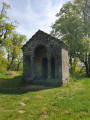
(1) Take the track that climbs to the left of the road, just after the barrier. Note the Barlots Tomb, known as "la Dame des Barlots". Climb up to the D174 road and arrive at the Porte du Rebout.

(2) Go up the road on the left. Just after the reconstruction of a Murus Gallicus, turn left behind the rampart, go down into the valley and climb straight up to the Fontaine Grenouillat.

(3) Turn right. Pass under the thatched roof, following the yellow markings.

(4) Continue straight ahead. Pass under the terrace (you can climb a few metres to admire the view and visit the tiny Saint-Martin Chapel).

(5) Continue straight ahead and cross the road.

(6) Be careful, take the path directly opposite, this time under the rampart. Continue straight ahead and cross the Ruisseau de la Fontaine Saint-Pierre stream.

(7) Pass under the Roche Salvée, still under the rampart.

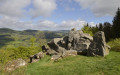
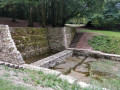
(8) At the Ruisseau de l'Écluse, cross the rampart and continue straight ahead to Theurot de la Wivre, a spectacular large rock.

(9) Continue along the ramparts to the Porte du Rebout. Take the D274 on the left for 100 metres to reach the crossroads from the outward journey.

(2) Turn left at the edge of the forest. Go downhill and turn onto the first path on the right. When you reach the road, without taking it, zigzag along the path on the left and then the one on the right. Pass behind the museum.

(10) Continue along the path to return to the car park (S/E).

Waypoints

  1. S/E : km 0 - alt. 609 m - Musée de Bibracte
  2. 1 : km 0.14 - alt. 616 m - Slope known as the "black run"
  3. 2 : km 0.61 - alt. 700 m - Porte du Rebout
  4. 3 : km 1.13 - alt. 720 m - Grenouillat fountain
  5. 4 : km 2.1 - alt. 777 m - Sous la Chaume
  6. 5 : km 2.36 - alt. 787 m - Under the Terrace
  7. 6 : km 2.63 - alt. 779 m - Road junction (caution)
  8. 7 : km 3.53 - alt. 743 m - Saint-Pierre Fountain Stream
  9. 8 : km 4.66 - alt. 706 m - Fontaine de l'Ecluse
  10. 9 : km 5.02 - alt. 735 m - Theurot de la Wivre
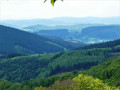
  11. 10 : km 6.62 - alt. 611 m - View of Glux en Glenne. Above the
  12. S/E : km 6.85 - alt. 609 m - Musée de Bibracte

Notes

Feel free to ask for a visitor map at the museum reception, where you will find all the tourist information you need to visit the archaeological site.

Cloakroom, shop and toilets at the museum (1).

Picnic tables are available in the car park, on the car park side and opposite the main road, and on the terrace at the top of the hill (4).

Le Chaudron restaurant (1) (Gallic cuisine) reservations: 03 85 86 52 40.

Worth a visit

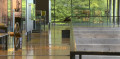
Bibracte Museum: designed by Pierre-Louis Faloci, the Bibracte Museum is one of the most beautiful in the Morvan. The first floor presents the major European cities ofthe 1st century BC and the daily life of people at the end of the Iron Age. The ground floor presents the excavations of Bibracte, the capital city of the Aedui, a pivotal point between the Gallic and Gallo-Roman worlds. Between its foundation and its abandonment, Gaul became Roman. (1)

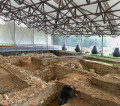
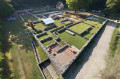
The archaeological site: Bibracte is a Gallic town under the forest, the remains of which can be seen. Today, archaeologists can still be seen excavating its ruins. Several sites are worth a visit: the horse park, domus built in the Roman style at the very end of Bibracte, the convent pasture, Bibracte town centre and then the medieval convent, the Saint-Pierre fountain, and the Theurot de la Wivre.

Mont Beuvray is an exceptional natural site, the perimeter of which is classified as a Grand Site de France. A remarkable natural ensemble, composed of ancestral forests, springs and exceptional viewpoints, it is an essential stop on any tour of the Morvan Regional Natural Park.

Other walks in the area

For more walks, use our search engine .

The GPS track and description are the property of this route's author. Please do not copy them without permission.