(S/E) Former Espiet railway station
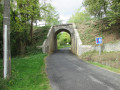
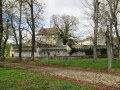
In 1873, a railway line was built between Bordeaux and Eymet in the Dordogne to serve the Entre-deux-Mers and Bergerac regions. Espiet station was one of the stations on this railway line.
Operational problems led to its partial closure in 1954, then its definitive decommissioning in 1979.
In 1996, the Gironde General Council turned it into a cycle path from Bordeaux to Sauveterre-de-Guyenne, known as the "greenway", and named it Roger Lapébie in honour of the regional cyclist who won the 1937 Tour de France.
Since then, it has been converted into a restaurant, but the changes required for this new activity have had little impact on the site, which continues to enjoy a privileged setting.
Between (3) and (4) Fuie du Château de Pressac
This 16th-century dovecote, known as a fuie because of its cylindrical shape, marks its belonging to the nobility, as the bourgeoisie and peasants were only entitled to square dovecotes, even after the Revolution. These buildings were used to raise pigeons, a prized delicacy, whose droppings, known as colombine, were a renowned fertiliser. Generally cool, these structures were also used as pantries.
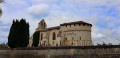
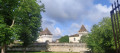
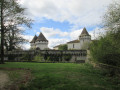
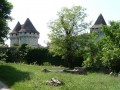
Château de Pressac, 14th to 19th century
In 1305, EdwardI of England, Duke of Aquitaine, granted Bernard and Thibaud de Pressac the right to build a fortified house.
The 14th-century upper courtyard was protected by a moat, a double-towered enclosure and a gatehouse with two round towers.
Behind a second moat, a 16th-century rampart with watchtowers, machicolations and arrow slits protected the lower courtyard.
Finally, the main building dates back to the 19th century.
(5) Tomb of General Darmagnac of the Revolution and Empire.
This building, which is ostentatious to say the least in the middle of this tiny rural cemetery, is unfortunately so massive that it borders on ugliness. Recalling the Egyptian campaign in which the deceased distinguished himself, the obelisk adds to the unusual nature of the ensemble.
General Viscount Jean Barthélémy Claude Toussaint Darmagnac was born in Toulouse on 13 September 1766.
Active from 1791 to 1830, his military career spanned the Revolution, the First Empire and the Restoration.
Throughout these forty years, he distinguished himself in the campaigns in Italy, Egypt and Spain.
More often than not, he emerged victorious from engagements in which he was outnumbered, such as at Bassano (1796) and Cairo after the Battle of the Pyramids (1798). Similarly, in 1799 at Damietta, he cut down 4,000 Ottomans with only 600 soldiers.
After distinguishing himself at Austerlitz (1805), the Emperor sent him to Spain, where he took Pamplona in 1808. Seriously wounded at Medina de Riosco that same year, he nevertheless remained on horseback until victory was secured.
The Restoration was more a time of honours than military exploits: in 1821, Louis XVIII made him a Commander of the Order of Saint Louis, then conferred on him the title of Viscount, NapoleonI having made him only a Baron. Finally, in 1823, he was promoted to Grand Officer of the Legion of Honour.
His name is engraved under the Arc de Triomphe de l'Étoile in Paris.
He died in Bordeaux on 13 December 1855. The reasons for his burial in Daignac are unknown.



 Country:
 City:
City:






 Visorando Member
 Moderate
 Association / Club / Walk leader