Country:

 City:
City:


Park in the small lay-by on the side of the D97 at the Col de la Chevestraye between Plancher-les-Mines and Fresse.
(S/E) Walk past the memorial erected in honour ofthe 2nd RCA (Régiment de Chasseurs d'Afrique) during the battle at the end of September 1944. Then turn right, following the sign for “Bois la Dame, Tranchées, Col du Coporot”. This marks theGR®59, signposted with a red and white rectangle, which heads west and climbs into the forest.
(1) After 400 m, an information panel marks the site of the village of Bois la Dame, destroyed in September 1944 during the fighting at La Chevestraye. You’ll need to look carefully, as all that remains are piles of stones overgrown with trees. Continue along the wide marked path, ignoring the side paths on either side.
(2) Look out for the information sign indicating the remains of trenches. To see them, you need to go 20 m to the right of the path. You’ll need to look carefully to spot a few traces, about 50 to 80 cm deep. Follow the GPS track to reach the point just off the path. Then continue uphill along the wide path to reach a junction of two forest tracks.
(3) Head straight ahead, following theGR® markings.
(4) Look out for the information sign pointing to the fountain. There are Blue Triangle markings. The fountain is quite striking and easy to spot. Continue along the wide path.
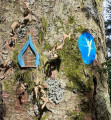
(5) Look out for the information sign indicating “engraved trees”. A Blue Triangle marker is affixed to a beech tree where a Cross of Lorraine is clearly visible. At the foot of the sign, there is a collection of objects salvaged from the surrounding area: a spade, a pig’s tail (an iron stake used to support barbed wire), and a clover (a stamped metal sheet used to package three shells).
Continue along the path until you reach a fork with signposting for mountain bikes. Route 53 to the right and route 9 to the left.
(6) At this point, leave theGR® to follow the left-hand route, which descends slightly.
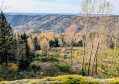
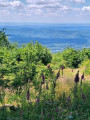
(7) At this junction, take a short 30-metre detour westwards for a superb view of Les Ballastières and Champagney, the village and the Champagney Basin, the Lomont and Haut Doubs mountains, and, in fine weather, the Swiss Jura.
Retrace your steps and turn right onto a path that descends steeply for about 400 m. Walking poles will be very useful on this section.
(8) Look out for the information sign indicating the spot where a German aircraft crashed in 1944. There are no remains. Immediately afterwards, turn left onto the forest track which follows the contour line, heading east-northeast. In places, there are clearings in the forest offering fine views of Plancher Bas, Le Salbert and Evette. Continue to the next junction.
(9) Here, you will find an information panel about the Plainet Maquis. A 200-metre detour to the right leads to a memorial stone marking the spot where the Maquis was based. The detour is signposted with a Blue Triangle. Retrace your steps.
(9) Continue straight ahead along the forest track.
(10) At this point, there is a beautiful view of the Planche des Belles Filles and the Ballon d'Alsace. Continue along the forest path to reach the crossroads you passed at the start of the route.
(3) Head straight ahead. After about 300 m, take the hairpin bend to the right and continue along the wide forest track as it descends.
(11) At the exit of a left-hand bend, take the path branching off to the right and descending steeply. Cross the stream and follow the path on its right-hand side. At the bottom, rejoin the wide forest track that is circular and follow it to the right. Arrive at the hamlet of La Chevestraye and join the D97 road.
Follow it to the right with care for 200 m, then turn right onto the path marked with a horseshoe that cuts across the hairpin bend. After a 200 m climb, you will reach the starting point (S/E).

 The local authority would need to carry out a major rebranding exercise to restore this route’s appeal. New signposting would be welcome (painting on trees is recommended).
 Visorando Member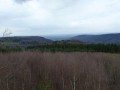
 Difficult
 Easy
Easy  Tourist office