Country:

 City:
City:


Departure from Quillan SNCF station.
(S/E) Head south to pass the Espace Cathare building before turning right, crossing the railway tracks via a wooden footbridge and rejoining the tarmac road of Rue Baptiste Marcet. Follow this road to the left for a few metres before turning right (signpostedGR®367Sentier Cathare) onto Chemin de Castillou. The stony track climbs in several stages to a crossroads on the other side.
(1) Leave theGR® and climb left up a track (yellow markings) to another junction.
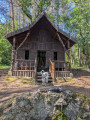
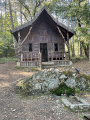
(2) Do not continue along the track that climbs opposite, but follow the magnificent path on the left that opens up on the mountainside in the forest towards the Chalet de Carach. A short but steep climb indicates that the route will fork to the right (yellow markings) onto a clearly marked path. This path winds through the forest for a short while before climbing again and reaching the Chalet de Carach, a wooden building with striking architecture (source).
(3) From the chalet, descend a little to the left to immediately find a rolling track that you must climb up to the right. A few hundred metres further on, do not descend to the left onto a path marked Belvédère du Diable, but continue climbing to a hairpin bend on this track (altitude 610).
(4) Then take the dirt track (yellow markings) opposite, which runs along the mountainside.
You will come to a junction with other markings.
(5) At another junction, Belvédère du Diable, which descends to the left, hikers have a choice:
- either follow this safer route, which ends with a return trip to the Belvédère viewpoint.
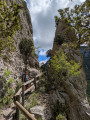
- or follow this description and continue straight ahead along a narrow, steep and exposed path, which is dangerous in wet weather due to the very slippery rocks, but which offers the advantage of a circular route and breathtaking views of the Gorges de Pierre Lys!
The choice here is to take this aerial circular path, and the narrow path (marked in yellow) is well marked. You sometimes have to hold on to branches (really) to steady yourself before coming out at a magnificent high viewpoint.
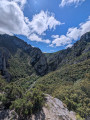
(6) Very high up, it offers unique views of the entrance to the gorges!
The rocks opposite resemble organ pipes descending towards the Aude, the peaks pointing high towards the sky and the road far below winding between the river and the cliffs... Magnificent!
The descent is very steep, and the tree branches are welcome to help steady your feet. When the path levels out and even climbs slightly, it reveals the Belvédère du Diable (Devil's Viewpoint).
(7) Take the time once again to admire the views before continuing down a gentler slope to a fork in the path, where the route rejoins the path you left earlier when you had to make a choice.
(8) Continue straight ahead downhill to reach the heights of Belvianes.
(9) Continue straight ahead along Chemin de la Loubatière (not to the left!) which descends to the heart of the village and passes close to the church. Continue down Rue Cyprien Bouchère and, after a left-hand bend, turn right onto Rue Georges Brassens until you reach the D 117 road.
(10) Cross the road and immediately turn right onto the track leading to the Cavirac footbridge. Cross the Aude river and enter the centre of the village of Cavirac.
(11) Follow the yellow markings that lead to the left and wind through the narrow streets to come out along the Aude. The track that opens up, when it climbs a little, allows you to discover the Belvédère du Maquis (vegetation).
(12) Continuing along the track, the route rejoins the tarmac a few hundred metres further on, which can be avoided by taking a very enjoyable fitness trail near the Aude river, just before reaching the Passerelle de La Forge footbridge.
(13) Do not cross it, but return to the tarmac on Avenue de Cancilla and continue until you see a flower-covered bridge with columns dating from 1928 on your left. After crossing the Aude for the last time, continue straight ahead and then immediately left along the post office to return to Quillan station (S/E).



 ! Those who take the walk will understand
  ). As a result, the path was very well marked by the trail organisers, who had done a good job and even strung up ropes as guardrails to prevent people from straying off the path on the big descent (which we quickly dubbed a slide). I don't know if these ropes are there permanently.
 Visorando Member
 Moderate
 Easy
Easy