Country:
 City:
City:


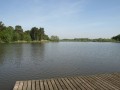
(S/E) The start of the ride, marked in yellow, begins at the Pincemaille car park, about 1 km from the centre of Rillé in the direction of La Pellerine. Head for the water's edge. Be careful when crossing the railway line: one train may hide another. Turn right and follow the riverbank. Here and there along the route, wooden structures have been installed to enhance your experience.
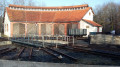
(1) After about 500 metres, make a quick detour to the right to discover the marshalling yard where a dozen locomotives, including two steam locomotives, are stored. Every summer, an association of enthusiasts allows you to relive another era and hear the train whistle as you travel.
Return to the lake shore and turn right again. Covering a total area of 260 hectares, it is divided into two bodies of water: the Pincemaille reservoir and Lac des Mousseaux. The complex, fed by the Lathan, was created in 1977 to irrigate the agricultural land of the Authion basin in Anjou.
(2) At the Moulin Arrault crossroads, at the end of the lake, turn left to reach the opposite bank directly. On the right, the route takes you towards the village of Rillé. Before arriving in the village, you will see a winter wash house fed by a fountain called Saint-Loup and a summer wash house on the banks of the Lathan. You will also see the remains of an ancient rampart, once protected by wide moats, on the right.
In the centre of Rillé, turn right and then left to see the church, also dedicated to Saint-Loup.
(3) Built between the 11th and 16th centuries, it houses relics of Saint-Loup and Pope Saint-Urbain, which attracted many pilgrims in the 13th century.
Head back to the main street and, before returning to the lake, don't miss the opportunity to admire the Portail, a former 13th-century fortified gate.
(4) It is believed to be the gate of a feudal castle that no longer exists. The mound, now topped by a calvary, probably supported the wooden tower of the original castle.
(2) Back at Moulin Arrault, turn right then left and walk along the lake shore again. Here, it is not uncommon to catch 20kg carp. Many species of fish, including pike, zander and black bass, live in these waters, which have an average depth of around 2m, with a maximum depth of 5m in the old bed in the middle of the lake.
(5) When you reach the dyke after the place called Petit-Pincemaille (a nickname for a miserly man), cross the road and enter the woods opposite to take a nature trail around the lake. When you reach a small road, turn left to reach the observatory.
(6) From this observatory, you can enjoy a remarkable panorama of the wild lake and its bird sanctuary. Lake Pincemaille is part of the Natura 2000 network, with more than 200 species of birds observed. We are just a stone's throw from the Maine-et-Loire department.
Retrace your steps and take the dyke to reach the opposite shore of the lake. Turn left and pass between the railway line and the Huttopia campsite, which offers a range of original accommodation in cabins, huts and caravans. A change of scenery is guaranteed.
(7) Before finishing your walk, stop off at Rillé-gare, the departure point and terminus of the railway line, which is unique in the region. During the summer, trains depart every 45 minutes on this 3-kilometre-long railway line. With more than 140 members, the association that runs the Train de Rillé has become a real institution in Indre-et-Loire. Return to the car park (S/E).



 Tourist office

 Moderate
  Visorando Member

 Association / Club / Walk leader