Huriel - Préveranges

In the footsteps of the Master Bell Ringers, stage7.

Details

56346
Creation:
Last update:
Last review:
  • Walking
    Activity: Walking
  • ↔
    Distance: 31.02 km
  • ◔
    Average duration: 9h 45 
  • ▲
    Difficulty: Very difficult

  • ⚐
    Back to start: No
  • ↗
    Ascent: + 323 m
  • ↘
    Descent: - 217 m

  • ▲
    Highest point: 452 m
  • ▼
    Lowest point: 299 m
  • ⚐ Country: France
  • ⚐ District: Huriel (03380)
  • ⚑
    Start: N 46.37559° / E 2.47493°
  • ⚑
    End: N 46.432482° / E 2.253959°
  • ❏
    IGN map(s): Ref. 2328E, 2328O
  • Hour-by-hour weather

Description of the walk

Red and white GR®100markings shared with the GRP® des Maîtres Sonneurs

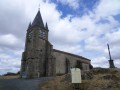
(S) From Huriel church, follow Rue de la Croix, then go down the road on the left, which is shared with the GR®100. At the three-way junction, turn towards the campsite. Just before the entrance to the campsite, turn left onto a grassy path and join the D916. Pass under the railway bridge (take care) and take the dirt track opposite.

(1) After about 1 km, take the path on the right towards the hamlet of Mandrant (new signposting in progress). In this hamlet, take the street on the right, then the one on the left and again on the left.

(2) At the last building, take the road on the right that immediately turns left. Follow it until you reach a small road, turn right, pass Maussat and follow the road opposite. Continue for about 200 m.

(3) Leave the road and take the path on the left. After a ford, go up a steep path. Cross the D150 and head towards Peige. About 150 m further on, turn right. At an intersection, turn right twice: the path heads towards Archignat and soon descends towards the railway line. Turn left and pass under the railway line through a narrow tunnel (not very visible on the right 50 m away). Cross a stream and climb up to Archignat.

(4) In Archignat, take the road (D916) on the left towards Boussac. In a bend, turn left onto Chemin de Longevergne (panorama). Continue to a crossroads before the hamlet of Longevergne.

(5) At the intersection of the small road, turn left, cross the Magieure, and pass under the railway bridge. Take the path on the right and follow it straight ahead until you reach a road. Head straight ahead before La Baudre*, cross the level crossing, and continue straight ahead until you reach the D916.

(6) Take this road on the left, staying on the side of the road for 200 m (be careful) before crossing to continue on the grassy lane. Turn left twice to climb up to the houses. Cross the village and continue on the second path on the right. Follow this path which passes near Les Boueix

(7). The GR® 100 trail branches off to the left towards Les Boueix

(if you wish to make an intermediate stop at the lodge, campsite or huts at the Herculat pond 2 km away, follow the GR® 100 and return the same way tomorrow)

The GRP® on the footsteps of the Master Bell Ringers continues straight ahead. Follow the red and yellow markings of the GRP® on the footsteps of the Master Bell Ringers; at a three-way junction, continue straight ahead and then take the path on the right. You will reach a crossroads with four paths.

(8) At the crossroads of four paths, continue straight ahead, following the GRP® again. At the entrance to the Sugère woods, continue straight ahead along a forest lane. At the crossroads, turn right and continue along this lane to leave the woods. Join a small road and follow it to the crossroads. Go straight ahead and then turn right onto the D549 towards Chambérat.

(9) Then turn left towards La Cueille. After the houses, continue straight ahead along a path lined with box trees.

(10) Cross the Meuzelle ford and go up a sunken lane to the Vieille Vigne pond. Go around the pond on the right, cross the D249 and continue straight ahead on a grassy lane. After passing the high-voltage power line, you will reach an intersection.

(11) Continue right on the GRP®, then at the next two intersections, turn left and left again. Cross the D113 road and continue straight ahead. Pass a path on your left, then another on your right. Go straight ahead at the next crossroads, first turn left then right and you will reach the crossroads at Les Brandes.

(12) Leave the GRP® here and turn left towards Saint-Rémy. Continue to the chapel.

(13) Return to the previous crossroads.

(12) Rejoin the GRP® and take the gravel road on the left. Cross a road and continue straight ahead. In a bend after a house, turn left onto a grassy path. At the next intersections, turn right then left. The path descends towards the Arnon. Ford the spillway of the ponds. After an old mill, take the path on the right in the undergrowth. Cross the hamlet of Le Patouiller.

(14) Take the footbridge on the right over the Arnon. A steep slope, then a small road on the left, lead to Vienny. Follow the access road to Vienny, turn left until you reach a three-way junction. Turn left. Cross the D245 and take the wide grassy path opposite. You will come to a crossroads with four paths.

(15) At this crossroads, continue straight ahead, then turn left. You will come to a road: follow it to the right, pass a reservoir and you will arrive at the D112. Turn right onto the departmental road. The route leaves the Allier department and the Bourbonnais region and enters Berry in the Cher department, in the commune of Préveranges.

(16) About 150 m further on, take the first path on the left. Cross a farmyard (communal path), then follow a small road on the left for a few metres. Turn right onto a path (east); follow it without difficulty until you reach the D997 departmental road (note the rest area with a pond opposite, while on the right, a beautiful farm forms the corner). Follow the road to the right until you reach the church of Préveranges (E).

At the exit of the village (see next stage), you will find the Préveranges - Sidiailles link, which allows you to complete the secondary Bocage Bourbonnais loop

Waypoints

  1. S : km 0 - alt. 325 m - Église Notre-Dame (Huriel)
  2. 1 : km 2.84 - alt. 364 m - Road on the right
  3. 2 : km 3.23 - alt. 362 m - exit from Mandrant
  4. 3 : km 4.06 - alt. 349 m - Start of the trail
  5. 4 : km 7.41 - alt. 367 m - Archignat Town Hall
  6. 5 : km 8.9 - alt. 379 m - Crossroads before the hamlet of Longevergne
  7. 6 : km 11.23 - alt. 396 m - Route D916
  8. 7 : km 13.06 - alt. 452 m - GR 100 GRP split
  9. 8 : km 13.74 - alt. 441 m - Crossroads of 4 paths
  10. 9 : km 16.08 - alt. 408 m - Crossroads
  11. 10 : km 16.72 - alt. 387 m - Fording point at - Meuzelle (rivière) - Affluent de la Magieure
  12. 11 : km 18 - alt. 410 m - Intersection
  13. 12 : km 19.97 - alt. 395 m - Access to the chapel
  14. 13 : km 20.4 - alt. 385 m - Saint-Rémy Chapel
  15. 14 : km 23.83 - alt. 350 m - Crossing the - Arnon (cours d'eau) - Affluent du Cher
  16. 15 : km 26.51 - alt. 409 m - Crossroads of 4 paths
  17. 16 : km 28.67 - alt. 432 m - Start of the trail
  18. E : km 31.02 - alt. 425 m - Église Saint-Martin (Préveranges)

Notes

Accommodation: Huriel, Archignat, Treignat (follow the GR 100 to reach the Herculat campsite 2.5 km away), St Sauvier, Préveranges (group lodge).
See website. Section: Organising your hike.
Refreshments: Huriel, Préveranges.
Water source in Archignat and Saint-Rémy (Saint-Sauvier), Préveranges.

Worth a visit

Archignat. "The tall red man called Archignat was considered as fair a man as a mule driver can be." Towards the Sugère woods, you will be enchanted by grassy paths and small ponds.

Saint-Sulpice Church, sold during the Revolution as national property and falling into disrepair, was restored by an architect from Montluçon in 1876. Only the walls of the nave (Romanesque period) and the base of the chevet (Merovingian period) remain. The vestibule supports the gallery with beautiful painted wooden pillars. The stained glass windows date from the 19th century. On the north wall of the nave is the lapidary will of Messire Guillaume des Ages, which mentions a donation made in 1416 to have a mass said every week in perpetuity for the remission of their souls and those of their friends (classified as a Historic Object in 1918). The roof structure is shaped like an inverted ship's hull, the walls and choir are covered with painted plaster and the sanctuary is decorated with superb trompe-l'oeil paintings.

Chapel of Frontenat (12th century) Opposite the entrance to the chapel is a healing spring. Originally dedicated to Saint Anne, the archaic fountain is topped by a niche housing a representation of Saint Peter. According to legend, all you have to do is lower the statue and dip his feet in the water for "the heavens to open".According to legend, a lord was cured of colic by drinking its water and a pilgrimage continued until recent times. During the Hundred Years' War, Frontenat served as a strategic base for the English, who captured the castle of Maussat (Huriel).

Jarges-Frontenat site: Numerous Celtic and Gallo-Roman remains (remains of a dolmen, carved slab, funerary urn, etc.). The highest point in the canton (572 m), an optical telegraph was installed here from the 19th century until 1970.

The Croix des Ages (late 15th century): (listed as a historic monument in 1969) is a granite calvary located on an old ridge path that is said to have been used by soldiers on manoeuvres. Saint Andrew is depicted on the polygonal shaft. The cross is double-sided: Christ is on the road side and the Virgin and Child on the opposite side.

Treignat (off the trail). Located on the border between the Occitan and French-speaking regions, between the dioceses of Bourges and Limoges, it has passed from one to the other over time. It therefore has two churches built side by side. Over time, only the bell tower remains of the second church. Outside, a crouching lion from the 11th century, classified as a historical monument, stands guard over the entrance to the cemetery, protecting the dead from evil spirits. A chapel houses the recumbent statue, made of hard beige limestone probably from Burgundy, of a knight in armour, Lord Anthoine Le Groin.

Fountain: On the square in front of the church stands a statue of Saint Julien. A Roman officer who converted to Christianity in the 6th century, he was sentenced to death, caught up with in Brioude and beheaded by soldiers on 28 August, his head taken away as proof of his death.

Herculat lake: covering 19 hectares in the middle of a 27-hectare site. Its northern bank is steep and wooded, while the southern bank is flat and sunny. It has a beach (ecological swimming), games and a campsite with a few huts. Downstream is the small Herculat pond. These ponds already appeared on Cassini's maps

St-Sauvier.

Chapel: Dedicated to Saint Rémy, dating from the 12th century, its miraculous inexhaustible water source was an important place of pilgrimage from ancient times until 1828, when it was banned, but it continued secretly until 1937. Achille Allier describes it in detail in "L'ancien Bourbonnais". On 24 June, many pilgrims come to drink the water from the fountain or bathe in it to relieve rheumatism, eye diseases, paralysis and even colic. Inside, there is a superb chestnut wood roof structure in the shape of a ship's hull. The St Rémy Chapel (venue for memorable concerts by the region's master bell ringers).

St-Palais. We are here on the border of three regions (Nouvelle Aquitaine, Auvergne-Rhône-Alpes and Centre Val de Loire) I was happy to travel and see St-Palais in Bourbonnais and Préveranges, which are small villages perched high up, then St-Prejet (St-Priest) and Pérassay, which are other villages further down the Indre river. As we were following this river, which flows through our village, I no longer felt like a stranger or lost in a foreign land."

Church: Mentioned as early as the 12th century, it was built in several stages: the barrel-vaulted nave dates from the 12th century, the flat-ended choir from the 14th century and finally the chapel attached to the north side from the 15th century. The church has a beautiful 15th-century stained-glass window divided into three superimposed sections, which is listed as a Historic Object. The other stained glass windows date from the 19th century and depict Saint Palais and the agricultural saints Blaise and Fiacre, the latter protecting children from convulsions. The stained glass window in the nave depicting the flight into Egypt bears the coat of arms of the Maisonneuve family, who must have donated the window. More rarely seen on stained glass windows is "Toby and the fish". The scene is described in the Old Testament, where the young man catches a large fish to extract the gall that will restore his father's sight.

Préveranges. The highest point in the Centre region is located in the commune of Préveranges, at a place called "Le Magnoux", at an altitude of 504 metres, a stone's throw from the high-altitude village. At the beginning of the 20th century, it was an important centre (according to the 1896 census, Préveranges had 2,196 inhabitants) with many shopkeepers (12 grocery stores) and craftsmen. Its 13th-century Church of St Martin (we are on the trail of the same name) and its elm tree (tree of liberty)

Always be cautious and plan ahead when you're outdoors. Visorando and the author of this route cannot be held responsible for any accidents occurring on this route.

The GR® and PR® markings are the intellectual property of the Fédération Française de Randonnée Pédestre.

Reviews and comments

4 / 5
Based on 1 review

Reliability of the description
Not used
Ease of following the route
4 / 5
Route interest
4 / 5
21christiane
21christiane

Overall rating : 4 / 5

Date of your route : Sep 11, 2013
Reliability of the description : Not used / Not applicable
Ease of following the route : ★★★★☆ Good
Route interest : ★★★★☆ Good

this hike is not difficult, except for its length! There are no elevation changes

Machine-translated

Other walks in the area

For more walks, use our search engine .

The GPS track and description are the property of this route's author. Please do not copy them without permission.