Route of the large islands

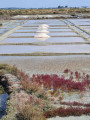
Discover the islands of Saint-Joachim and some of the islands of Saint-Malo-de-Guersac by bike, with some beautiful views of the Brière marshes.

Details

166797
Creation:
Last update:
Last review:
  • Touring/Gravel
    Activity: Touring/Gravel
  • ↔
    Distance: 40.10 km
  • ◔
    Duration according to the author: 4 hrs 
  • ▲
    Difficulty: Moderate

  • ⚐
    Back to start: Yes
  • ↗
    Ascent: + 5 m
  • ↘
    Descent: - 5 m

  • ▲
    Highest point: 8 m
  • ▼
    Lowest point: 0 m
  • ⚐ Country: France
  • ⚐
    Area: Brière
  • ⚐ City: Saint-Joachim (44720)
  • ⚑
    Start/End: N 47.383306° / W 2.201084°
  • ❏
    IGN map(s): Ref. 1022ET

  • ◶
    Type of surface:
  •  
     
     90% Road  10% Byway
  • Hour-by-hour weather

Description of the route

In Saint-Joachim, leave your car in the church car park.

(S/E) Take the small street opposite the car park, on the other side of Rue Joliot-Curie (D50).

(1) At the next intersection, turn left (Rue de la Potriais) and continue to the next intersection.

(2) Turn right onto the D16 ( a fairly busy road). Cross the Pont de la Claie de Mazin bridge to leave Île de Pendille (the village of Saint-Joachim is located on this island), continue through the marsh to the next bridge, Pont de la Miterne.

(3) Just after the bridge, turn left onto another bridge to enter Île de Mazin. At the intersection, turn right and go around the island, staying on this street. You will find yourself at the entrance to the island. Cross the Pont de Mazin bridge again and turn right onto the D16.

(3) Cross Pont de la Miterne again, then Pont de la Claie de Mazin.

(2) Immediately afterwards, turn right (Rue de la Roderie) to go around Île de Pendille. Continue along this street, which leads to the D50 (be careful, this is a busy road).

(4) Turn right for a short round trip to a bridge that offers a beautiful view of the marsh. Retrace your steps... or rather, your wheels!

(4) Turn right onto Rue de Pendille. Continue straight ahead on this street, passing three small streets on your left.

(5) At the junction with Rue Guy Mocquet or Route de Fédrun (fairly busy), turn right, cross the Pont des Îles bridge to leave Pendille, then continue straight ahead through the marsh. Cross the Pont de Fédrun bridge and enter the island of Fédrun.

(6) At the next intersection (roundabout), turn right to go around the island. At the third intersection, turn right and leave a street that cuts the island in two on your left. Continue straight ahead.

(7) This is the most typical and touristy part of the island (bearing in mind that Fédrun is the most touristy island on the route). Continue along this same street until the next intersection and turn right. Cross the Pont de la Rochette bridge to leave Fédrun.

(8) Continue straight ahead through the marsh on this street (Rue du Millaud) until you reach the hamlet of Les Millaud. Cross the bridge to enter Île d'Aignac.

(9) Turn right onto Rue de la Rinais, continue straight ahead and then turn right at the fork.

(10) At the intersection, turn immediately right onto Rue du Pintré (do not go to the roundabout) and continue straight ahead along the Brivet to the Maison de l'Éclusier in a place called Rozé. You are now in the commune of Saint-Malo-de-Guersac.
You can take a break here and climb up to the viewpoint overlooking the marshes.

(11) Turn right onto the lock bridge and then, immediately afterwards, turn left onto a wide path, part ofthe GR®® de Pays "Tour de la Brière" trail, which you should follow until you reach the cycle path. Continue along this path, which runs alongside the Brivet river at the edge of the marsh. Pass four bridges on your left and then go under the high-voltage power lines.
(12) Turn left at the intersection, cross the Brivet and pass a small road on your left.

(13) Turn right, then left at the T-junction. After 100 metres, turn right, pass a small street on your right and then turn right immediately afterwards. You will then arrive at the junction with the cycle path.

(14) Turn left and continue straight ahead on the cycle path, passing three intersections.

(15) At the junction with Rue Jouhaux, turn left towards Brais, leaving the D50 on your right. At the next junction, turn right and continue straight ahead, passing two streets on your right. You will come out again in Rozé, opposite a café. On your left is the Maison de l'Éclusier (lock keeper's house) and the bridge. Turn right until you reach the
roundabout on the D50.

(16) Go straight ahead at the roundabout. Follow this street (Rue de la Petite Brière), at the intersection leave Rue de la Paquelais on your left and continue to the next junction.

(17) Turn left onto Route d'Errand. Continue along this road.

(18) Cross the Brivet at the Pont de Boisman.

(19) A second bridge marks the entrance to Île d'Errand. At the intersection, continue straight ahead to go around the island and return to this intersection.

(19) Then turn right to leave the island and retrace your steps (to the Rozé roundabout).

(18) Cross the Boisman Bridge again.

(17) Turn right at the next intersection, leaving Rue de la Paquelais on your right, and head for the roundabout.

(16) Continue straight ahead to cross the Brivet and return to an intersection you passed on the way there.

(11) Turn right onto Rue du Pintré, which you already took on the way there in the opposite direction.

(10) Leave the street from the outward journey on your left and continue to the Pintré roundabout. Take the second exit (the first is the D50), Rue du Brivet, pass two streets on your left and reach a fork.

(20) Turn right to go around Île de la Lande.

(21) At the third crossroads, turn right to go around Île de Ménac. Further on, leave Impasse du Gué on your right.

(22) Turn right at the intersection. Cross the Pont du Gué bridge, then turn right immediately afterwards to go around Île de Bais, following the GRP®® markings.

(23) Leave the road and follow theGRP®® on a path to the right, the Chemin de la Grole, to make a round trip in the marsh (please note that this path is flooded in winter). Stay on this path and pass close to the house called La Grole.

(24) Cross the Pont Brûlé bridge over the Canal de la Boulaie and continue until you reach the first houses of the village of Crossac, where the marsh gives way to fields.

(25) Return along the same route you took to the road.

(23) Turn right to continue around the island.

(26) At the intersection, turn right onto a short road that turns into a path. At the next intersection, turn right and cross the Chiloup Bridge.

(27) At the stop sign, opposite the school, turn right to go around the island of Brecun. At the next intersection, turn right. The street goes up and then down again.

(28) At the bottom of the descent, turn right and go through a gate to enter the leisure area. Turn right, pass between the canal and the pond, then continue along the canal to a bridge.

(29) Cross the bridge and exit the recreation area through another gate. Continue straight ahead, then turn right onto the street and continue to the intersection you passed at the start of the walk.

(1) Turn left to return to the church car park (S/E).

Waypoints

  1. S/E : km 0 - alt. 5 m - Church car park
  2. 1 : km 0.09 - alt. 3 m - Turn left
  3. 2 : km 0.48 - alt. 3 m - La Claie de Mazin, D16, turn right
  4. 3 : km 1.19 - alt. 3 m - Pont de la Miterne
  5. 4 : km 4.23 - alt. 3 m - D50, return trip to the right
  6. 5 : km 6.08 - alt. 3 m - Route de Fédrun junction, on the right
  7. 6 : km 6.94 - alt. 3 m - Roundabout at the entrance to Fédrun
  8. 7 : km 8.29 - alt. 3 m - Fédrun tourist district
  9. 8 : km 9.38 - alt. 2 m - Pont de la Rochette, Fédrun exit
  10. 9 : km 10.3 - alt. 3 m - Turn right at Millaud
  11. 10 : km 11.22 - alt. 2 m - Turn right before the roundabout
  12. 11 : km 11.67 - alt. 5 m - Turn right onto the lock bridge
  13. 12 : km 15.12 - alt. 2 m - After the high-voltage power lines, turn left
  14. 13 : km 15.47 - alt. 3 m - Turn right
  15. 14 : km 16.19 - alt. 3 m - Turn left onto the cycle path
  16. 15 : km 18.81 - alt. 6 m - Turn left towards Brais
  17. 16 : km 20.11 - alt. 4 m - Rozé roundabout
  18. 17 : km 21.42 - alt. 5 m - Turn left towards Errand
  19. 18 : km 22.23 - alt. 2 m - Boisman Bridge on the - Brivet (rivière)
  20. 19 : km 22.91 - alt. 2 m - Enter the island of Errand
  21. 20 : km 29.04 - alt. 2 m - Turn right at the Île de La Lande
  22. 21 : km 30.31 - alt. 2 m - Turn right at the Ménac roundabout
  23. 22 : km 31.41 - alt. 3 m - Turn right and cross the Gué bridge
  24. 23 : km 31.94 - alt. 2 m - Turn right onto the Chemin de la Grole
  25. 24 : km 33.76 - alt. 1 m - The Brûlé bridge
  26. 25 : km 34.72 - alt. 3 m - Near Crossac, turn around
  27. 26 : km 37.98 - alt. 2 m - Turn right at Chiloup
  28. 27 : km 38.45 - alt. 2 m - Turn right opposite the school
  29. 28 : km 39.29 - alt. 2 m - Turn right to go through a gate
  30. 29 : km 39.75 - alt. 1 m - Turn right to go through a gate
  31. S/E : km 40.1 - alt. 5 m - Church car park

Notes

Easy walking, mainly on roads or wide paths. Only the Chemin de la Grole between (23) and (25) is more uneven. This route cannot be done in winter as the path is flooded. Bring binoculars for bird watching.

Alternative parking and self-service Vélycéo bike hire at the Rozé roundabout

Worth a visit

Discover more hikes in this area with a description or the Visorando app here

In summer, the Brière islands do not correspond to the idea we have of an island: a small piece of land lost in the middle of a lake or sea. But they are indeed islands in the strict sense of the word: each island is surrounded by a canal (or "curée") and can only be accessed by a bridge. However, in winter, the marsh is completely flooded and only the islands emerge from this immense expanse of water. The landscape seen from the sky is magnificent.

Saint-Joachim and Saint-Malo-de-Guersac are the only municipalities actually surrounded by the marsh. The other municipalities of Brière are located on the edge of the marsh. In the 11th century, Saint-Joachim, which was not yet a commune, was attached to the parish of Montoir-de-Bretagne and was called "les Îles" (the Islands). During the Revolution, the commune temporarily regained the name "les Grandes Îles" (the Great Islands).

The Brière habitat was once very typical: poor housing, small cottages often attached to each other and covered with reeds from the marsh. Today, many modern houses, which are built on the now overcrowded islands, do not follow any particular style, even if some are covered with thatch. Most of the old houses that are still inhabited are now covered with slate, which is cheaper to maintain than thatch. However, you can still find beautiful renovated thatched cottages on most of the islands, especially in Fédrun (7). Often, two or three small adjoining thatched cottages have been renovated to form one larger dwelling. Outside the route suggested here, you can see many beautiful thatched cottages in other villages and hamlets in the Briéron region, particularly in Saint-Lyphard (hamlets of Kerinet and Kerkradet).

Stop on the bridges to discover the canal and its banks below. The ducks and geese are domesticated but are raised in the wild. The boats or "barge" are moored at the end of the "levées", strips of land between the houses located near the island road, which is not supposed to be floodable, and the belt canal or "curée". The levées can be flooded in winter. They often have a vegetable garden and a chicken coop. The centre of the islands, or "gagnerie", was mainly devoted to cereal cultivation. Cattle were once brought by boat to summer pastures on the small islands or "buttes" in the heart of the marsh.

(7) On the Île de Fédrun. We pass by a restaurant that offers a Brièronne speciality: eels or "pimpeneaux", which can be enjoyed grilled, with parsley or in a matelote sauce. They are caught in traps or "bosselles". In the past, the people of Brièron used to fish for large quantities of very young eels or "civelles". They were boiled and then served with a vinaigrette. It looked like you had spaghetti with eyes on your plate! But it was delicious. Nowadays, eels are rare (one wonders why!) and elver fishing is, fortunately, highly regulated.
It is also at this point on the Île de Fédrun that you can hire a boat or "barge" and a guide for a trip along the island's ring canal or "curée", or even on larger canals in the marshes.

(8) At the exit of Île de Fédrun. About a hundred metres to your right, you will see a group of tall trees. This is a heronry. In spring, large numbers of herons and egrets nest in these trees.
On another note, also look on your right, very close to the road, for the remains of a railway line. Between 1907 and 1948, the Morbihan Railway Company transported the brièrons, most of whom went to work at the Trignac forges or the Saint-Nazaire shipyards (now the Chantiers de l'Atlantique). The trains also transported goods and animals, especially on market days in La Roche-Bernard. Further along the route, you will pass:
(10) Le Pintré, behind a café that was the former Le Pintré station, and

(14) to (15) the cycle path follows the route of the old railway line.

Between (8) and (9) La route du Millaud. From this road, you can see the superstructures of the Donge refinery and the Saint-Nazaire shipyards in the distance, with the silhouette of the Saint-Nazaire cable-stayed bridge, which spans the Loire estuary for more than 3 km, in the background.

(11) The Rozé lock. La Brière is a basin where rainwater accumulates. In winter, the marshes are flooded, which is normal and even desirable for this ecosystem. The Brivet is the only river that crosses La Brière. It rises in the commune of Drefféac, flows for 33.8 km and empties into the Loire estuary. The locks on the Brivet regulate the amount of water that stagnates in the marshes. The locks are closed when it is desirable for water to accumulate and opened when there is too much water. However, the locks cannot be opened when the high tides are too strong, as this would cause the brackish water from the estuary to flow back into the marshes. Heavy rain and high tides can sometimes cause a large amount of water to accumulate in the marsh. The water then overflows around the islands, flooding the levees and sometimes some of the houses.

(24) In the marsh. Animals are discreet in the marsh. However, you cannot fail to see nutria and Louisiana red crayfish, as they are very numerous. These are two invasive species that have colonised the marsh to the detriment of the local ecosystem. Nutria have been in Brière for a long time. During the Second World War, the locals made pâté out of them. However, this local speciality did not last. Red swamp crayfish have been there for less time and, unfortunately, the locals are not very fond of them either!

Always be cautious and plan ahead when you're outdoors. Visorando and the author of this route cannot be held responsible for any accidents occurring on this route.

The GR® and PR® markings are the intellectual property of the Fédération Française de Randonnée Pédestre.

Reviews and comments

4.5 / 5
Based on 3 reviews

Reliability of the description
4.3 / 5
Ease of following the route
4.5 / 5
Route interest
4.7 / 5
rotko
rotko

Overall rating : 3.5 / 5

Date of your route : Jun 10, 2019
Reliability of the description : ★★★☆☆ Average
Ease of following the route : Not used / Not applicable
Route interest : ★★★★☆ Good

"Route des grandes Îles". Hello,

I did the cycle tour. The cycle routes are well signposted, and as these are islands, you can cycle around them without worrying about getting lost. There are few views of the Brière marshes, given our expectations, because the Brière habitat, which is very dense and even intertwined, offers views of houses, alleys, or gardens, but not of the marshes, which are "at the end of the garden". As for the Visorando signage, it would have been sufficient to list the different stages, about 6 or 7, rather than providing an exhaustive, overly detailed list that is impossible to consult while cycling. My short list (6 or 7 notes) was more than enough. Best regards.

Machine-translated

pyreno
pyreno

Overall rating : 5 / 5

Date of your route : May 27, 2019
Reliability of the description : ★★★★★ Very good
Ease of following the route : ★★★★★ Very good
Route interest : ★★★★★ Very good

Very easy route accessible to all bikes. Landscapes and wildlife to discover.

Machine-translated

JCW44
JCW44

Overall rating : 4.7 / 5

Date of your route : May 22, 2018
Reliability of the description : ★★★★★ Very good
Ease of following the route : ★★★★☆ Good
Route interest : ★★★★★ Very good

Pleasant bike ride, very easy.

Machine-translated

For more walks, use our search engine .

The GPS track and description are the property of this route's author. Please do not copy them without permission.