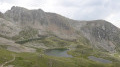
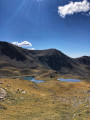
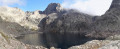
Summit of Gélas

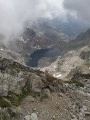
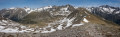
This route, which is closer to simple mountaineering than standard hiking, provides access to the highest peak in the Mercantour. From the summit, there is an exceptional panorama of the surrounding mountains and a view of the sea, stretching as far as Corsica on a clear day.
The proposed ascent is via the small pass Saint-Robert and the west-southwest ridge, descending via the northeast ridge and the Balcon du Gélas.

Details

135330
Creation:
Last update:
Last review:
  • Walking
    Activity: Walking
  • ↔
    Distance: 11.28 km
  • ◔
    Duration according to the author: 8 hrs 
  • ▲
    Difficulty: Extremely difficult

  • ⚐
    Back to start: Yes
  • ↗
    Ascent: + 1,424 m
  • ↘
    Descent: - 1,424 m

  • ▲
    Highest point: 3,119 m
  • ▼
    Lowest point: 1,900 m

Photos

Description of the walk

Please note: since Storm Alex, access to the Madone de Fenestre refuge is no longer possible, as the road is cut off 10 km earlier.

(S/E) From the Madone de Fenestre refuge, take the path towards Lac de Fenestre.
Pass the intersection (marker 368), keeping Lac de Fenestre on your right.

(1) At around 2000m, at a sharp bend with a large isolated rock, take a smaller, unmarked path to the right heading north-east. There is a start below and above the large rock: the two meet a little higher up.
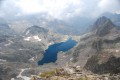
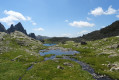
Cairns quickly mark the path. Follow them to Lac Mort (2527m), then Lac Blanc (2665m).

(2) From Lac Blanc, head north towards the small pass Saint-Robert (small snowfields may be present).

Climb via the small pass Saint-Robert and the west-southwest ridge:

(3) From there, put on your helmet as you are leaving the hiking area for a mixed climbing-hiking route. There is no longer a visible path and you have to choose the best possible route through the scree and along the ridge. It took us 2 hours to reach the summit, progressing very slowly. It should be possible to do better.

From the small pass, we spotted a yellow painted trail leading to the top (sometimes there is quite a distance between two marks, but you eventually find them again).
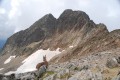
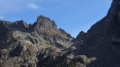
Cross a few metres onto the Italian side and climb straight up the face (a few metres of climbing) from the small pass, then continue climbing generally below the ridge on the north side until you reach a large basin (occupied by a huge snowfield when we passed through in mid-July, which is probably there all the time). From there, at around 3000m, join the ridge (staying to the right of the snowfield) and climb until you reach the foot of a copper-coloured rock couloir (you can see a bolt and a plaque). Keep to the right in the scree to climb (there are lots of yellow markings in this section) towards the summit. Once above the couloir, head left to reach the summit ridge and then (finally) the north summit.

Descent via the north-east ridge:

(4) This is the most technical part of the route and a rope may be useful to secure the passage.
From the summit, a clear path descends rapidly towards the normal route: do not take it! This is mountaineering requiring appropriate equipment, and rock falls are frequent.

Go around the Virgin and head north-east. Descend the ridge for about 50 metres to a small, obvious pass, then follow the ridge line that leads straight to the Balcon du Gélas. It doesn't seem obvious at first glance (no cairns or traces of passage), and it looks like you can't get through... but it is indeed possible! It's more like climbing than hiking here too (no falling allowed), but the rock is very good and there are handholds everywhere. It took us 2 hours to get there from the summit, again progressing very slowly.

(5) From the balcony, we are back in hiking mode and the path is clearly visible for the descent to Lac Blanc.

(6) Then, retrace your steps to reach the large isolated boulder and the official trail, and it's another half hour to reach the refuge (S/E).

Note following one of the comments: the couloir is a mountaineering route (the normal route up Gélas) requiring appropriate equipment and knowledge. The route we suggest does not go that way.

Waypoints

  1. S/E : km 0 - alt. 1,903 m - Madone de Fenestre Refuge
  2. 1 : km 1.92 - alt. 2,194 m - Large isolated boulder
  3. 2 : km 3.93 - alt. 2,639 m - Lac Blanc - Mercantour
  4. 3 : km 4.61 - alt. 2,831 m - small pass St-Robert
  5. 4 : km 5.48 - alt. 3,116 m - Cime du Gélas (3143m)
  6. 5 : km 5.95 - alt. 3,070 m - Balcony of Gélas
  7. 6 : km 7.31 - alt. 2,664 m - Source of the - Vésubie (rivière)
  8. S/E : km 11.28 - alt. 1,902 m - Madone de Fenestre Refuge

Notes

Parking at Madone de Fenestre, at the top. Departure above the CAF refuge.

Please note that the climb to Gélas is challenging with some climbing sections, which are simple (III max) but very exposed! A rope may be useful to secure your progress (no pitons or other equipment in place). Helmets are mandatory due to falling rocks! And of course, avoid this route in wet weather or if there is too much snow, making crampons and ice axes essential.

This route passes through a protected area, which may be subject to special regulations:

Worth a visit

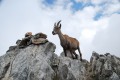
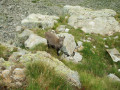
There are many ibexes at the summit and on the Balcon du Gélas, and a few chamois in the valleys below.

Reviews and comments

4.7 / 5
Based on 10 reviews

Reliability of the description
4.7 / 5
Ease of following the route
4.6 / 5
Route interest
5 / 5
OUF
OUF

Access road to the Madonne refuge closed from St Martin. Too much time and too many kilometres to complete the hike from St Martin in one day. Waiting for the access to reopen at the end of spring, I hope.

Machine-translated

LeoPetit
LeoPetit

Overall rating : 4.7 / 5

Date of your route : Jul 23, 2021
Reliability of the description : ★★★★★ Very good
Ease of following the route : ★★★★☆ Good
Route interest : ★★★★★ Very good
Very busy route : No

Important note: As the road leading to the refuge is closed to vehicles following Storm Alex in 2020, you will need to add a 10km walk between the parking point (you can park where the road is closed) and the refuge, making a total of 20km there and back. The route is a mixture of tarmac road and stony path. You can therefore either set off on a 15-hour trek (which is what I did) or spend a night at the refuge or in a bivouac.

For my part, I set off at 11 p.m. to avoid the potential heat, knowing that it would take 15-16 hours to complete the round trip, and travelling solo. If you climb at night, be careful of cows roaming free (I came across two, surprised to see a walker in their sleep). I don't know if there are any herding dogs, but assume there are. The night of the climb was chosen based on the weather and the almost full moon, in order to make the most of the natural light, which accompanied me throughout the approach walk, until the start of the small pass Saint-Robert (the moon being hidden by the ridge of the Pas Saint-Robert).
There were no problems during the entire approach, even at night. You will come across a sign prohibiting access to the path due to storm damage, but there is nothing to report until you leave this same path. After that, cairns make it easy to find your way. Sometimes there are several cairns and you have to rely on your instincts to find the best route, but they all lead to the same place. There are also some yellow markings, but many have been erased by time.

The start of the mountaineering approach is marked by a large yellow arrow pointing towards the small pass. Once again, you need to follow the cairns carefully, and when you reach the foot of the small pass, do not stick to the ridge on your left where the couloir is very unstable. Instead, take the route on the right, which has more green vegetation.
Once on the ridge, I was able to follow it almost entirely from below, despite the presence of a few snowfields, which will melt quickly. Only the last one forced me to go around it on the way up and over it on the way back.

The only major difficulty, despite ideal weather conditions, was a very strong southerly wind, which made the final ascent difficult as it blew sideways across the copper-coloured couloir. The wind chill factor was also low (-10/-15), so I was glad I had my mountain jacket and jumper in my rucksack, as I had climbed in just a T-shirt up to that point.
In this couloir, just follow the yellow/blue markings and follow your instincts. Make sure you pass to the right of the copper-coloured rocks. I then crossed into the north couloir (the markings point towards this couloir) to get some shelter from the wind, despite the steep incline (50°) and the fact that falling here would be even more dangerous than during the rest of the climb.

I reached the summit at around 7 a.m., after an 8-hour climb with few breaks. The wind was very strong, so I took shelter in the "niche" of rocks near the Madonna, after taking the time to appreciate the magnificent landscape that lay before me, in perfect solitude, under a blue sky. I allowed myself my first real rest and my first meal, all while huddled up. It was only 15-20 minutes into this break that I saw threatening clouds coming in from the north-west (despite having checked the weather forecast repeatedly before setting off and seeing no rain forecast).
So I quickly packed up and began to observe this passage towards the Gélas balcony, but not knowing the terrain, with the potential exposure to the wind, and especially the rain that arrived at breakneck speed but with no sign of clearing, I preferred to descend by the same route as I had ascended, because once I reached the WSW ridge I would be safe.

The descent was very difficult on wet rock, but the holds were still decent. There were a few rockfalls caused by the rain and wind, so a helmet was essential.
For the entire return trip, I followed the same route as on the way up, and fortunately the clouds lifted and the sun came out a little later, allowing me to warm my hands, which were cold (note to self: maybe it would be a good idea to bring a pair of gloves, even thin ones, next time).
A smooth return, a break for a second meal at the refuge, before continuing on to the car.

In terms of wildlife, you may encounter chamois, ibex and marmots (and cows on the first part). There are also a few small birds, but arachnophobes beware: if you're climbing at night, there are lots of spiders of all kinds on the rocks, and you'll see their eyes shining in the light of your head torch.

Machine-translated

Mar ousalka
Mar ousalka

Overall rating : 4.3 / 5

Date of your route : Sep 05, 2020
Reliability of the description : ★★★★☆ Good
Ease of following the route : ★★★★☆ Good
Route interest : ★★★★★ Very good
Very busy route : Yes

I wouldn't call it a hike, but rather a climb. You need to be equipped with a helmet and a rope, and above all, go with someone who already knows the site.
It's a long, physically demanding climb. We went up via the west ridge and came back down the same way because the couloir was too dangerous with so many people around, as there was a risk of getting hit on the head by a rock.
The view is splendid and the experience is thrilling. Be sure to check the weather conditions, as Gélas is often shrouded in mist.

Machine-translated

Jean-Philippe Rizzo
Jean-Philippe Rizzo

Overall rating : 4.7 / 5

Date of your route : Aug 22, 2020
Reliability of the description : ★★★★☆ Good
Ease of following the route : ★★★★★ Very good
Route interest : ★★★★★ Very good
Very busy route : No

Hello

We did this hike on Saturday, 22 August 2020.
We left the Refuge at 7 a.m. and arrived at... ; )
The day was indeed full of many twists and turns.
One of our friends dropped out at the exit of small pass Saint Robert, overcome by a fear of the surrounding void that was difficult to control. Another more experienced hiker felt the same way 150 metres from the summit. He had to be roped up to finish the hike.
Because of these factors, we were unable to descend via the balcony but had to return via the same route we had taken on the way up.

The hike is truly magnificent, but it is currently the most technical and exposed we have ever done. It is not suitable for people who are prone to vertigo, as it is difficult to descend once you have started.
I would classify it as extremely difficult, but I am only an average hiker.

Sportingly yours

Machine-translated

Gilm06
Gilm06

Overall rating : 5 / 5

Date of your route : Jul 27, 2020
Reliability of the description : ★★★★★ Very good
Ease of following the route : ★★★★★ Very good
Route interest : ★★★★★ Very good
Very busy route : No

Beautiful hike, beautiful climb, but the first part of the descent (the ridge) is very exposed, so you have to be extremely careful where you put your feet and hands—no slipping allowed.

Machine-translated

Miguel08
Miguel08

Overall rating : 4.7 / 5

Date of your route : Jun 24, 2020
Reliability of the description : ★★★★★ Very good
Ease of following the route : ★★★★☆ Good
Route interest : ★★★★★ Very good
Very busy route : Yes

With snow still present in mid-June, I stopped at the Terrasse du Gélas, where I could admire the frozen Lac Long. When there is snow, follow the cairns carefully to avoid the snowy sections if you want to avoid climbing/descending on hard snow that is sometimes soft. An ice axe and crampons are essential to reach the summit at this time of year.
Good weather, view of the sea: MAGNIFICENT!

Machine-translated

salomon3012
salomon3012

Overall rating : 5 / 5

Date of your route : Aug 06, 2018
Reliability of the description : ★★★★★ Very good
Ease of following the route : ★★★★★ Very good
Route interest : ★★★★★ Very good

Very beautiful hike.

Machine-translated

serge_ikonomoff
serge_ikonomoff

Overall rating : 5 / 5

Date of your route : Oct 02, 2017
Reliability of the description : ★★★★★ Very good
Ease of following the route : ★★★★★ Very good
Route interest : ★★★★★ Very good

I was only able to validate the description of the hike and the GPX track up to Lac Blanc at the foot of Gélas. The weather was too bad, so we didn't attempt the impossible. We settled for the Balcons du Gélas.

Up to Lac Blanc, the description and GPX track were perfect.

THANK YOU

Machine-translated

jackydecontes
jackydecontes

Overall rating : 4.3 / 5

Date of your route : Jul 15, 2017
Reliability of the description : ★★★★☆ Good
Ease of following the route : ★★★★☆ Good
Route interest : ★★★★★ Very good

You have to leave early in the morning, between 6 and 7 a.m. at the latest.
I climbed up to the balcony in 4 hours and 15 minutes and came back down in 3 hours.
I found this hike very challenging but doable for an average hiker like me.

From La Madone to Lac Blanc: 2 hours 45 minutes. It's a tough climb but it's okay, with a few tricky scree slopes to cross.
From Lac Blanc to the Balcon: 1 hour 30 minutes.
The first steep section is a huge scree slope with large rocks, which makes the climb more difficult.
The climb continues on a less steep slope with a crossing of a large snowfield.
The last steep section is almost on all fours in a large scree slope... You have to follow the cairns if you don't want to have to climb.

Once at the top, the view is magnificent, superb and grandiose. It's worth the effort, provided you arrive before the clouds roll in...

Machine-translated

Aurelmouth
Aurelmouth

Overall rating : 5 / 5

Date of your route : Aug 27, 2016
Reliability of the description : Not used / Not applicable
Ease of following the route : Not used / Not applicable
Route interest : ★★★★★ Very good

Climbed up to the Gelas balcony via the normal route.
It's a long and risky climb, but the view from the top is exceptional... We didn't climb to the summit because we didn't have helmets and there were quite a few people in the final corridor, and we could hear rocks falling...
It took us 5 hours to climb up from Madone de Fenestre and 3 hours to come back down.
It's really difficult, with little or no markings except for cairns, but there are some everywhere... Lots of elevation gain over a short distance, often on all fours... the further you go, the further away it gets... but once you reach the top...

Machine-translated

pagabard
pagabard

Overall rating : 5 / 5

Date of your route : Aug 30, 2015
Reliability of the description : ★★★★★ Very good
Ease of following the route : ★★★★★ Very good
Route interest : ★★★★★ Very good

I only went to the Balcon du Gelas and back. Magnificent view from the top.

Machine-translated

Other walks in the area

For more walks, use our search engine .

The GPS track and description are the property of this route's author. Please do not copy them without permission.