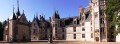
- Meillant Castle:
Like the sumptuous royal residences of the Loire Valley, this château has magnificently furnished rooms. The former cellar houses a surprising miniature discovery trail that recreates the setting of everyday life through the centuries. Meillant also has a magnificent English-style park.
- Saint Blaise Church in La Celle:
Dating from the 12th century, it is dedicated to Saint Blaise, patron saint of quarry workers and stonemasons. It is one of the most beautiful Romanesque monuments in the Cher department. The modillions and column capitals are very varied and the tomb of Saint Sylvain has been in this church since 1897.
- At the crossroads in the village of Bruère-Allichamps, a monumental stone marks the geographical centre of France.
- The Noirlac Bocage is classified as a Sensitive Natural Area and protects several species of flora and fauna.
- Noirlac Abbey:
Founded in 1150 by Cistercian monks, this abbey is located on the banks of the Cher. Today, it is a cultural centre and meeting place. It welcomes visitors curious to discover its history and architecture. It hosts many concerts.
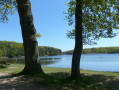
- The Lac de Virlay is a pleasant and peaceful place to take a break. Classified as a Natura 2000 site, the lake's shores are home to a variety of flora and fauna, including many rare and protected species.
- Saint-Amand-Montrond's history lies at the foot of a fortress and in the heart of a town centre with a remarkably well-preserved heritage. It is one of the treasures of the Jacques Cœur route, the oldest historic road in France. It was well after the French Revolution that the two towns of Saint-Amand Le Chastel and Saint-Amand sous Montrond merged to form Saint-Amand-Montrond.
- The Fortress of Montrond is the only bastioned fortification built in central France. Its origins date back to the 13th century. At the top of this military building, the view over the valley is breathtaking.
- Drevant is located on the right bank of the Cher and is home to a Gallo-Roman theatre. Its sanctuary and thermal baths bear witness to the importance of the city at that time.
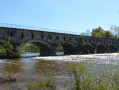
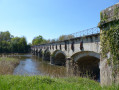
- The Canal de Berry crosses the Cher at a place called "La Tranchasse" via the canal bridge of the same name, built between 1829 and 1834 and widened in 1872. It is of historical, heritage and technical interest it is representative of the large masonry canal bridges built in France at that time and was the first canal bridge built in the Centre region.
It is 96 metres long with eight arches, 8 metres wide and the waterway is 5.5 metres wide. Since 15 April 2009, this canal bridge has been listed as a historic monument.
Saint-Amand-Colombiers International Karting Circuit
Beginners' and competition circuit
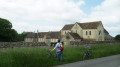
The manor house of La Salle in Colombiers dates mainly from the 15th and 17th centuries.
In Coust, the first thing you will see is the Château de Bonnais, dating from the late 15th century.
It is built on a square plan and has six towers, four of which are corner towers, one of which houses a dovecote.
The Ruisseau du Chignon stream rises in the castle moat, which it fed, as did the moat of the Château de Montrond.
Next, you will discover the Château du Creuzet, which dominates the Chignon valley. Construction of the rectangular keep began around 1530. This is the oldest part of the castle and stands 40 metres high.
The castle complex and the hamlet's farm were listed as Historic Monuments in 2014.
Carento Magus is the Gallic name for Charenton. In Gallo-Roman times, Carento-Magus was part of Aquitaine Première and was located in the territory of the Bituriges on the road between Avaricum and Bourbon.
In 620, the Abbey of Notre-Dame de Bellavaux de Charenton was built
In 1150, the lords of Charenton, who came from the powerful Déols family, founded the town of Saint-Amand le Chastel and the Abbey of Noirlac.
During the Fronde and the siege of the Fortress of Montrond, Charenton was occupied by royal troops and pillaged extensively. The town was left in ruins.
During the French Revolution, the abbey was dismantled and the commune of Charenton was attached to Berry.
Ainay le Château is a medieval town founded in the 12th century and protected by ramparts with 24 towers. Four gates allowed access to the town. All were equipped with drawbridges and portcullis. The clock gate is the only one that has been perfectly preserved. The Church of Saint-Étienne, which dominates the banks of the Sologne, was built in the 11th century and was subsequently transformed in the 16th and 17th centuries.
The Saint-Roch Chapel was built in 1641 to ward off the plague epidemic of 1621.
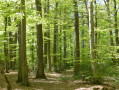
The Tronçais Forest is the largest oak forest in Europe. It also contains beech and hornbeam trees, which force the oak trees to grow ever higher in search of light.
Colbert, minister to King Louis XIV, keen to provide the Kingdom of France with a powerful navy, decided to plant more than a million hectares of trees, whose trunks and branches would provide the shipbuilding industry with high-quality raw materials.
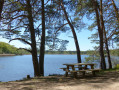
The Étang de Saint-Bonnet covers 45 hectares and is home to a leisure centre.



 Country:
 City:
City:



 Tourist office
 Easy
Easy  Visorando Member
