North-West loop of Sark

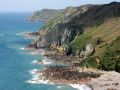
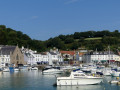
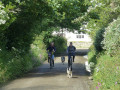
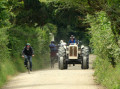
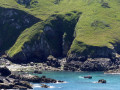
With an area of 5.5 km², 600 inhabitants and located 35 km off the Normandy coast, Sark is perched on a plateau surrounded by cliffs, 100 m above the sea. Motor vehicles, cars and two-wheelers are prohibited. Only tractors are allowed and the roads are unpaved. The only things you'll see are pedestrians, bicycles, horse-drawn carriages and tractors.
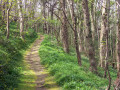
With its stunning coastal landscapes and unspoilt nature, it is a paradise for walkers and cyclists.

Details

56218540
Creation:
Last update:
Last review:
  • Walking
    Activity: Walking
  • ↔
    Distance: 10.46 km
  • ◔
    Average duration: 3h 50 
  • ▲
    Difficulty: Moderate

  • ⚐
    Back to start: Yes
  • ↗
    Ascent: + 292 m
  • ↘
    Descent: - 292 m

  • ▲
    Highest point: 105 m
  • ▼
    Lowest point: 14 m

Photos

Description of the walk

(S/E) Pass the square where the horse-drawn carriages wait for their customers and take the avenue opposite, where all the shops are located.

(1) As you leave the avenue, in the left-hand bend, walk past the Tourist Office to the nearby prison.
Return to the bend, where the road then turns right and, at the end, you will find the Manor, the first residence of the Lords.

(2) Pass the mill and, 200 m further on, at the crossroads, turn right, then immediately take the path on the left.
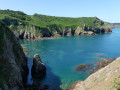
Pass the Beauregard duck pond and turn left at the fork. Continue for 400 m until you reach the Pilcher Monument. There is a beautiful view of Le Havre Gosselin and Îlot de Breqhou.

(3) Retrace your steps and do not turn right towards the duck pond, but continue straight ahead on the path to Gouliot Headland. The path begins to descend. At the tip, climb up a little to the left until you reach a junction with a larger path, which you follow up to the left. A first bench offers a nice view, then a second one before a gate.
(4) Go through the gate and follow this path across the field, passing another gate and continuing along the path to Port à La Jument Bay.
The path joins Rue du Sermon, at the Methodist church cemetery. Continue for another 250 m.

(5) Just before the stadium, go through the wooden gate on the left. The path leads to the Moinerie estate. Leave the Sercq dairy on your right to arrive at a cobbled street and, after a left turn, the hotel complex.
After the last houses, a short cobbled climb leads to a crossroads.

(6) Take the path on the right, going downhill alongside a building.

(7) At the buildings, continue straight ahead along a small path that descends into the woods. It joins a stream on the right, which you follow.

(8) Cross to the other side and follow the larger path on the left that descends from the right.
Just after this, a path descends to the left (a few steps), then a footbridge.
The path leads to a ridge.
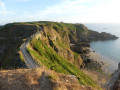
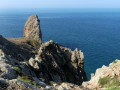
Continue to the fork and take the path going up to the left, continuing to climb zigzagging upwards. There are breathtaking views on both sides: Port à la Jument, Port du Moulin and Les Autelets (a series of pillars).

(9) Return by the same path and, after the footbridge, turn left towards Window-in-the-Rock.
Another, more complete viewpoint is just to the right as you leave.

(10) Return via the main path running alongside the stream on your right. At the main road, turn left towards L'Eperquerie.
(11) Take the path on the left, just before the gate. After 250 m, take the small path on the left, marked by a rock at the entrance, and descend for about 100 m to enjoy the superb view of Les Autelets and Dixcart Bay in front of you. Return to the starting point and descend on the left.
Follow the path and continue north towards the point. An engraved rock is located below a bench, which is itself below the turret.
The Buddhist engravings are behind the rock, facing the sea.
(12) Return by climbing up the path furthest to the left. Pass a cannon and continue climbing until you reach the barrier you crossed on the way there.

(11) Return to the main road and continue straight ahead until you reach the Seigneurie. The magnificent gardens are well worth a visit.

(13) Continue south on Rue de la Seigneurie, passing the Chief Pleas & Seneschal's Court (the local parliament) to arrive between the cemetery and St Peter's Church.

(14) Follow the road as it turns left off the church and enter the avenue, which you follow until you reach your destination (S/E).

Waypoints

  1. S/E : km 0 - alt. 95 m - Bicycle park after the horse-drawn carriage parking area
  2. 1 : km 0.38 - alt. 100 m - Prison
  3. 2 : km 0.79 - alt. 105 m - Mill
  4. 3 : km 1.85 - alt. 57 m - Pilcher Monument
  5. 4 : km 3.34 - alt. 89 m - Barrier
  6. 5 : km 4.36 - alt. 104 m - Walkway to La Moinerie
  7. 6 : km 4.96 - alt. 94 m - Crossroads
  8. 7 : km 5.06 - alt. 86 m - Small path downhill through the woods
  9. 8 : km 5.3 - alt. 66 m - Crossing to the other side
  10. 9 : km 5.53 - alt. 14 m - Port à la Jument
  11. 10 : km 5.76 - alt. 52 m - Window-in-the-Rock
  12. 11 : km 6.94 - alt. 86 m - L'Eperquerie
  13. 12 : km 8.08 - alt. 32 m - Buddhist Carving
  14. 13 : km 9.4 - alt. 99 m - The Lordship
  15. 14 : km 10 - alt. 105 m - Saint Peter's Church
  16. S/E : km 10.46 - alt. 95 m - Bicycle park after the horse-drawn carriage parking area

Notes

This hike takes you along paths, coastal trails and "roads" on Sark. Don't be put off by the word "road": there are no cars or scooters here. The roads are unpaved.

The island can be reached by boat from Guernsey all year round. Passports are required.

The local currency is the Guernsey pound. Sterling is also accepted. Please note that any local pounds you have left over will not be accepted in the United Kingdom.

The local language is English.

Sercq is part of the Bailiwick of Guernsey but retains its autonomy. The Lord of Sercq is appointed by the British Sovereign, as is the Bailiff of Guernsey. The island belongs to the Crown but not to the United Kingdom. Following a vote, the feudal system was replaced by a parliamentary monarchy in 2008.

Worth a visit

(1) Prison: rebuilt in thesecond half of the 19th century, it is still in use. Its two cells are used very rarely and mainly to sober up a few tourists. The stay cannot exceed two days. After that, the prisoner is transferred to Guernsey. Sark has two volunteer police officers: the gendarme and his vingtenier.

(2) The Old Mill: the highest point on Sark at 114 m. Until 2008 (when the island became a parliamentary monarchy), only the lord could own a mill, a dovecote and an unsterilised female dog.
The lord was the only person on the island legally authorised to grind grain and charged his tenants for the privilege of grinding theirs. The mill was used until the Second World War.

(3) Pilcher Monument: in memory of Captain Pilcher who sank with his crew in this channel separating Serck and Brecqhou: the Gouliot passage.

(6) La Moinerie: St Magloire, originally from Wales, became bishop of Dol-de-Bretagne before retiring to the island in 565 with 62 monks. They built a mill on the stream. The monastery remained active for several centuries before being pillaged by pirates.

(10) Window-in-the-Rock: in 1857, in order to develop the fledgling tourist industry, the Lord of Sark, W. T. Collings, had the rock cut away to open up a view of Port-du-Moulin and Les Autelets.

(12) Buddhist Carving: this stone was carved for the millennium by a Tibetan monk at the request of a lover of Sark. The inscription is a sacred Buddhist mantra, "Hail to the jewel in the heart of the lotus", and offers protection against evil.

(13) The Seigneurie: this has been the residence of the Lords of Sercq since 1675. Built on the site of the former priory of Saint-Magloire, the magnificent enclosed garden is well worth a visit.

(14) Chief Pleas & Seneschal's Court
This is the island's parliament. The 28 Chief Pleads have been elected by universal suffrage since 2008. The Seneschal is their president.
Sercq, the last feudal state in Europe until 2008, was founded by ElizabethI, who appointed the first Lord of the island, Helier de Carteret, in 1565 to protect the area from pirates.
Each year, the lord pays a rent of £1.79 to the British monarch. This amount has not increased since 1565.

Other walks in the area

For more walks, use our search engine .

The GPS track and description are the property of this route's author. Please do not copy them without permission.