Country:
 City:
City:


To get to the starting point, at Labarthe-sur-Lèze, at the D820 roundabout, head towards Clermont-le-Fort (D68E) and turn right a few metres later, towards La Riverotte. Park immediately afterwards in the car park between the two roads.
(S/E) Take the tarmac road towards the hamlet of La Riverotte. Pass between the two concrete bollards that mark the entrance to the neighbourhood (road reserved for residents and services), then, still on the tarmac road, turn left and enter the old neighbourhood of La Riverotte.
La Riverotte, in Occitan, means "little riverbank". This neighbourhood may have been named this way because most of the route you are about to follow is in an area at high risk of flooding (more than 1 m of water). This is why this old neighbourhood of Clermont is located at a safe distance from the river. You will arrive at a junction marked by a roundabout with greenery.
(1) Continue straight ahead. The roads leading off to the left and right (Chemin de Lombardel) represent the old imperial roads that linked Toulouse to Ariège. Following flooding, this road was moved and now forms part of the current four-lane road. The neighbourhood is built on a slight elevation but, as you can see from thesecond house on the left after the crossroads, it is not necessarily safe, as a marker indicating the 1875 flood is fixed to the façade at a height of 1 m (marker 2).
Reach an old car park, now blocked by rocks, and turn right through the opening in the rolling gate.
From there, and up to the start/finish car park, the route is marked in yellow and signposted (route created by the municipality of Clermont-le-Fort, with the help of Sicoval).
Follow the lake shore.
If you wish, you can sit down on the shore, which has a few open spots. If you are lucky, you may see ducks, a few wading birds, turtles, a nutria swimming, or a large black bass jumping, but only the view of the village is guaranteed, especially from the southern edge of the lake.
This lake is the remains of a former gravel pit (from the 1960s and 1970s) which exploited all the aggregate layers in the area.
At the end of the lake, you can continue along the bank for a few dozen metres to see the aquatic meadow that has been created and continues to expand. It is formed by water primrose, a problematic invasive plant.
Then leave the lake and walk along the cultivated plot of land that is part of the Confluences Garonne Ariège Nature Reserve until you return to the car park. Please follow the written instructions and do not leave the path (risk of a fine).
When you reach the riverbank, turn left and follow the bank to quickly reach the Clermont waterfalls.
(2) Although located within the reserve, access to the rocky outcrop jutting out into the river is tolerated.
Continue along the Ariège and you will reach a fenced-off area. Go around it on the left (site of an old mill, washed away by the flood of 1875) and continue on a fairly straight path until you reach a tarmac road (seriously damaged by the 2021 flood).
(3) Ignore this road, which leads to both a gravel pit and the Granhota water sports centre, and cross it to rejoin the grassy path opposite. This path runs alongside the road for a few metres then turns sharply left. Continue straight ahead through an old poplar grove. The path soon rejoins the bank of the Ariège, which you should follow until you reach the bridge.
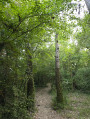
(4) Follow the marked path that turns left and leads to the car park, after crossing a pretty grove (S/E).

 Visorando Member
 Moderate