Circular Crésancey route via Noiron, Arsans and Champtonnay

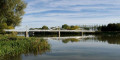
An easy walk around the village of Crésancey, leading along the Tenise and then through valleys and woods, to discover the churches and wash houses of Noiron, Arsans and then Champtonnay, before returning to Crésancey through the fields.
The villages you pass through are surrounded by magnificent natural landscapes such as beech woods, green hills, farmland and winding rivers.

Details

43094868
Creation:
Last update:
Last review:
  • Walking
    Activity: Walking
  • ↔
    Distance: 16.63 km
  • ◔
    Average duration: 5h 00 
  • ▲
    Difficulty: Moderate

  • ⚐
    Back to start: Yes
  • ↗
    Ascent: + 98 m
  • ↘
    Descent: - 98 m

  • ▲
    Highest point: 257 m
  • ▼
    Lowest point: 206 m
  • ⚐ Country: France
  • ⚐ City: Cresancey (70100)
  • ⚑
    Start/End: N 47.392165° / E 5.654674°
  • ❏
    IGN map(s): Ref. 3222E
  • Hour-by-hour weather

Description of the walk

Park along the side of Saint-Étienne Church in the centre of Cresancey. Several spaces on the grassy pavements on either side of Rue d’Onay.

(S/E) Start on the side of the church. Walk down to the left for 20 m, turn left and pass in front of the town hall, then keep to the right in front of the pretty castle and immediately turn left into Rue du Vieux Pont, along the castle grounds. Note the fountain-wash house on the right. Picnic area, opposite the wash house, to the left of the street. Cross the bridge over the Tenise.

(1) Carefully cross the D67, Route de Besançon, diagonally to take Rue de Noiron opposite. At the second junction, turn right then immediately left, slightly uphill, continuing past the Rougelot housing estate on the right. On the tarmac path, follow the sparse woodland on the left until you reach the three-way junction.

(2) At an altitude of 235, head straight into the woods. Plot signs are fixed on the right. Ignore the side paths. Follow the path through the forest, slightly uphill.
At plot 24, follow a good dirt track to a T-junction.

(3) Turn right at altitude 242, into an open woodland with conifers on the right and deciduous trees on the left. Leave the woodland. The path continues between the fields. A glimpse of Noiron Castle in the distance on the left.

(4) At the entrance to Noiron, at the crossroads, go straight on; further on, you’ll have a view of the rear of the château and its grounds. Retrace your steps back to the crossroads.

(4) Turn left onto the Grande Rue to reach the village centre. Pass the old well, the town hall and Saint-Pierre Church (worth a visit), continue along Rue de l’Église then turn left onto Rue Principale. Walk carefully for 400 m, first on the right-hand pavement, then keep to the safest verge of the road.

(5) At the left-hand bend, at an altitude of 207, turn right onto the path leading into the forest.
Follow the main path to a fork. Keep left. Shortly afterwards, go round the trees blocking the path on the right, along a small track. Continue straight on along the wide path. The trees in the forest are sparser; they are growing back. Pass a three-way junction where a large oak stands. Continue to the junction with a white track. Then turn right to its end, at a T-junction.

(6) Turn left onto a straight, well-maintained track, ignoring the side paths. Continue straight ahead until the main path turns right. At this point, continue straight on towards the open woodland. The path narrows through the brambles and descends slightly to the next T-junction.

(7) At an altitude of 226, facing the fields, turn left onto the path, Les Grandes Rasses, until you pass a playground at the entrance to Arsans (picnic spot).
At the next crossroads, turn right and cross a stream until you reach the war memorial in the square. Turn right to head for the old wash house in Arsans.

(8) Retrace your steps, continue straight on along Rue de la Fontaine, then turn right onto Rue de la Mairie to leave the village via the east and reach a crossroads.

(9) At altitude 226, at the Stop sign, carefully cross the D21 and take the tarmac road opposite through the fields. Follow the medium-voltage power line. Continue carefully along the road for 800 m until you reach the edge of the woods.

(10) At altitude 228, turn right to follow the edge of the woodland, keeping to the left, with a tricky 20-metre section due to forestry work. Join the path leading left into the woodland, near a viewing point. The track is clearly visible and continues straight ahead, with conifers on the left and deciduous trees on the right. Ignore the side paths until you reach a junction with a road. Cross the road and continue straight on, going round a wooden barrier. You will come to a T-junction.

(11) Turn left and then immediately right to pass between the Bois des Bersots and the Bois des Haies, until you reach their end. Then turn left, straight into the Bois des Bersots, pass close to the point with an altitude of 242, and follow a better-maintained path to the Y-junction in the middle of the fields.

(12) At the point with an altitude of 232, turn left towards the woodland. Inside the woodland, the path changes. Continue straight ahead to the crossroads of tracks, with the start of plot 81 on the right.

(13) Follow this plot 81 until it veers off to the left. Pass in front of a hunting lodge with its woodshed; the signpost is on the right. Join a tarmac road (there is a water tank on the right).

(14) Turn right onto this tarmac-surfaced local road which leads straight on to Champtonnay. You will reach the junction with the D67.

(15) Cross it carefully, keeping to the left and then immediately turning right onto the D177. Head towards the village, walking carefully on the safest verge. Cross the bridge over the Tenise.

(16) Walk past the wash house opposite the town hall. Saint-Médard Church is a little further on to the right (well worth a visit). Follow Rue de l’Église before turning left onto Grande Rue. Head right towards the cemetery.

(17) Leave the D177 and turn left onto a tarmac road. Take the first path on the left, before the woods. The white path leads through the fields to a place called La Charme, entering the outskirts of Cresancey (between two hedges of thuja trees).

(18) Turn left onto Rue de Velesmes, then take the first right onto Rue d’Onay. Continue straight ahead until you reach the car park and the Church of Saint-Étienne in Cresancey (S/E).

Waypoints

  1. S/E : km 0 - alt. 221 m - Église Saint-Étienne (Cresancey)
  2. 1 : km 0.24 - alt. 212 m - D67 junction - Tenise (rivière)
  3. 2 : km 0.97 - alt. 235 m - Junction of three tracks (elevation 235)
  4. 3 : km 1.81 - alt. 242 m - T-junction. Altitude 242
  5. 4 : km 2.62 - alt. 221 m - Noiron entrance. Turn-off (there and back) towards the - Château de Noiron
  6. 5 : km 3.48 - alt. 207 m - Leave the D21, turn right onto the path
  7. 6 : km 5.08 - alt. 231 m - T-junction, left onto track
  8. 7 : km 6.45 - alt. 224 m - T-junction, turn left. Elevation 226
  9. 8 : km 7.27 - alt. 218 m - Arsans wash house (there and back)
  10. 9 : km 7.53 - alt. 226 m - D21 junction
  11. 10 : km 8.34 - alt. 227 m - Edge of the woods, on the right
  12. 11 : km 9.17 - alt. 247 m - Left-right
  13. 12 : km 10.93 - alt. 232 m - Y-junction. Elevation 232
  14. 13 : km 11.92 - alt. 254 m - Route 81, turn right, path
  15. 14 : km 12.48 - alt. 250 m - Local road, on the right
  16. 15 : km 13.52 - alt. 220 m - D67 junction. Left-right
  17. 16 : km 14.04 - alt. 215 m - Champtonnay – Wash house and town hall
  18. 17 : km 14.35 - alt. 224 m - Cemetery, on the left along the path
  19. 18 : km 16.31 - alt. 230 m - Entrance to Crésancey. Left-right
  20. S/E : km 16.63 - alt. 221 m - Saint-Étienne Church in Crésancey

Notes

Picnics are possible in Crésancey, opposite the wash house fountain: table and benches behind the park wall.

South entrance to Arsans: two benches on the pétanque, basketball and football pitch, ideal for a picnic break.

Champtonnay, a few pleasant spots for picnics by the banks of the Tenise.

There are many sections through woodland; use walking poles if it rains.

Worth a visit

Crésancey: may derive from the word ‘creuse’, a pre-Latin term adopted into the Romance languages, which may have referred to the valley (as in Le Creusot in Burgundy).
Saint-Étienne Church
It is dedicated to Saint Stephen, built in the 18th century, with its Comtois bell tower featuring an imperial-style spire, and contains a large 17th-century gilded and carved wooden altarpiece, altarpieces of Our Lady of the Rosary and Saint Sebastian, paintings including a work depicting the Holy Family and Saint John the Baptist, 18th-century furnishings, and numerous ancient tombstones. In front of the church, the small wrought-iron cross also dates from the 18th century.
Cresancey Castle
Cresancey Castle was rebuilt in the 19th century. A medieval tower can still be seen there, however. (This castle is private property and is not open to the public).
Fountain and wash house
A covered fountain with a table and benches outside, ideal for a picnic. Located at the entrance to the village, near the small bridge.

Noiron: The first written records of the village’s name appear in the 12th century under the spellings ‘Neront – Nocront – Noyront’, but the name was first spelled as we know it today in 1329.
The castle (17th century) was restored in 2010/2011.
An oldwell with a pulley system in front of the town hall.
An 18th-centurychurch in the centre of the cemetery, along with a few old houses that bear witness to the village’s past.

Arsans: The name Arsans is thought to be of Germanic origin.
The village grew up around a barn owned by Corneux Abbey, but was never a parish; it has always been attached to the church at Lieucourt.
There is no church, but there is a wayside cross at the eastern edge of the village.
The old wash house, decorated with a nativity scene at Christmas time.

Champtonnay:
The fountain-washhouse. To replace the old fountain, which was no longer suitable as its location was flooded by the rising waters of the river running alongside it, it was decided in 1860 to build a new fountain-washhouse. A spring capable of supplying the necessary water was discovered at a place known as Le Vésignoz. It was channelled in 1862, over a distance of nine hundred and seventy-five metres.
In the meantime, the contract for the construction of the fountain was awarded on 5 March 1863. It was accepted on 15 May 1866 by the architect Maillot of Fouvent-le-Haut.
Despite the quality of the stone used, frost damage, particularly during the winter of 1879–1880, caused deterioration to the public drinking trough. The town council deliberated and decided to remove the old troughs and replace them with new cast-iron ones. The central section would form a semicircle and the two side sections would be straight. This is how they remain to this day.

The church and its 18th-century bell tower with an imperial-style spire, more ornate than that of Noiron. Well worth a visit.

To the south-west of the village, the Champtonnay Tile Works was built by royal decree of 19 February 1839, at a place known as Les Vendues, on the edge of the road linking Gray to Besançon. Production included tiles, bricks and floor tiles, as well as lime, sourced from a local quarry. Operations ceased in 1922, with the Dubois family being the last operators. It has been listed in the supplementary inventory of historic monuments since 1993.

To the south of the village, following the course of the Tenise just after the small stone bridge towards the ponds (private and fenced off), one can see on the right the ruins on the site of a castle.
Already mentioned in 1267 in the will of Aymon de Chantonnay, who bequeathed it to his son before setting off on the Eighth Crusade, this castle was owned by great and powerful figures such as the Perrenot de Granvelle family, the La Baume-Saint-Amour family, and finally Claude-Antoine-Clériadus, Marquis de Choiseul-Beaupré, known as de Choiseul-La Baume. This immense building — the ruins of which appear on the Napoleonic land register — was used as a quarry during the Revolution. All that remains today is a half-ruined tower known as the ‘Tour de la Chapelle’ and part of the outer bailey’s ramparts, which have been converted into housing and farm buildings.

Reviews and comments

4.7 / 5
Based on 5 reviews

Reliability of the description
5 / 5
Ease of following the route
4.8 / 5
Route interest
4.2 / 5
Caroline Sennecey Rando

Overall rating : 5 / 5

Date of your route : Mar 08, 2026
Reliability of the description : ★★★★★ Very good
Ease of following the route : ★★★★★ Very good
Route interest : ★★★★★ Very good
Very busy route : No

Recognition of this hike in very good weather.
Very detailed route map.

Very interesting villages passed through, beautiful monuments
Beautiful views

I recommend

Details:
Between points 11 and 12, at the right-hand corner, the path is "blocked" by posts and straps (roadworks) but is still accessible. At the tree marked 56

Point 13: Turn right between plots 80 and 81

Machine-translated

Sosso70
Sosso70

Overall rating : 5 / 5

Date of your route : Mar 21, 2025
Reliability of the description : ★★★★★ Very good
Ease of following the route : ★★★★★ Very good
Route interest : ★★★★★ Very good
Very busy route : No

This walk was very pleasant, despite a few sections along less pleasant roads. If I do this walk again (it could be brilliant in the autumn), I’d start from Champtonnay so that I cover the longest stretches of those less pleasant roads and farm tracks at the start of the walk.
The woodland was truly beautiful.

Machine-translated

PRAOM Annie
PRAOM Annie

Overall rating : 4.7 / 5

Date of your route : Sep 02, 2024
Reliability of the description : ★★★★★ Very good
Ease of following the route : ★★★★★ Very good
Route interest : ★★★★☆ Good
Very busy route : No

A lovely, easy walk with some really charming little villages. The comments are interesting.
The only downside: the 300m stretch before point 7, which is tricky due to the brambles and overgrown vegetation making the path difficult to navigate. If you’re in a group, you can take a slight detour along easier paths.
Thank you.

Machine-translated

camino70
camino70

Overall rating : 4.7 / 5

Date of your route : Jun 14, 2024
Reliability of the description : ★★★★★ Very good
Ease of following the route : ★★★★★ Very good
Route interest : ★★★★☆ Good
Very busy route : No

An easy walk linking peaceful little villages with interesting heritage sites, all clearly described in the introduction. The paths wind through woods and farmland, with a few sections featuring tall grass and brambles. Thank you, MaLau, for sharing this well-documented route.

Machine-translated

cuzcodom
cuzcodom

Overall rating : 4 / 5

Date of your route : Mar 31, 2024
Reliability of the description : ★★★★★ Very good
Ease of following the route : ★★★★☆ Good
Route interest : ★★★☆☆ Average
Very busy route : No

A really lovely, varied walk through woods and fields.
We particularly enjoyed the cultural commentary.
I do have a slight doubt about the choice of path running alongside the Bois des Haies: with all the signs saying ‘private woodland’ and ‘no trespassing under penalty of prosecution’, I wonder if it might not be better at point 11 to go a little further into the Bois des Bersots and take the parallel path, thereby avoiding these ever-so-welcoming folk...
In any case, my warmest congratulations to the author.

Machine-translated

Other walks in the area

For more walks, use our search engine .

The GPS track and description are the property of this route's author. Please do not copy them without permission.