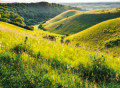
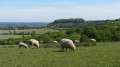
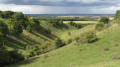
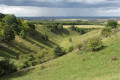
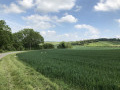
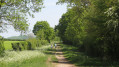
Barton and Pegsdon Hills, Chilterns

A walk through two of the finest nature reserves in the North Chilterns linked by the ancient Icknield Way track. Fine views and a wealth of natural interest.

Details

23918928
Creation:
Last update:
Last review:
  • Walking
    Activity: Walking
  • ↔
    Distance: 13.34 km
  • ◔
    Average duration: 4h 10 
  • ▲
    Difficulty: Moderate

  • ⚐
    Back to start: Yes
  • ↗
    Ascent: + 132 m
  • ↘
    Descent: - 133 m

  • ▲
    Highest point: 185 m
  • ▼
    Lowest point: 68 m

Photos

Description of the walk

Start : Barton le Clay Church. Postcode : MK 45 4LA. Grid ref : TL 084 304 (51.96158; -0.42215)

(S/E) From the church head uphill on Church Road and in 200m turn left onto a bridleway that leads to the Barton Hills.

(1) Leave the bridleway at the field corner, heading up through a gate into the Barton Hills Nature Reserve. Follow a Permissive Path, taking the steepest route up the ridge using steps in places. At the top (2), the path continues southwards with the fence line on the left and the hillside dropping away steeply to the right.

After 800m you come beside a track over the fence but do not go onto it. In a further 200m turn right (westwards) staying on the edge of the hill.

(3) In 450m enter a small thicket, then keep left at a path up from the bottom. In 10m you leave the reserve and turn left, heading south along the remains of a hedgeline. After 800m turn left onto the LilleyStreatley Road and then, after 100m, turn right onto a bridleway continuing southwards with the hedge on the left side.

(4) After 900m you come to a wood (Maulden Firs) and meet a crossroads. Turn left to join the ancient track of the Icknield Way. (5)

When you meet a road continue straight ahead, walking on the path on the left hand verge, taking care to look for traffic. After 500m, as the road bends left, keep straight ahead on the Icknield Way byway. After 800m you come to a junction of paths near Hoo Bit.

(6) At the junction of paths stay on the same path, following the Icknield Way on a gentle incline through a grove of beeches. At the top of the climb, continue on the Ickneld Way for a further 200m and you will find a footpath left through a wooden kissing gate into the Pegsdon Hills Nature Reserve. You will see an interpretation board near the gate.

(7) Go into the reserve (8) and straight ahead to a fence corner. Follow the footpath left of the fence. The path descends initially above a steep-sided coomb and then across open ground to the B655 at Pegsdon,
Cross straight over the B655 and take the road ahead of you to the village.

(9) 200m after crossing the B655 you reach a right turn on to Pegsdon Way. You can turn right to visit the Live and Let Live pub or continue straight on to return to Barton.

(10) You soon reach a left turn that passes between two former farms. Continue past the farms on to a bridleway bearing rightwards to trees where the path turns right. 100m after this, turn left following the John Bunyan Trail past The Mill and across a stream. The bridleway becomes a lane. Follow it as it turns left to reach Hexton.

(11) Walking southwards through Hexton you’ll come to a road junction just before The Raven pub. Turn right here and walk along the road for a couple of hundred metres to a footpath that goes diagonally left across the field on the left immediately after the cricket ground.

Cross a stream by some trees. Now the path heads almost directly West (apart from some small zigzags) for 2km of easy walking to Barton le Clay.

(12) Keep left of the hedge as you near Barton. Turn left then bear right over a footbridge. The path then turns right and passes between houses to Manor Road

(13) Turn left on to Manor Road. At Hexton Road (B655) turn right and shortly after left, crossing the road in to Church Road to return to the Church. (S/E)

Waypoints

  1. S/E : km 0 - alt. 81 m - Barton le Clay Church
  2. 1 : km 0.38 - alt. 90 m - Barton Hills Nature Reserve
  3. 2 : km 0.89 - alt. 144 m - Barton Hills - Barton Hills
  4. 3 : km 1.74 - alt. 155 m - Small thicket
  5. 4 : km 3.8 - alt. 157 m - Maulden Firs
  6. 5 : km 4.27 - alt. 149 m - Icknield Way - Icknield Way
  7. 6 : km 6.2 - alt. 157 m - Junction of bridleways
  8. 7 : km 6.82 - alt. 178 m - Interpretation board
  9. 8 : km 7.03 - alt. 173 m - Pegsdon Hills Nature Reserve - Pegsdon Hills Nature Reserve
  10. 9 : km 8.25 - alt. 81 m - B655
  11. 10 : km 8.52 - alt. 72 m - Two former farms
  12. 11 : km 10.35 - alt. 77 m - Hexton
  13. 12 : km 12.26 - alt. 68 m - Hedge
  14. 13 : km 12.72 - alt. 73 m - Manor Road
  15. S/E : km 13.34 - alt. 80 m - Barton le Clay Church

Notes

A walk through two of the finest nature reserves in the North Chilterns linked by the ancient Icknield Way track. Delightful walking, often on hills reminiscent of the South Downs.

Terrain: There is a fair bit of ascent and descent and in places the ground can be slippery in wet weather, but good paths and waymarking make the route finding easy.

Start: Barton le Clay Church (limited parking). Postcode : MK 45 4LA. Grid ref : TL 084 304 (51.96158; -0.42215)

Food and Drink: You can enjoy food and refreshments at "The View" pub in Pegsdon and the Raven in Hexton. There are also pubs and shops in Barton.

Parking: Parking is possible in a variety of locations in Barton free of charge, including limited parking near to the church.

Local Transport: Buses MK1 (Stagecoach /Luton or Bedford) and 79 (Centrebus/Luton or Meppershall) stop in Barton.

Map: OS explorer 193

From Barton to Pegsdon this walk uses the North Chiltern Trail - a 42 mile walk created and waymarked by the Chiltern Society in 2014. [A guide to the trail can be purchased from the Chiltern Society here.
|https://chilternsociety.org.uk/shop/]

We hope you have enjoyed your walk. Please remember to rate the walk and add comments. We are interested in how we could improve the instructions or the route and would like to hear about any issues with paths on the walk.
To find out more please visit Chiltern Society website here.

Worth a visit

(2) Barton Hills
Designated a Site of special Scientific Interest, the Barton Hills contain a wonderful variety of orchids and other flowers typical of chalk grassland, a wealth of butterflies both common and rare, buzzards, red kite and small mammals. Look carefully and you might find the pasque flower, which flowers between late April and early June. The reserve also includes some important beech and ash/maple woodland, with significant numbers of large-leaved lime. The woodlands provide some stunning autumn colours.
At the base of the hills are some delightful springs which once fed local watercress beds, and which are well-worth seeking out. John Bunyan described the hills as his ‘delectable mountains’, and while his use of the word ‘mountain’ is open to some debate, the word delectable seems most apt.
There are extensive views to the north encompassing most of the Central Bedfordshire Greensand ridge. At the west end is Woburn Park (a radio mast is just visible); in the middle (northwards) is Ampthill and Flitwick and at the east end is Sandy Heath with its TV transmitter.

(5) Icknield Way
The Icknield Way is one of the oldest tracks in England and possibly our oldest road. Extending from East Anglia to the West Country, the route stays on the chalk, clear of the clay strata to the north west which could become very sticky in wet weather prior to the introduction of surfaced roads. Generally, it is located below the scarp of the chalk where the weather is more clement. It is one of the four ancient highways of England mentioned by Geoffrey of Monmouth. First used in Neolithic times by flint traders, it’s now a 195km / 120 mile long distance path.

(7) Pegsdon Hills Nature Reserve
A Chiltern gem, the Pegsdon Hills offers some of the best views in the area. The steep chalk hills and secluded valleys are full of wildlife, with splendid displays of orchids, numerous species of butterfly and lots of nesting birds including lapwings and buzzards. Spring highlights include the rare dingy and grizzled skipper butterflies and moschatel (also called town hall clock, due to the arrangement of it’s flowers). The summer flora is outstanding, with herbs such as wild thyme, marjoram and wild basil and a huge range of plants typifying the variety to be found on chalk hills, including the pasque flower. After dark you might see glow-worms and bats flying overhead and fallow deer are also seen. You might spot the previously cultivated terraces, called strip lynchets, which provide clear evidence of an ancient settlement.

Reviews and comments

4.7 / 5
Based on 1 review

Reliability of the description
5 / 5
Ease of following the route
5 / 5
Route interest
4 / 5
Julien VR
Julien VR ★

Hi!
Thanks for taking the time to rate and review.
I’m happy to hear that you had a nice time. =)
Kind regards,
Julien

Content Manager & User support

User 24901829

Overall rating : 4.7 / 5

Date of your route : May 15, 2025
Reliability of the description : ★★★★★ Very good
Ease of following the route : ★★★★★ Very good
Route interest : ★★★★☆ Good
Very busy route : No

Some fine views and virtually no ugly bits. The pub at Hexton is great for lunch- it was busy, which was nice to see.

Other walks in the area

For more walks, use our search engine .

The GPS track and description are the property of this route's author. Please do not copy them without permission.