Around Le Roeulx

A relaxing stroll in and around the town of Le Roeulx.

Details

497269
Creation:
Last update:
Last review:
  • Walking
    Activity: Walking
  • ↔
    Distance: 5.84 mi
  • ◔
    Average duration: 2h 45 
  • ▲
    Difficulty: Easy

  • ⚐
    Back to start: Yes
  • ↗
    Ascent: + 102 ft
  • ↘
    Descent: - 102 ft

  • ▲
    Highest point: 528 ft
  • ▼
    Lowest point: 397 ft

Description of the walk

Parking at the Grand Place in Le Roeulx

(S/E) Opposite the Town Hall, head to the right, towards the narrowest part of the Grand Place, and walk past the buildings of the former Saint-Jacques Hospital on your right.

(1) Continue straight on to the next T-junction just before a block of flats.

(2) Turn left onto Rue de la Liberté. At the junction with Rue de la Victoire, take the path opposite and slightly to the left that crosses the fields, the Chemin des Charognes. At the end of the path, turn left into Rue des Huit Bonniers. At the junction with Rue d’Houdeng, turn left. At the junction with the traffic lights, cross to the other side of the road and turn left towards the Saint-Feuillien brewery.

(3) In front of the brewery building, turn right onto Rue Courte. At the junction with Rue Paul Janson, cross over and continue straight ahead. Turn left at the T-junction onto Rue Léon Mabille, heading towards Square Mabille. In front of the square, go round it on the right. At the junction with Rue des Arbalestriers, turn left and then right at the T-junction at the end of the street into Rue Sainte-Gertrude.

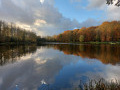
(4) At the end of this street, turn right onto Rue de la Station. At the Y-junction, turn right onto Faubourg de Mignault and at the next Fork in the road, continue left until you reach the edge of the Bois de la Haye du Roeulx. At the edge of the woods, take the path on the left which crosses through the woods. At the T-junction, continue left along the forest path leading towards the Grand Étang. At the junction by the Grand Étang, continue straight on until you reach a T-junction.

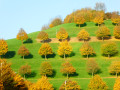
(5) Turn left and follow the tree-lined lane. At the junction at the edge of the woods, turn right. At the T-junction, turn right onto the Drève du Petit Château. At the junction with Rue des Écaussines, turn left and continue to the junction with Chaussée de Soignies.

(6) Cross the Chaussée de Soignies and continue straight on towards the Bois Saint-Joseph. Cross the Bois de Saint-Joseph. At the junction with Rue de la Reine, go straight on along the path that crosses the fields. At the Y-junction, turn left onto Rue de la Renardise. Continue straight on. At the junction, turn right and continue straight on.

(7) At the junction with Chaussée de Mons, turn left towards Place de la Tannée and continue on the left-hand side of the church. Head towards the flowerbed with the two lime trees and continue straight on towards Rue Verte.

(8) On Place du Château, turn left onto Rue Nivelloise and use the pedestrian crossing to get to the other side of the street. Turn right onto Rue Albert 1er and continue towards Square Léon Mabille.

(9) At the square, turn right and then, at the junction, turn right onto Rue de l’Ange-Gardien. At the junction with traffic lights, cross Rue Paul Janson and take Rue Émile Vandervelde opposite. At the end of the street, at the junction, turn left onto Rue Grande to reach the Grand Place (S/E).

Waypoints

  1. S/E : mi 0 - alt. 427 ft - Grand Place
  2. 1 : mi 0.07 - alt. 436 ft - The former Saint-Jacques Hospital building
  3. 2 : mi 0.18 - alt. 413 ft - Junction of Faubourg de Binche and Rue de la Liberté
  4. 3 : mi 0.75 - alt. 430 ft - Saint-Feuillien Brewery
  5. 4 : mi 1.21 - alt. 446 ft - Junction of Rue Sainte-Gertrude and Rue de la Station
  6. 5 : mi 2.47 - alt. 456 ft - Tree-lined avenue, on the left
  7. 6 : mi 3.56 - alt. 486 ft - Montauban
  8. 7 : mi 5.06 - alt. 397 ft - Place de la Tannée and Saint-Nicolas Church
  9. 8 : mi 5.3 - alt. 440 ft - Castle of the Princes of Croÿ
  10. 9 : mi 5.49 - alt. 436 ft - Square Léon Mabille
  11. S/E : mi 5.84 - alt. 427 ft - Grand Place

Notes

All the tourist information featured along the route is available from the Rœulx Tourist Office. Website: Rœulx Tourist Office.

Worth a visit

(S/E) Grand Place. The Town Hall: dating from 1862, it replaced the ‘Maison de la Paix’ which stood on the left-hand corner of the Grand Place (now a estate agency). The façade is heavily inspired by the central section of the castle: six windows, a triangular pediment, and a balcony with a balustrade. Until 2006, it housed the magistrates’ court, hence the words ‘peace – justice – law’ engraved on the pediment. It features a clock whose mechanism was designed by Prince Emmanuel de Croÿ in 1864
Opposite, at number 28, stands the Maison Saint-Nicolas (1745), which was once an inn with guest rooms, ‘stables’ and a ‘grainguette’. The entrance door features a niche containing a statuette of the saint. The garden at the rear of the building is the Jardin de la Ramée, which boasts many remarkable trees.

(1) Former Saint-Jacques Hospital. Former Saint-Jacques Hospital. Around the year 1202, during the period of the Crusades. Before setting off for the East at the Pope’s behest, Baudouin, bailiff of Le Roeulx, entrusted his property to Eustache, Lord of Le Roeulx, so that it might be turned into a hospital to care for the town’s poor and pilgrims setting out for Santiago de Compostela. For the first four centuries, the running of the hospital was entrusted to lay people, nuns and hospitaller brothers. They were responsible for reception, care and administration. On 25 April 1622, the running of the hospital was entrusted to four Augustinian sisters from Ath. They set about rebuilding the hospital and the chapel and founded a school for girls. The hospital’s entrance door is decorated with a bas-relief of St James standing above a burning heart surrounded by the word ‘charitas’. The choir of the Gothic chapel dates back to the 16th century. One of the rooms adjoining the chapel allowed the sick to attend services without risk of infection. Opposite this building, the sisters built the Saint-Joseph Institute.

(3) Saint-Feuillien Brewery. Founded in 1873 by Stéphanie Friart. In 1920, the brewery moved into its current premises, which date from 1893. In recent years, these have undergone significant alterations with the construction of two brewing halls. The fifth generation of brewers still owns the establishment. A wide range of beers is brewed there, including St-Feuillien, Grisette, Grand Cru and two organic beers. Visits without booking every Saturday at 2.00 pm and Sunday at 10.30 am. Website http://www.st-feuillien.com/

(6) Montauban site. One of the highest points in Hainaut, rising to just over 150 metres.
The name ‘Montauban’ comes from ‘mont aux banalités’ or ‘mont aux banaux’. In the French feudal system, ‘banalités’ or ‘banaux’ were technical facilities that the lord was obliged to maintain and make available to all inhabitants of the seigneury. In return, the inhabitants of this seigneury could only use these seigneurial facilities in exchange for a fee payable to the lord.

(7) Place de la Tannée and Saint-Nicolas Church. Place de la Tannée is so named to recall that two tanneries were in operation in the 1850s.
Saint-Nicolas Church. The first church dates back to 1181; it was the abbot of Saint-Feuillien Abbey who was in charge of the services. It was burnt down in 1400 and destroyed by storms in 1581 and 1606. On 27 June 1706, on the day of the ‘karmesse’, a massive fire ravaged the town from the Grand Place to the church square. The blaze was so intense that the church bells melted and the molten metal could be seen on the ruined bell tower. Reconstruction began in 1716 and was completed in 1733. In 1837, following the church’s enlargement, the cemetery was moved outside the town. The church was demolished and rebuilt in 1869. It is in the Neo-Gothic style. The bell tower rises to a height of 75 metres. Five bells are installed: Adélaïde and Constance (1818), Léopoldine, Magdelain and Louise in 1871.

(8) Château des Princes de Croÿ. It was in gratitude for services rendered that Antoine de Croÿ, who was Grand Chamberlain to Philip the Good, Duke of Burgundy, received the estate of Le Roeulx from Jacqueline of Bavaria in 1433. Since then, the de Croÿ family has always occupied the château.

(9) Léon Mabille Square. Created in the early 1900s on the initiative of Léon Mabille, mayor of Le Roeulx from 1903 to 1922. It is surrounded by stone bollards taken from the Grand Place. There are also two commemorative plaques here, honouring young members of the Resistance who died on 4 September 1944 whilst setting an ambush for retreating German troops.

Other walks in the area

For more walks, use our search engine .

The GPS track and description are the property of this route's author. Please do not copy them without permission.