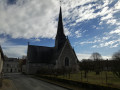
Circular in the Colombian countryside

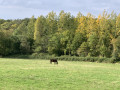
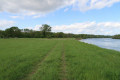
A beautiful circular route to discover the habitat and nature around Villandry, through the highlands and along the banks of the Cher, with the option of visiting the confluence of the Cher and the Loire and, if you have time, the gardens and the château. The village was called Colombiers in the Middle Ages: the name of its inhabitants remains as a reminder!

Details

166104
Creation:
Last update:
Last review:
  • Walking
    Activity: Walking
  • ↔
    Distance: 15.08 km
  • ◔
    Average duration: 4h 30 
  • ▲
    Difficulty: Moderate

  • ⚐
    Back to start: Yes
  • ↗
    Ascent: + 71 m
  • ↘
    Descent: - 72 m

  • ▲
    Highest point: 92 m
  • ▼
    Lowest point: 40 m
  • ⚐ Country: France
  • ⚐ District: Villandry (37510)
  • ⚑
    Start/End: N 47.341019° / E 0.510756°
  • ❏
    IGN map(s): Ref. 1723ET, 1822O, 1822SB, 1823SB
  • Hour-by-hour weather

Description of the walk

Access: park in the village of Villandry, near the tourist office or in the castle car park, on the edge of the D7. In summer, when it is very busy, a good alternative is to leave your car near the cemetery (1), as the route passes by there anyway.
This route is only partially signposted

(S/E) From the tourist office, cross the D7 and walk up into the village. Pass in front of the church and continue straight on towards the cemetery on the D121. At a crossroads, look out for the red and white markings ofthe GR®®3coming from the left. Follow these markings until further notice. Shortly afterwards, you will arrive at the cemetery.

(1) After the cemetery, turn right into a small street that leads to the Racoupeau housing estate. At the end of the estate, where the tarmac road ends, take a wide path on the right, then turn left at the next intersection. The path passes between fields and joins a road.

(2) Leave theGR®® trail on your left and continue straight ahead on this road until you reach Huberdière. Then turn right to cross Houssat. At the exit of this hamlet, find the D321 and take it to the right.

(3) Cross the A85 motorway via a bridge. After the bridge, continue straight ahead on the D321, which crosses through a wood. Further on, you will come to a wide path marked GR®®.

(4) Take this path on the left. At the fork, turn right, then join another road and turn right, following theGR®® markings. Immediately after, at the intersection, ignore theGR®® markings going straight ahead and turn right.

(5) Cross the hamlet of Vallée du Vau. Continue to the junction with the D321.

(6) Turn right, then go up to the junction with the path marked by theGR®® you took earlier to descend into the Vallée du Vau.

(4) Turn left and walk through the undergrowth. Join a road near a small house called La Robichère.
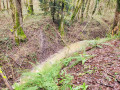
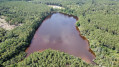
(7) Continue straight ahead on this road, following theGR®® markings. Pass close to a pond. Further on, the road turns left. Continue straight ahead on a wide path through the woods, still following theGR®®. After a steeper climb, you will come out onto a road.
(8) Continue straight ahead and cross the bridge over the motorway. Then continue straight ahead on a wide path through the fields. Further on, you will reach a road. Leave theGR®® markings that turn right and turn left. At the next intersection, near a riding club, turn left onto a road that descends to the D7 at a place called Les Caves d'Amont.

(9) Follow the road to the right (caution: busy road). After about 30 metres, at a cave restaurant, cross the D7 with caution and follow the small road that leads straight to wooden houses on the banks of the Vieux Cher. Turn left with the road, then turn right to cross the Vieux Cher over a bridge.

(10). After the bridge, leave the road on the left and take a wide path on the right. At the next intersection, ignore the path on the left and continue until you reach a riding centre.
(11) Continue straight ahead, ignoring first a path on the right that crosses the Vieux Cher, then a path that branches off to the left. The path turns into a small tarmac road that crosses the hamlets of Port Baudin and then Le Barrage. At the dam, near Villa Desmarais, ignore the road that branches off to the left and continue straight ahead. The tarmac gives way to cobblestones (you are now on a dam built around 1770).

(12) At the intersection, turn right.

(13) At the next intersection, turn right again for a round trip on a levee, a road built on a dyke through areas that flood in winter. This road is called the Levée de Travers. Pass by a group of two houses. Continue to the D7 at a place called Bellivier.

(14) Turn back to the cobblestones.

(13) Turn right, then left at the three-way junction. Return to the village of Villandry via the Cher river levee, on the Loire à Vélo cycle route (take care). Pass a riding centre, then arrive at a three-way junction marked with a cross.

(15) Leave the Loire à Vélo cycle route (no cars allowed) opposite and turn right. Continue straight on towards the village. You will soon arrive at the tourist office (S/E).

If you have time, why not visit the gardens and the castle?

Waypoints

  1. S/E : km 0 - alt. 43 m - Car park near the tourist office. - Château de Villandry
  2. 1 : km 0.76 - alt. 83 m - Intersection - Cemetery
  3. 2 : km 2.17 - alt. 89 m - Junction with a road
  4. 3 : km 3.69 - alt. 86 m - Intersection - Route D321
  5. 4 : km 4.88 - alt. 82 m - Crossroads - Junction with the GR
  6. 5 : km 5.47 - alt. 61 m - The Vau Valley
  7. 6 : km 5.81 - alt. 62 m - Bridge over the Vau
  8. 7 : km 6.58 - alt. 63 m - La Robichère
  9. 8 : km 7.59 - alt. 79 m - Bridge over the A85
  10. 9 : km 8.73 - alt. 46 m - Route D7
  11. 10 : km 9.6 - alt. 42 m - Bridge over the Vieux Cher
  12. 11 : km 10.7 - alt. 44 m - Near the Cavalerie du Vieux Cher
  13. 12 : km 11.48 - alt. 46 m - Dam paving stones - Le Cher
  14. 13 : km 11.67 - alt. 46 m - Return trip on the levee
  15. 14 : km 12.32 - alt. 44 m - Route D7 - Bellivier
  16. 15 : km 14.73 - alt. 46 m - Intersection
  17. S/E : km 15.08 - alt. 43 m - Car park near the tourist office.

Notes

Hike of moderate difficulty, standard hiking equipment required. The route follows only small roads and good trails. It can also be done by mountain bike or on horseback.

Alternative route: from point (12) on the dam, if you turn left onto the D16, you can make a round trip to the confluence of the Cher and Loire rivers (1730 m round trip).

Worth a visit

Discover more hikes in this area with a description or the Visorando app here

Villandry Castle and Gardens: climb up to the terrace for a beautiful view of the gardens. The small buildings bordering the gardens on the west side are inhabited by gardeners. Under a porch, they leave flower and vegetable plants for the public to take. The guided tour of the castle is very interesting and the rooms are furnished and very beautiful.

Villandry village: beautiful church and pretty houses in the street bordering the gardens to the south.
The Vau Valley and its houses lining the cliff. All of them have a cellar in the cliff, and some houses use the cliff as a fourth wall. There are many cave dwellings in the region. To save money, some houses are built entirely or partially into the cliff. In extreme cases, only the façade and a roof overhang are built. This is the case for one of the houses opposite point (14), to the left of the group of houses when you come out onto the D7 at a place called Bélivier. Note other more or less abandoned cellars elsewhere on the route between La Robichère (7) and the bridge over the A85 (8).
The Cher and the Vieux Cher: In the past, the Cher flowed into the Loire further downstream, at Bréhémont. However, this confluence with its multiple branches was too marshy to allow river navigation. So, in 1778, dykes and a dam (at a place called "Barrage", a paved section of the road between (12) and (13)) were built to channel the Cher into the Loire. Since then, it has flowed just a few hundred metres downstream from the dam: Variation on the route. A backwater remains in the old bed of the Cher, known as the Vieux Cher. The same concern for economy that encouraged the construction of troglodyte houses meant that, when the dykes or levees were built, some people built their houses right up against the dyke, which served as a fourth wall. These constructions, which are a kind of artificial semi-troglodyte house, are quite common along the Cher and Loire rivers. You can see an example of this at the "La Traversière" house (photo), a former coaching inn built around 1780 at the same time as the "levée de travers" (cross levee). This house has a roof typical of the region: tiled, but with a few rows of slates at the bottom. I was told that when these roofs were built, the slates, which came from Anjou, were very expensive, certainly more so than the tiles made locally. The roofs were therefore made of tiles. However, as it rains a lot in Touraine, a few rows of slates were placed at the bottom of the roof to help water run off. These old tiles are very beautiful but are no longer manufactured. Roofers sometimes salvage them from ruined houses. When a roof needs to be renovated because many tiles are broken, the good tiles are reused and the others are thrown away. To make up for the shortfall, one or two extra rows of slates are added. This is why, in extreme cases, you can see a ridge and only one or two rows of tiles at the top of some slate roofs! Another feature typical of the region can be seen on this house: the door and window frames are made of tuffeau stone. The walls are made of rubble stone, which cannot be seen here because of the roughcast, but can be seen at point (14) on the pretty house with red shutters located on the far right of the hamlet of Bélivier, called "la Mignonette", where birdhouses are sold.
At a place called "le Barrage" (12), you will pass in front of the "Villa Desmarais" with its chickens, dogs, cats, donkey and, above all, goats. Don't hesitate to ring the bell to buy some goat's cheese, even on a Sunday. Don't be intimidated by the big dog, who is very friendly. His barking will attract the attention of the residents to you as you wait in front of the gate. You will then be taken to a small cellar that is well worth a look.

Always be cautious and plan ahead when you're outdoors. Visorando and the author of this route cannot be held responsible for any accidents occurring on this route.

The GR® and PR® markings are the intellectual property of the Fédération Française de Randonnée Pédestre.

Reviews and comments

4.7 / 5
Based on 1 review

Reliability of the description
5 / 5
Ease of following the route
5 / 5
Route interest
4 / 5
sissidanseuse
sissidanseuse

Overall rating : 4.7 / 5

Date of your route : Apr 17, 2024
Reliability of the description : ★★★★★ Very good
Ease of following the route : ★★★★★ Very good
Route interest : ★★★★☆ Good
Very busy route : No

At No. 9, be careful: an arrow points to a path on the right back to Villandry, but you must continue straight ahead. Apart from that, it's a beautiful walk.

Machine-translated

Other walks in the area

For more walks, use our search engine .

The GPS track and description are the property of this route's author. Please do not copy them without permission.