Country:

 City:
City:


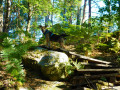

Park in the Rocher Cailleau car park, just before the village of Le Vaudoué when coming from Achères-la-Forêt via the D63. The starting point, with a map and information board, is located between the two parts of the car park.
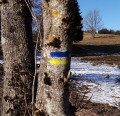
Signs with a yellow silhouette on a white background of two hikers, an adult and a child. The signs are one-sided, in the direction of this description. They are mainly found at major intersections. The seven information panels, relating to successive periods from the Upper Palaeolithic to the present day, are excellent landmarks and are indicated in the description.
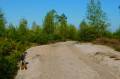
(S/E) Go through the forest barrier on the right of the map and head north. After about 100 metres, turn right and ignore a vague sandy path that continues on the left. Head due east and walk along a large sandy area on your left.
Upper Palaeolithic (from 40,000 to 9,500 BC)
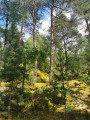
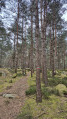
Continue along the path between pine and birch trees, with mossy rocks on your left.
(1) At the T-junction, turn left onto Chemin du Fond de la Garenne.
Mesolithic period (9500 to 5500 BC)
Continue along the path, which soon turns right. At the three-way junction, take the Chemin de la Pente de la Garenne on the left. After about 250 metres, ignore a path coming from the right.
Neolithic period (5500 BC to 1800 BC)
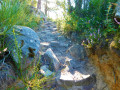
(2) At the fork, turn left and walk past the foot of a hill covered with rocks on the left-hand side. The path narrows and winds its way up through a rocky landscape. Finish the climb via a wooden staircase.
Protohistory (1800 BC to 52 BC)
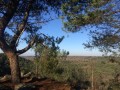
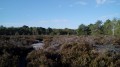
Continue along the path and, at the T-junction (elevation 115), turn left onto a wide path. Head due west and walk along a heathland on your left.
Antiquity (52 BC to 476 AD)
(3) Leave the wide path and turn left onto a narrow path that descends between the broom bushes. Note the still visible traces of a forest fire on the left. At the bottom, at a three-way junction, follow the Chemin de la Cathédrale to the left.
Middle Ages (476 to 1492)
(4) Cross a path marked in red (Route des 25 Bosses) and continue westwards. Ignore a path branching off to the right. Cross the red-marked route again at the edge of forest plots nos. 170 and 169.
Modern and Contemporary Periods (1492 to present)
Continue south-west, pass a forest barrier and walk past a few houses on your right.
(5) At the T-junction, turn left (east-southeast). At the end of the path, walk along the fence of a house on your right. Then turn left and then right to return to the starting point (S/E).




 Visorando Member
 Difficult
 Moderate