Country:



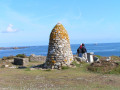
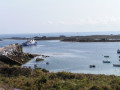
(S/E) From the landing stage, walk past the ferry terminal and follow the road uphill. Just around the bend, near the area designated for the civil protection helicopter (H on the map), turn right to follow the coastal path that circles the entire island. Pass by the stone Oratory of Notre-Dame du Bon Retour and arrive at the orientation table, which helps you find your bearings in the archipelago. Opposite, look out for the Rocher du Kastel, an imposing rock weighing several tonnes.
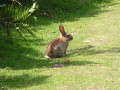
(1) Continue along the path that descends towards the coast to walk along the beach. Pass Anse de Porzh Karn Don, the largest cove on the island, and continue along the west coast path. You’ll see plenty of rabbits here, which are often quite tame. Pass the pebble beach at Porzh Ronan and reach Rocher du Roelen and Anse du Vougeu, a natural viewpoint offering breathtaking views of Ouessant and the Iroise Sea. On the hill to your left, look out for an old windmill whose roof serves as a landmark. Continue along the coast and its rocky ledges. Pass, on your left, the catchment basin built in 1976 to collect rainwater.
(2) Turn left to reach the wayside shrine and its enclosure, which offer a beautiful viewpoint, then turn right onto a diagonal path to return to the seaside. Continue to reach the southern tip, Beg Ar Loued, where archaeological excavations have uncovered a dry-stone dwelling dating from the period between 2200 and 1800 BC.
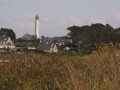
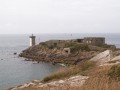
(3) Continue, noting the small fields well sheltered by dry-stone walls. Arrive at Anse de Porzh ar Bloc’h, which offers a view of the islet of Trielen to the south, which, until 1955, was worked by three seaweed-gathering farmers who kept 12 cows there and cultivated the land. The ruins can still be seen there. On the left stands an imposing navigation mark.
Walk along Porzh Bihan Beach, a pretty little beach sheltered from the north winds, and reach the slipway and shelters of the old lifeboats, now abandoned as they are permanently moored in the harbour. Walk along Penn an Ero Beach, which is very popular at low tide for its fine sand and turquoise, crystal-clear water.
Reach the shelter of the old lifeboat "Amiral Roussin" (1894–1950), now adorned with magnificent murals.
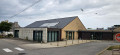
(4) Take a sharp left to pass near the Puits Saint-Ronan, continue slightly to the right along Rue du Patronage, go past the community hall, turn left to reach Rue du Canon on the right, which leads out opposite the semaphore, now a museum.
(5) Turn right into Rue du Sémaphore, pass the five-storey statue of Saint Joseph and arrive at Saint-Ronan Church. Just before this, on the right, is the English cistern. Walk past the church on the right, then after the War Memorial, turn into the small street that runs alongside the cemetery where some of the victims of the “Drummond Castle” shipwreck are buried. At the crossroads, turn left near the wayside shrine known as the “Croix du Karit” (1616).
With the rescue centre on your left, head right along a small road that leads to the small fishing port and its beach, which you follow on the left.
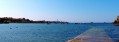
(6) Go round the harbour area, pass behind the Drummond Castle Museum and continue along the path along the east coast via the Boulac’h and Feuntinigou beaches, with a view of the inlet to Molène harbour, which serves, amongst other things, as a shelter for visiting pleasure craft (view of the Îlot de Lédénez Vraz, accessible on foot at low tide). Finally, head to the jetty (S/E).



 Visorando Member

 Moderate