
Solheimajökull, the icy tongue of a fire monster

Neighbouring the famous Eyjafjallajökull, which paralysed air traffic in 2010, the Solheimajökull glacier is the southernmost tongue of the great Mýrdalsjökull glacier, which caps a "monster", the much-feared Katla volcano. It flows southwards and gives rise to a torrent that empties into the Atlantic Ocean.
This short walk is accessible to all and makes for a pleasant diversion during a visit to Iceland's south coast.

Details

2237254
Creation:
Last update:
Last review:
  • Walking
    Activity: Walking
  • ↔
    Distance: 2.61 km
  • ◔
    Average duration: 1h 10 
  • ▲
    Difficulty: Easy

  • ⚐
    Back to start: Yes
  • ↗
    Ascent: + 141 m
  • ↘
    Descent: - 141 m

  • ▲
    Highest point: 307 m
  • ▼
    Lowest point: 164 m

Photos

Description of the walk

From Route 1 along the south coast, coming from the west towards Vik, leave the Vestmann Islands (the country's newest islands) on your right, the Eyjafjallajökull glacier on your left, then the track to the beautiful Skogafoss waterfall, and about 7 km further on, after the bridge over the Jökulsá where the road narrows to a single lane, turn left onto track 221. After about 4 km, you will arrive at a car park, which is the starting point for the hike.

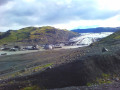
(S/E) Head towards the information boards and the sign marking the start of the trail and the entrance to Katla Geopark(a). The slope is gentle on black sand and rocks. Very quickly, the front of the glacier appears above the horizon.

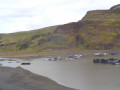
(1) A gap on a hillock on the left offers a panoramic view of the site. To the east is Mýrdalsjökull and its Solheimajökull tongue, whose front plunges into a greyish lake of meltwater(b). It is dotted with ice blocks of all sizes and covered with blackish ash, evidence of recent eruptions(c).
Further west, the turbulent meltwater swells the Jökulsá river before flowing into the ocean.
The slope gradually steepens, but luckily a ray of sunshine brings out a variety of colours in this grey landscape.
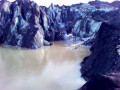
Approaching the front of the glacier tongue, we discover the large cavities with their astonishing blue reflections up close.

(2) At this point, the path and the ice merge. It is tempting to continue, but without a guide and the appropriate equipment(d), it is more sensible to content oneself with the exceptional panorama that unfolds before your eyes.
Retrace your steps.

(3) The level of the meltwater lake varies with the seasons. The left bank is accessible via a black sand beach, where you can enjoy the spectacle of blue ice blocks covered in black ash, creating striking colour contrasts.
Return to the path and head back to the car park (S/E).


Waypoints

  1. S/E : km 0 - alt. 166 m - Sólheimajökulsvegur car park
  2. 1 : km 0.41 - alt. 205 m - Viewpoint
  3. 2 : km 1.33 - alt. 307 m - Front of the glacier tongue
  4. 3 : km 1.7 - alt. 289 m - Shore of the meltwater lake
  5. S/E : km 2.61 - alt. 166 m - Parking

Notes

(a) Katla, which means "kettle" in Icelandic, is a huge volcano under the Mýrdalsjökul ice cap. Its eruptions are characterised by strong and sudden floods (jökulhlaups) that are particularly devastating due to the melting ice, and by smoke and gas emissions that can reach an altitude of 25 km.
It erupts on average twice a century. Its last eruption was in 1918, and it is one of the most closely monitored volcanoes in the world.

(b) Solheimajökull is highly sensitive to climate change. Between 1930 and 1969, it receded, then regained thickness and length after a period of cooling until 1995, but since then it has receded considerably. In 2010, it had lost 1 km in length and 150 m in thickness compared to 1960.
This figure represents the average retreat of glaciers across the island. It is estimated that the country is losing around40 km² of glacier surface area per year.

(c) Eyjafjallajökull is not Iceland's most feared volcano. Only a few eruptions are known: in 550, 920, 1612, 1821 and 2010, the most powerful. It led to the ejection of a gigantic cloud of ash and rock, with a volume exceeding 250 millionm3, which rose to an altitude of 9 km. Its large neighbour, Katla, is much more worrying.

(d) Hikes with crampons can be undertaken on the glacier, supervised by professionals. Please enquire at the tourist offices.
Arcanum Glacier, located nearby (see Map and directions), can organise a 3-hour walk on Solheimajökull with a guide and equipment.

For more walks, use our search engine .

The GPS track and description are the property of this route's author. Please do not copy them without permission.