Reykjadalsá, the hot river

North of the town of Hveragarði (hot garden in Icelandic), 45 km east of Reykjavik, this hike climbs the Reykjadalur valley (valley of smoke), encountering bubbling holes, steam jets, fumaroles, hot water streams, waterfalls, multi-coloured terrain and rocks, until you reach a spot where you can relax and bathe in the warm waters of the Reykjadalsá.

Details

2229787
Creation:
Last update:
Last review:
  • Walking
    Activity: Walking
  • ↔
    Distance: 10.88 km
  • ◔
    Average duration: 4h 15 
  • ▲
    Difficulty: Moderate

  • ⚐
    Back to start: Yes
  • ↗
    Ascent: + 389 m
  • ↘
    Descent: - 380 m

  • ▲
    Highest point: 424 m
  • ▼
    Lowest point: 78 m

Photos

Description of the walk

Park near the Delakaffi café at the southern end of a long car park.

(S/E) Go to the northern end of the car park to find a sign with a map of the area and information on the geology, fauna and flora. Then continue northwards.

(1) Cross the river on the wooden footbridge, pass to the right of a sheep sorting enclosure and take the wide, steeply sloping path.

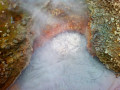
(2) In the right-hand bend, a few metres to your left, a first "marmite" of bubbling mud(a) with abundant sulphurous vapours is worth a detour (be careful, especially with children).
Continue climbing. The slope is steep and the stony path slows you down. Take a break to turn around and enjoy the magnificent view of the town and the ocean to the south.
The slope levels out and the path becomes narrower. A balcony-like section offers a remarkable view.

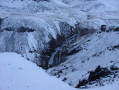
(3) Below on the left, admire the canyon and waterfalls of Djúpagil, into which the Reykjadalsá river flows(b). Further west, at the bottom of a valley, you can see abundant fumaroles(c).
A few hundred metres further on, on a kind of plateau, the terrain is greener and the river winds through the meadow.

(4). Take the footbridge on the left. A sign indicates that you can swim in the river 700 metres further on.
The geothermal activity becomes increasingly frequent and intense, with pools of various colours, fumaroles, mud holes and bubbling water.

(5) A little further on, a dense, humid, warm, sulphurous cloud covers the path. Just look at the ground and watch where you put your feet. After this breathless passage, a short descent leads to a place called Klambragil, on the right bank of the river, towards a wooden footbridge. The water temperature here is around 35°C.

(6) Enjoy swimming to your heart's content.
On each bank, the path is covered with wooden duckboards and steps make it easy to get down into the shallow river. A few basic screens provide privacy for changing.
The water temperature averages 38°C, depending on the season, and increases as you move upstream.

The changeable weather(d) often means you have to cut short your relaxing swim and hurry back. Otherwise, you can extend your trip by taking a short detour. Head upstream from the left bank, then leave the duckboard and follow the path.

(7) The trail quickly leads to the centre of the Ölkelduhnúkur loop, which is about 3 km long. Choose the direction you want to go. You will see numerous solfataras(e) and other geothermal features.
Then return to the Klambragil footbridge.

(6) You now have two options. If it is raining, take the same route you took on the way there. If conditions(f) allow, you can return along the left bank of the river (route marked on the map) and further on, on the plateau, you will find the footbridge over the Reykjadalsá.

(4) The Reykjadalsá river on your right flows into the Djúpagil canyon and its waterfalls. Continue along the same path you took on the way there, this time enjoying the view to the south. As you approach the car park, notice the streams with their striking colours (S/E).
Waypoints

  1. S/E : km 0 - alt. 78 m - Delakaffi car park
  2. 1 : km 0.38 - alt. 108 m - Hengladalaá footbridge
  3. 2 : km 0.6 - alt. 162 m - Boiling mud pot
  4. 3 : km 2.06 - alt. 273 m - Viewpoint: Djúpagil Canyon
  5. 4 : km 2.68 - alt. 298 m - Footbridge over the Reykjadalsá
  6. 5 : km 3.22 - alt. 300 m - Sulphurous fumaroles
  7. 6 : km 3.58 - alt. 300 m - Klambragil footbridge
  8. 7 : km 3.77 - alt. 300 m - Crossroads of the Ölkelguhnúkur loop
  9. S/E : km 10.88 - alt. 78 m - Parking

Notes

It is also possible to start the hike at the northern end, but on some days there are many Icelanders and tourists.

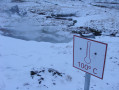
In rainy weather, the ground is slippery and in winter the path is not cleared of snow. It is recommended not to stray from the path, out of respect for the flora and for safety reasons, as the ground is unstable in places, especially near mud holes and boiling water.

(a) Boiling mud pots: in the solfatara fields (see (e)), you can sometimes see pools of mud that are more or less viscous, bubbling, steaming and smelly. They are formed by the action of hot acidic water on the rocks. Bubbles of carbon dioxide often rise and burst on the surface.

(b) All Icelanders speak English. However, some information and direction signs only useIcelandic, which is not easy to pronounce for those who are not familiar with it.
Ð or ð is roughly equivalent to the English th.
Á or á are pronounced ao.

(c) Fumaroles: this term is rather overused and refers indiscriminately to any gaseous emission from a hydrothermal system.
For scientists, fumaroles correspond to gas emissions between 300 and 1000°C that accompany volcanic eruptions.

(d) Icelanders have a saying: if you don't like the weather, wait five minutes and you'll be delighted. The problem is that when you like the weather, five minutes later...

(e) Solfatara are composed of 90% water in vapour form and various other components, including carbon dioxide, methane and hydrogen sulphide, at temperatures between 100 and 300°C. They are usually surrounded by sulphur deposits formed by the reaction of hydrogen sulphide with the air. Various deposits (clay, sulphur compounds, sulphates, etc.) are also found, giving the solfatara magnificent yellow, ochre and red hues.
Solfataric fields often emit fascinating sounds and foul odours reminiscent of rotten eggs.

(f) The trail is not recommended in rainy weather and is sometimes closed to protect the flora or for safety reasons.

Dalakaffi, bar and snacks. Closed in winter.

Definitions are taken from planet-terre ens Lyon.

Worth a visit

Reviews and comments

5 / 5
Based on 1 review

Reliability of the description
Not used
Ease of following the route
Non utilisé
Route interest
5 / 5
habanera
habanera

Overall rating : 5 / 5

Date of your route : Dec 21, 2016
Reliability of the description : Not used / Not applicable
Ease of following the route : Not used / Not applicable
Route interest : ★★★★★ Very good
Very busy route : No

Hike done a few years ago, in December. Extraordinary in winter when everything is dusted with snow. Swimming in the hot springs, even at 0°C, is very refreshing. Be careful of the weather, which can change very quickly. We left under sunny skies and returned just before a blizzard hit Hveragarði.

Machine-translated

For more walks, use our search engine .

The GPS track and description are the property of this route's author. Please do not copy them without permission.