Country:
 City:
City:


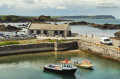
Start : Rathlin harbour (BT54 6RT)
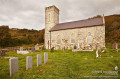
(S/E) At the harbour you may choose to go left (West) to take the steep route. After 200m, turn right (North) by the church and up the Church Brae to the chapel.
Or at the harbour, you may choose to go right, pass the Manor House and take the first left by McCuaig’s Bar and left again at the cross roads (peering over the wall into the field to see the ancient Standing Stone). Follow this route looking down on the village, past the Rescue Station, round past the school and arrive at the top of the Church Brae, by the chapel.
(1) From the chapel, take left (South-West) and continue uphill until you can look behind and see the East Lighthouse (against the backdrop of the Mull of Kintyre on clear day).
By the side of the road, is a memorial to the Rathlin emigrants of the Irish Famine years. The climb is not quite over as the road continues to rise to the plateau.
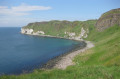
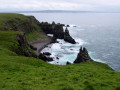
Now, to the right, the farmland along the cliffs is managed by RSPB for chough and corncrake habitat – controlled grazing and hay meadow with rough early cover vegetation.
To the left, the banks rise to rocky outcrops which are popular vantage points for birds of prey. Look out for buzzards and peregrines.
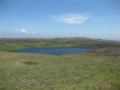
Around Brockley, near the centre of the island, marshes lying on either side offer different habitat attracting waders such as heron and lapwing.
(2) After 2.3 Km, behind the white farmhouse over to the right is the ancient volcanic hill from which Stone Age men extracted hard porcellanite rock for their weapons and tools. Keep straight along the road (West).
(3) 1.6 Km later on, walking along the road, find Kinramer Wood, a plantation some 50 years old, supporting bird species such as short eared owl and sparrowhawk. Across the cattle grid at Kinramer ASSI the way is open to heathland, which is carpeted with orchids in early summer, after the rare pyramidal bugles flourish in Spring.
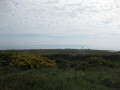
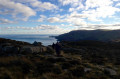
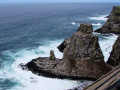
(4) After 3.5 Km, the path becomes a rough track once Kebble NNR is reached and the sea views stretch away beyond the Giant’s Causeway to the Inishowen peninsula in Donegal.
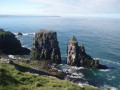
As you approach the RSPB seabird viewpoint in summer, you’ll become aware of the sounds, sights and smells of thousands of seabirds in their struggle for survival on the ocean’s edge.
(5) Having spent time at the RSPB Centre and viewpoint, return to the harbour via the same route. (S/E)
 Tourist office
 Easy
Easy