Circular route between Tressé and Mesnil-Roch through the two forests.

This route will take you through wooded and hedgerow landscapes. Mostly in the undergrowth, it will take you through the Mesnil State Forest (600 ha), formerly owned by the privateer Surcouf, as well as a very small part of the Coëtquen Forest (557 ha).
Due to land consolidation policies, many hedgerows have disappeared over the last 50 years. However, hedges and embankments play an important role in the diversity of fauna and flora. They shelter livestock from the wind, limit water runoff and slow down the wind. Birds, insects and small mammals find shelter and food in these areas. Hedgerows are also a source of renewable energy and carbon sinks. For the past twenty years or so, local authorities have been encouraging the restoration of hedgerows and copses.

Details

90809520
Creation:
Last update:
Last review:
  • Walking
    Activity: Walking
  • ↔
    Distance: 21.84 km
  • ◔
    Average duration: 6h 30 
  • ▲
    Difficulty: Difficult

  • ⚐
    Back to start: Yes
  • ↗
    Ascent: + 96 m
  • ↘
    Descent: - 94 m

  • ▲
    Highest point: 76 m
  • ▼
    Lowest point: 39 m
  • ⚐ Country: France
  • ⚐ City: Tressé (35720)
  • ⚑
    Start/End: N 48.481104° / W 1.885695°
  • ❏
    IGN map(s): Ref. 1116ET, 1216O
  • Hour-by-hour weather

Photos

Description of the walk

(S/E) Facing the church, take the street on the right for 120 metres and, at the fork, turn left towards Les Touches/Les Brosselets. Continue, then turn right after the second bend to the left, towards Les Brosselets/Rouesnel.

Yellow markings

(1) When you reach Rouesnel, turn left onto the path. Follow it to the road and continue to the right. Pass Lake Gué Briand and continue to the bend.

(2) Take the dirt track opposite, slightly to the left, leaving the stony path on your left. Follow the path and cross a wooded area. At the end, leave the path on the right and take the one on the left.

(3) When you reach the road, turn right and, at the second intersection, take the road on the left. Pass under the bridge (caution: narrow), continue and cross the hamlet of Saint-Grégoire.

(4) Shortly before the end of the hamlet, take the small path on the left. At the crossroads, turn right onto the path that joins the four-lane road.

(5) Cross the D309 (take care) and follow the path that runs alongside the four-lane road before turning right onto the gravel path that leads to the Noë Davy locality, on the right-hand side of the pond.

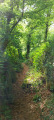
(6) Take the sunken lane on the left, which winds through the undergrowth. At the crossroads, turn right and continue until you reach a road.

(7) Follow it to the left, continue straight ahead, pass the place called Bel-Air, then keep left and go through the tunnel under the dual carriageway.

(8) Take the road on the left. Then take the grassy path on the right. Take the track on the right to reach, after a left turn, a road to follow on the left, towards the hamlet of Le Fertier.

(9) Continue on the road opposite until you reach the place called Le Rocher Marie.

(10) At the intersection with the path, turn left onto it, then turn right and follow a grassy path on the left, downhill. The path branches off to the right and, after a passage through the undergrowth, take a gravel path on the right that runs alongside a forest on the left. The path climbs and leads to a road. Take it to the left and you will reach another fork.

(11) Take the road on the right to Tertre Guy. At the end of the lane, the road turns at a right angle to the left and continues along a wooded dirt track. At the edge of the woods, the stony path veers to the right, almost due south. Further on, the path splits in two.

(12) Take the path on the left towards the hamlet of "La Ville ès Liez", leave it on your left and continue to the road. Cross the road, take it on the left, then the one on the right to the place called Le Haut Plessis. Cross it and take the gravel path at the end of the houses. The path turns right, heading due east. Ignore a crossroads, then follow the edge of the woods, ignoring a fork. At the star-shaped intersection of farm tracks, take the second left until you reach the next crossroads.

(13) Take the track on the left, and further on, turn onto the path on the right.

End of signposting

You will reach a forest crossroads called "le Jardin d'Amour".

(14) Take the path on the left, between the two forest tracks. At the next crossroads, take the path opposite which joins the D9.

Yellow markings

(15) Cross it carefully and follow the winding discovery trail. Ignore two forks. Take the path on the left at the third fork, pass the logging roads and continue straight ahead. The path climbs slightly and joins the covered alley.

(16) Turn right, heading north-west. At the farm track, turn left and leave the woods to reach Les Brosselets.

End of signposting

(1) Continue along the route, in the opposite direction to the outward journey, to the left, to return to the starting point (S/E).

Waypoints

  1. S/E : km 0 - alt. 53 m - Church
  2. 1 : km 0.95 - alt. 67 m - Le Brosselets
  3. 2 : km 2.21 - alt. 45 m - Rimbriant crossroads and bend
  4. 3 : km 3.03 - alt. 51 m - Road
  5. 4 : km 4.06 - alt. 56 m - St-Grégoire
  6. 5 : km 5.4 - alt. 53 m - D309
  7. 6 : km 7.79 - alt. 39 m - Noë Davy Pond
  8. 7 : km 8.61 - alt. 52 m - Road
  9. 8 : km 9.63 - alt. 63 m - Tunnel
  10. 9 : km 11.73 - alt. 61 m - Le Fertier
  11. 10 : km 12.31 - alt. 67 m - Ruelle le Rocher Marie
  12. 11 : km 13.29 - alt. 56 m - Carrefour le Tertre Guy
  13. 12 : km 15.12 - alt. 51 m - Fork
  14. 13 : km 17.49 - alt. 51 m - Crossroads
  15. 14 : km 18.32 - alt. 58 m - The Garden of Love
  16. 15 : km 19.17 - alt. 59 m - D9
  17. 16 : km 20.35 - alt. 76 m - Covered walkway
  18. S/E : km 21.84 - alt. 53 m - Church

Notes

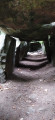
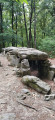
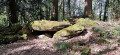
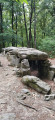
Don't miss the covered walkway. It has nothing to do with the famous Roche aux Fées (Fairy Rock) located in Essé, south-east of Rennes, which is also worth a visit.

Cross the roads with caution.
Small car park about a hundred metres from the church, signposted.
Toilets at the town hall.

Worth a visit

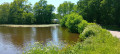
La Noë Davy pond and Coëtquen forest
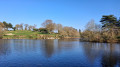
Take a break at La Noë Davy pond near the Cabane à Picot. You are northeast of the Coëtquen State Forest, which covers 557 hectares. Owned by the State since 1983, this forest is managed by the Office National des Forêts (National Forestry Office). Two-thirds of the forest is composed of deciduous trees (oaks, beeches, chestnuts, birches, cherry trees, etc.) and one-third of conifers (spruces, Scots pines, Douglas firs, etc.). The forest was owned by the Coëtquen family from before the9th century until around 1850. From this period, a feudal mound remains in the forest, and on the edge, a castle, part of which is inhabited and part of which is in ruins.

The hamlets of Rocher Marie and Haut-Plessis
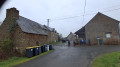
These hamlets are home to numerous farms and rows of granite houses typical of the region. The oldest date back tothe 17th century and consist of a single room. These houses are built with materials sourced locally: granite from the Lanhélin and Saint-Pierre-de-Plesguen basins.

The priory of Saint-Grégoire
Saint-Grégoire is one of the largest hamlets in Miniac-Morvan. A priory and its chapel were located in this village. A granite wayside cross, whose base is located nearby, marks the site of the former chapel. You can see many renovated farms from the18th,19th and20th centuries. They are built of granite rubble and the window and door frames are made of cut stone.

Saint-Etienne Church and the former presbytery
The church, built in 1887 by architect Arthur Regnault, replaces an old15th-century church. It is in the Neo-Romanesque style, with rounded features: a bulbous bell tower and a domed choir. Even the interior furnishings reflect this style (confessional, altar, etc.). The former19th-century presbytery now houses the town hall.

The covered walkway of La Roche aux Fées (listed as a Historic Monument)
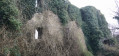
Covered passageways were collective tombs that could be used for several centuries. These burial sites allowed communication with the dead. This one was excavated and restored in the 1930s by R. Mond. Relief sculptures, engraved breasts, a skeleton and several pottery items were discovered. Observe the sculptures of breasts and necklaces on the remains of the chamber. They symbolise the cult of the Mother Goddess and are the origin of the belief in the House of Fairies.

Other walks in the area

For more walks, use our search engine .

The GPS track and description are the property of this route's author. Please do not copy them without permission.