Local history also features a strong character: Brita Behm, nicknamed Järn-Brita (“Iron Brita”). She ran Axmar with a firm hand for over 50 years. The site also reveals an unexpected link to Emanuel Swedenborg, the famous Swedish scientist, philosopher and mystic, who owned part of the estate before selling it on.
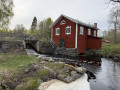
(1) The mill (kvarnen) is a charming, intact red-timbered building dating from the 1860s, which replaced an older structure from 1771. Right next to it, on the edge of the pond, stand the remains of the warehouse (formerly a coal shed) and the forge. These ruins are all the more fascinating as they are built of slaggsten (slag bricks), a magnificent building material with a bluish sheen, derived directly from the residues of iron smelting.
(2) Also in 1860, a new steelworks complex was built closer to the sea (see Hyttan). The former industrial area was then transformed into an English-style park, featuring mirror-like ponds, walking paths and gardens. A large building, known locally as “slottet” (the castle), was erected there, but it was eventually demolished in 1970 after a long period of disrepair. The park, however, still retains some of its romantic atmosphere.
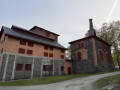
Hyttan was the productive heart of Axmar bruk: it was here that the ore was transformed into cast iron, using the heat from the blast furnaces and the energy provided by water.
(4) When the new Hyttan was built in the 1860s, four residential buildings were dismantled and moved from the neighbouring village of Tönnebro to house the workers at Axmar. Today, three of these buildings are still standing, the last having been demolished in the 1950s.



 Country: