


 Country:

 City:
City:


Main signage: Green disc.
Departure: Corcieux, Place de l'Église Notre-Dame de l'Assomption - Behind the church and in front of the Place des Martyrs, there are numerous free parking spaces.
(S/E) With your back to the church, head south-west along Rue de l'Hôtel de Ville (D31). Pass the Town Hall and Place du Général de Gaulle. At the crossroads, turn left onto Rue Pierre Nicole (D31), leave Allée des Pivoines and continue for another 60 metres.
(1) Turn right onto Rue de l'Ormeau, which leads to the Croix Égline housing estate. Follow the dirt track across the fields to the Croix de l'Ormeau calvary.
(2) Turn right onto the GRP® de la Déodatie. On your right, you will see the Trois Monts and the Roche des Corbeaux, which overlooks the village of La Houssière-Vanémont. The dirt track leads to a tarmac road, which you take on the left. On your right, you will see the Romanesque church of Saint-Jacques du Stat* in the distance.
(3) After 200 metres, turn right towards the hamlet of La Nolle. Pass the calvary on your left and take the dirt track. A little further on, take the tarmac road on the left which will lead you to the hamlet of Mariémont.
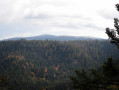
(4) At the first crossroads, continue straight ahead. At the next crossroads, leave the calvary on your left. Enjoy the beautiful view over the Corcieux basin, the site of an ancient prehistoric lake. Continue to the Col des Arrentès de Corcieux.
(5) Ata place called La Querelle, at the beginning of this square in the direction you are coming from, there is a table and two benches where you can take a break. There is a restaurant on the other side of the road. Cross the D31 with caution and take the C1 towards the centre of the village of Arrentès de Corcieux in the direction of Champ de Roches.
(6) At the next crossroads, ignore Rue du Patis du Houssot on your right and continue straight ahead for another 100 metres.
(7) Turn right onto Route du Popet and continue to Ruisseau de la Corbeline.
(8) After crossing it, continue up the road.
(9) In front of an old farmhouse, turn left onto a small path lined with stone walls, in a forest of spruce trees, heading south.
(10) Turn sharply right onto a small loop to reach the Champ de Roches site. Walk along it on your right-hand side, and at the end you will find information panels explaining this geological feature.
(11) Go up the path on the left and quickly turn right.
(12) Follow the marked path to the right until you reach a road.
(13) Continue almost straight ahead on the tarmac road. If you make a return trip to the car park on the right, you will find two tables with benches where you can take a break. After 150 metres, at the crossroads, follow the markings and continue straight ahead on a dirt track until you reach the Route Forestière de la Voinerie.
(14) Turn left onto this downhill forest road (towards Corcieux).
(15) Leave the path that branches off to the left, cross the Ruisseau de la Corbeline stream again and continue straight ahead to the Carrefour des Goutelles crossroads.
(16) Continue straight ahead towards Les Arrentès, through the pine forest for 800 metres.
(17) Leave the road and take the small path slightly uphill to the right. After about 200 metres, look to your right and you will see the entrance to a water mine* in the low stone wall. At the edge of the forest, turn left and enjoy the beautiful view of the Corcieux basin, with the Col des Arrentès in the foreground and the blue line of the Vosges mountains on the horizon. You will arrive at the first houses.
(18) Cross the tarmac road and take the path opposite, which descends to the hamlet of La Charmelle.
(19) Then turn right and continue for about 300 metres.
(20) Take the dirt track on the left that runs alongside the small Ruisseau des Bans stream. Pass by some old granite quarries. After the stone bridge, turn left. After about 300 metres, below, you will see the ruins of an old mill at a place called La Folie and, further on, on the right, some imposing granite blocks.
(21) At the first houses of the hamlet of Vichibure, turn left. On the right, the first farmhouse, dating from 1723, is a former prison that belonged to the Counts of Martimprey. A small flamboyant Gothic window remains on the south-east façade. Note the date of construction (1827) on the façade of the next farm, its sandstone pediment and two inscriptions, H10. CH6: during the German occupation in 1940, homes were requisitioned to house the enemy army. The inscriptions specified the number of men (H 10) and horses (CH 6) that could be accommodated.
(22) Turn right and continue for approximately 550 metres.
(23) Turn left onto Rue James Wiese, pass the Forfelet nursing home and walk alongside the Bans and La Tour campsites.
(24) Turn left onto Rue Notre Dame, then left again onto Rue Henry (D60) and return to Place de l'Église (S/E).

 Visorando Member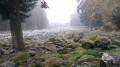

 Difficult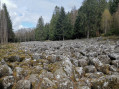
 Easy
Easy 
 Tourism professional
 Tourist office
