Country:

 City:
City:


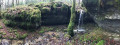
(S/E) Car park in Flagey, near the small fountain after the church at the corner of Rue de la Charrière and Rue de Cheneau. A quick visit to the church is a must before setting off. Then leave Flagey with your back to the church on your right, heading towards the Duchènes nurseries and following the road to the next crossroads, where you continue straight on along this tarmac road.
(1) Pass the first gravel path on your left, enter the undergrowth, then pass a second gravel path on your right and enter a large clearing, walking along the right-hand side of the shrubbery.
(1bis) " The first gravel path at the entrance to the woods on the left is shorter and more pleasant for reaching the marked trail," explains Bflagey, a resident of the village.
(2) At the edge of the forest, leave this road and take the path on the left marked with a sign saying "No vehicles over 5 tonnes". Cross the fields in a straight line and join another small tarmac road at the corner of a wood. Then turn right onto the gravel path.
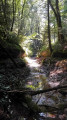
(3) You enter the forest. Ignore the track on the left immediately after the entrance. You will soon come to a fork; take the left-hand path. At the ONF signs No. 4 & 5, you will join a yellow-blue marked hiking trail. Look at the back of the sign. Turn left towards the Norvaux viewpoint. Now follow the signs with the rather un-forest-like toilet seat logo. You will reach a stream, and the path merges with its bed. 150 metres further on, at the signpost, leave the stream and climb up to the left. You will walk along pretty little gorges and come to another stream. At a metal handrail fixed to the rock, cross the stream and climb up to the right on the other bank. Climb the hillside via two sets of small steps. Cut across a dirt track, continuing straight ahead.
(4) You will reach a gravel road, which you will cross again to continue straight ahead along a cattle track that climbs up and down a small hill. The cattle track leads perpendicularly to a path that runs alongside a stream. Take this path on the right.
(5) You will rejoin the gravel road at a hairpin bend. Cross it again and continue straight ahead, following the yellow markers for the discovery trail. Cross another small stream that flows down into the valley through small gorges. At the start of these gorges, you will see a small path that descends a few metres to the right (half hidden when I passed by due to cut branches) and leads you to the start of the valley. Turn back and head off to the right.
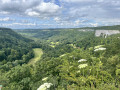
(6) At a signpost, the discovery trail splits. Take the path on the right that runs along the gorge. You will come to a small clearing/play area, which you cross, and at the signpost, turn right to reach the viewpoint. To get to this clearing, rely on the description rather than the track (I don't have a system that can retrieve it in the field. Please send it to me, thank you).
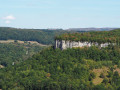
(7) Leave the viewpoint via the path on the right that runs along the edge of the cliffs, following the yellow signs for the discovery trail. You will arrive at the Comboyer spring. It is said that the centenarians of Amancey drank only the clear water from this spring. Carefully descend the slippery path on the right that runs alongside the stream for about a hundred metres to discover the small suspended pools created by mineral deposits. Then climb back up towards the spring.
(8) At the Comboyer Spring sign, you will come to a gravel path. Turn right here, leaving the discovery trail. About a hundred metres before it joins another stony path, at a signpost, turn right onto a path that leads perpendicularly into the woods. Continue straight ahead, ignoring the other paths. You will soon be guided again by yellow and blue markers. You will come to a stony path. For the curious, after a short climb, take a path on the right to reach a strange calvary. Retrace your steps and continue along the stony path that leads to Amancey. You will come to a tarmac road, then turn left towards the pylon and the Ferme du Vallon.
(9) When you reach the D32, go up to the right for fifty metres and, before the pylon, turn left onto the small tarmac road. Pass a first road (tarmac) and a second (gravel) on your right, a third on your left, then go straight on at the first crossroads and turn left at the next crossroads. With Bolandoz in sight, on your right between two copses, you will see the old railway station. You will reach the D32, which you take to the right to reach the village.
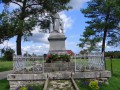
(10) At the Notre-Dame-Le-Refuge-Des-Pécheurs oratory, dating from 1841, cross the D492 to go up Rue de la Charrière. Immediately on your right, you will see an old cistern. Turn left into Rue Saint-Georges to reach Grande Rue, which you follow to the right. At the second house on the right, you will see an old cul-de-four oven with a slate roof, followed by a drinking fountain dating from 1875. Then turn left onto Rue du Chalet and left again, walking alongside a low wall. When you reach Rue de la Mairie, turn right and walk fifty metres to see another fountain, then head back down towards the church, which is well worth a visit (even if you have to ask for the doors to be opened) to see its 15th-century polychrome wooden statues.
(11) After your visit, walk past the town hall/school and its bell tower and head back down towards the D492 via Grande Rue. Walk past the Marianne fountain and turn right onto the departmental road, then immediately left onto Rue de la Vierge. At La Vierge, turn left and at the first fork, turn right, following the yellow and blue markings that will take you back to Flagey along this tarmac road.
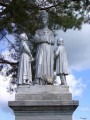
(12) The first house as you enter the village is La Ferme de Flagey, owned by the Courbet family. If you are not too tired, walk a hundred metres or so to see the statue of Notre-Dame-de-La-Salette and then return to the church and car park by retracing your steps (S/E).






 Visorando Member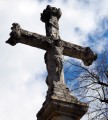
 Easy
Easy