The Brèche du Carciara... and a little further

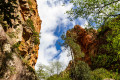
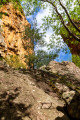
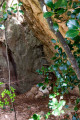
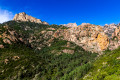
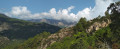
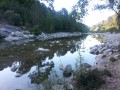
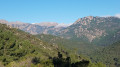
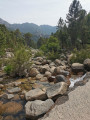
A hike towards the Brèche du Carciara, and a little further, amidst a landscape of rocky chaos and numerous magnificent waterfalls and crystal-clear pools! The final section requires climbing metal rungs, scaling a rope ladder and ascending with the aid of a cable (but without additional equipment), which may put some people off. Furthermore, many sections involve walking over rocks and can therefore be very tricky.

Details

48623893
Creation:
Last update:
Last review:
  • Walking
    Activity: Walking
  • ↔
    Distance: 9.33 mi
  • ◔
    Average duration: 6h 35 
  • ▲
    Difficulty: Very difficult

  • ⚐
    Back to start: Yes
  • ↗
    Ascent: + 2,661 ft
  • ↘
    Descent: - 2,631 ft

  • ▲
    Highest point: 2,149 ft
  • ▼
    Lowest point: 554 ft
  • ⚐ Country: France
  • ⚐ City: Zonza (20124|20144)
  • ⚑
    Start/End: N 41.732439° / E 9.292697°
  • ❏
    IGN map(s): Ref. 4253ET, 4253ETR, 4254ET
  • Hour-by-hour weather

Photos

Description of the walk

Park at the car park by the three swimming pools.

(S/E) Follow the track towards the Marioni bridge.

(1) Turn right to cross the bridge, then continue along this track, veering slightly to the left.

(2) Cross the Funtanella Bridge and continue straight on until you reach a junction.

(3) Go straight on again and follow the track all the way. Cross the first ford, over the Niffru.

(4) Note the path on the left, which you will take on the return journey, and continue along the track.

(5) Cross a ford over the Ruisseau de Peru. At this point, leave the track that heads straight on towards Paliri and take a clearly visible, cairn-marked path on the left that immediately turns right. Follow this unmarked but very well-maintained path, which leads to a larger ford over the Ruisseau de Mela.

(6) Cross it over the stones; the path continues uphill, still clear and well-defined, along the west bank of the stream.

(7) Once you reach the clearly visible gap, a magnificent waterfall catches your eye, and from there the path disappears. Climb up a 2.5-metre-high rock on the right using metal steps fixed into the rock, which may not be immediately visible. At the top, descend the other side, again using the metal steps, to reach a small platform with a rope ladder opposite, which you must climb.
These successive sections require great caution.

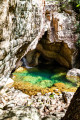
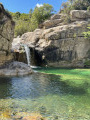
On the other side, cross a small bridge: the two tree trunks that used to allow passage have been broken; so you go underneath and climb back up onto the rock opposite, using new rungs that have just been fixed in place. And finally arrive at the entrance to the gap. Ahead of you lies a magnificent waterfall and pool, an ideal spot for a swim, with a superb little cove! Cross over the rocks to the other side and follow the path, which, as it crosses the gorge, leads you up the rocks (on the north side of the stream) using a thick cable. You then reach a flat area, and you must follow the cairns to exit the gorge and reach the end of this hike, where there is a magnificent pool.
A further outing on 11 May allowed us to continue along this path; you must cross the river at this point, go round to the south side (following a red ribbon tied to the trees and the cairns), then cross the river again at the ford to return to the north side. From there, the path climbs steeply to reach (after 10 mins) the summit, where, on the right, there is a fine wall supporting a platform: this was the site of a cable car platform (there were four of them) that allowed the ‘carbunari’ to transport their coal down to the valley.
The path descends and you reach the confluence of the Carciara and Frassiccia; the path climbs again and, off the path to the left, you can see a superb waterfall. Allow half an hour from waypoint 8.
You can walk straight down to the base; it’s magnificent.
The path continues (half an hour) to reach its destination: the caseddi d’Aracale; for our part, we take a detour

(8) Follow exactly the same route back , taking the same precautions.

(4) Leave the track by taking the path marked PN (in red on a tree) and signposted in yellow on the right. This path, which is more challenging than the track, takes you down to the riverbank (beautiful rapids), then climbs back up to rejoin the track.

(9) Continue along the forest path which leads to a track adjacent to the one taken on the ascent.

(10) Turn right, head towards the river and cross it over the stones at a small reservoir. Then continue straight on to reach the junction at the Marioni bridge.

(1) Go straight on to follow the lovely track and return to the starting point (S/E).

Waypoints

  1. S/E : mi 0 - alt. 584 ft - Car park
  2. 1 : mi 0.35 - alt. 600 ft - Marioni Bridge
  3. 2 : mi 0.7 - alt. 646 ft - Funtanella Bridge
  4. 3 : mi 1.32 - alt. 876 ft - First junction
  5. 4 : mi 1.94 - alt. 938 ft - Junction for the return route
  6. 5 : mi 3.31 - alt. 1,175 ft - Three-way junction, to the left
  7. 6 : mi 3.48 - alt. 1,142 ft - Crossing the ford on the Mela
  8. 7 : mi 4.3 - alt. 1,444 ft - Arrival at the entrance to the pass
  9. 8 : mi 4.64 - alt. 1,673 ft - Return point
  10. 9 : mi 8.02 - alt. 837 ft - Maintenance of the forest track
  11. 10 : mi 8.52 - alt. 640 ft - Junction with track, on the right
  12. S/E : mi 9.33 - alt. 591 ft - Car park

Notes

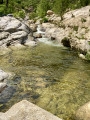
There are no springs, but you follow the river almost the whole way, so there is the opportunity to top up your water supplies and have a swim, as there are numerous swimming spots.

Please note: during the summer season, it may not be possible to park at the three swimming pools. Check at the reception further down, near the treetop adventure course.

You cross an easy ford on the Peru; two others may be trickier in the event of heavy rainfall: waypoints (6) and (9).

Physically, it’s not difficult, and depending on how tired you are, you have the choice on the way back of taking the PN path, with some steep gradients, or continuing at a leisurely pace along the track.

The section between (7) and (8) includes several tricky and potentially dangerous sections that require caution. Furthermore, the route is difficult to follow on the ground and may involve some trial and error.

Worth a visit

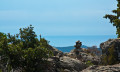
Magnificent pools and superb waterfalls, a beautiful cascade for the more adventurous, a rocky landscape in the pass. Further on, there is the chance to see the remains of the carbunari’s former work: the remains of the bases for the cableways that were used to transport the charcoal produced down into the valley.

Reviews and comments

4.3 / 5
Based on 5 reviews

Reliability of the description
4.2 / 5
Ease of following the route
3.6 / 5
Route interest
5 / 5
smashdc
smashdc

Overall rating : 4.7 / 5

Date of your route : May 26, 2026
Reliability of the description : ★★★★★ Very good
Ease of following the route : ★★★★☆ Good
Route interest : ★★★★★ Very good
Very busy route : No

How sad to respond in such a clearly biased manner. My thousands of kilometres of hiking across France and Corsica enable me to assess this route, whose difficulty is rather fanciful given the 12 or 15 rungs, a rope ladder and a cable; most of my references are also taken from Visorando, which is why I’m making the comparison, Mr Know-It-All.
This isn’t mountaineering, and I made it clear that two rungs are a bit too far apart but not impossible, plus details on the ladder if you’ve read… If ‘you’ spend all year on your sofa, yes, it will be difficult! You can’t just improvise being an experienced hiker... But I see all sorts of things on my hikes.
I did say it’s better to be tall; you do need to read a bit and understand...
I’m not looking for the elevation gain, but at high altitude, the scenery is magnificent.
You see people walking the GR20 without crampons, even though there can be real risks and genuine rescue operations... are you aware of that?
Er... the Omo di Cagna has plenty of open views... The surroundings are just as beautiful; it’s not all just rocks LOL
🌍 All my thousands of kilometres of hiking 🎬 ALL OF FRANCE #toutelafrance 💥
https://www.youtube.com/@TopoRandos/vide...
https://bit.ly/4psvGNl
https://www.youtube.com/c/JeuxVoyagesIns...
https://bit.ly/3GOMKua

Machine-translated

philevr
philevr
• Edited:

Overall rating : 3.7 / 5

Date of your route : May 27, 2026
Reliability of the description : ★★★☆☆ Average
Ease of following the route : ★★★☆☆ Average
Route interest : ★★★★★ Very good
Very busy route : No

I must say I had a good laugh reading smashdc’s comment!!

The bloke, with his 9,000 km and 275 lakes under his belt, does seem to have rather strange ideas about the beauty and difficulty of hiking routes...
So, comparing the difficulty of the Brèche du Carciara and the Omu di Cagna (“beautiful and otherwise much more difficult”, he writes) seems to suggest that, for him, difficulty is all about the elevation gain: the Omu di Cagna is in fact a hike of little interest (a long, arduous path with elevation gain but no scenery), with no difficulty other than the elevation gain, where only the final boulder offers a fine view that is now only visible at the end, with the final stretch of the ascent path from Giannucciu.
As for beauty, that remains a subjective matter, and the Omu di Cagna offers nothing but a landscape of boulders (with a beautiful scree slope that you cannot see at all during the hike), but in Cagna there are dozens of much larger and more beautiful scree slopes, for example towards Uovacce and Apaseu!!

Indeed, the partial ascent undertaken by smashdc involves little elevation gain and, as bonachera jean francois points out, that is not the problem. In Corsica, the difficulty rarely lies in the elevation gain, but in the combination of steep slopes (which is only the case in places on this partial route), vegetation with scrub blocking the paths, navigation difficulties, the occasional need for climbing (generally without cables or belays), stream crossings and boulder fields, scree, etc...
Personally, I agree with bonachera jean francois’s rating, because even though the route follows an old path, the crossing of the pass with its accumulated difficulties (no climbing, crossing of rock basins, steep and equipped rocky sections, etc.) is beyond the capabilities of the average hiker and many turn back at the entrance.

We can point out to smashdc that, if he wanted a challenge (elevation gain + steep slopes), he need only have continued on to the GR20 (an extra 1½ hours’ climb, plus the descent back) or, better still, turned off onto the ascent of the Velacu to the “Tafonu di u Cumpuleddu” (formerly the Trou de la Bombe)! It’s advisable to take a rope with you... Just goes to show, the concept of difficulty...

A quick reminder: part of smashdc’s comment on the “difficulty” of the route is based on the long track section taken from Ranuchjaghja (the start of the hike described by bonachera jean francois). This is a section that isn’t really part of the hike and that almost no one here does on foot (dirt/gravel track, mountain bikes, 4x4s, quads, etc.). Locals go straight to the end of the track (the Mela track to the unnamed stream before the Peru stream): unfortunately, it’s an unmaintained track and you now absolutely need a powerful 4x4...
One final issue (which ties in with the above): the local council closes the tracks (with barriers) during the summer months (June–September), which bars 4x4s except for authorised users. Tip: in summer, tackle this approach by mountain bike or e-bike, but certainly not on foot unless you’re on a proper trek!!

A rather long comment, but necessary in my view to highlight the specific challenges of hiking in Corsica. Normally, if smashdc returns in two or three years’ time, he’ll struggle, with or without a GPS, to follow this route, which will have vanished beneath the scrub. Unless someone takes it upon themselves to clear the scrub and re-establish the track!!

Machine-translated

bonachera jean francois

Hello
I agree about the difficulty; if it’s labelled that way, it’s because it’s aimed at everyone, and lots of people (I know some) get stuck on the rungs and the rope; it’s true that it’s not complicated, but that’s just how it is

Machine-translated

smashdc
smashdc

Overall rating : 4.7 / 5

Date of your route : May 26, 2026
Reliability of the description : ★★★★★ Very good
Ease of following the route : ★★★★☆ Good
Route interest : ★★★★★ Very good
Very busy route : No

First of all, thank you for this hike – it’s absolutely stunning, but Tavignanu to the north is also beautiful, and thank you for the details below regarding Philevr HR21, 22 and 23. But Omo di Cagna is beautiful and, in a different way, much more challenging :-)
When I read ‘breach’ and ‘very difficult’, I expected to climb a chimney towards the end (a chimney I thought I could see in the distance), but there’s actually a subtle difference between the two that I won’t go into here ;-) I met another person who agreed with me completely too
And the breach is actually... a very high pass (over 150 m of two very beautiful slopes) and we were right at the bottom towards the end of the hike (PS: I don’t necessarily read the full description but I follow the track I’m on as usual), with sections featuring three lovely pools with fairly cool water (where I had a good dip, covering three-quarters of my body – cool!). And pink sand

PS: I, toporandos, have over 9,000 km of hikes under my belt & have discovered over 275 different lakes
Let’s start by setting the difficulty level straight... Certainly not difficult. Max: Medium+(+). Objectively speaking, and even then...
I extended the route a bit at the 9.4 km mark on the way out, thinking I might find something else or a challenge, but no :-) Forest as far as the eye can see
Explanation: After 6.5 km and less than 350 m of elevation gain (so it actually climbs very gently and is in the shade early in the morning)... I thought it was going to get really steep next! But no. And that’s why I carried on

In the end, about ten U-shaped iron steps on large boulders, though three of the steps are quite far apart, so it’s better to be tall, but it’s not impossible. You have to pull hard with your arms and push with your feet
The ladder that maybe scared me a bit... Actually, no. Relatively stable. The only ‘difficulty’ is that there’s no hold right at the top apart from the tree at the top to pull yourself up by, but it’s not difficult at all (and the cables are attached to the boulder)
And a cable that’s easier to climb up than down (I missed it among the boulders), but the cable is on the right, on the right-hand wall, when you see a massive boulder and rough terrain (on our left, then)
So, all in all, the difficulties described are moderate at best. Yes, there are boulders on the last kilometre, but it’s certainly not a difficult hike, compared to the thousands of kilometres I’ve covered
PS: The gap with the two slopes can be seen in the distance several times during the hike

What’s moderately difficult is the return leg, which really adds to the elevation gain in the end with the circular Ora loop. There, it goes up and down :-o and it was very hot, which really takes it out of you.
Watch out for the Corsican roads as usual; there are three speed bumps before you reach the car park, the sort with two waves: if you go too fast... bye-bye bumper, smashed to smithereens!
A bit technical, that’s all, and even then… I’d say there are two visible cairns missing, because at one point I was looking for them, but the path is still easy to find

In the end, 18.2 km with 720 m of elevation gain (I added 50 m of elevation gain because the GPS watch doesn’t pick up a signal in these ravines, of course)
Short: https://www.youtube.com/shorts/ewDvbbrXt...

Track: https://s.coros.com/D0gm91tT
The full report to follow, as usual, to give you an idea of the relative difficulty!

Machine-translated

Mesylda
Mesylda

Overall rating : 4.7 / 5

Date of your route : May 20, 2026
Reliability of the description : ★★★★★ Very good
Ease of following the route : ★★★★☆ Good
Route interest : ★★★★★ Very good
Very busy route : No

A superb hike, with the first 5 or 6 km climbing gradually without any major difficulties, but then it gets more challenging as the gradient steepens and, above all, there are lots of rocky sections – some of which require a rope ladder or handholds carved into the rock to reach the summit – which might put some people off. So it’s a bit technical towards the end and on the way back, but it’s really very interesting
And the scenery is truly sublime – it’s well worth the effort

Machine-translated

bonachera jean francois

Thank you for all these details... and for all your hard work!!

Machine-translated

philevr
philevr
• Edited:

Overall rating : 3.7 / 5

Date of your route : Jun 28, 2024
Reliability of the description : ★★★☆☆ Average
Ease of following the route : ★★★☆☆ Average
Route interest : ★★★★★ Very good
Very busy route : No

Well, it was only right that there should be a Visorando trail on the Brèche du Carciara, which is one of Corsica’s most spectacular sites. And we at the “A Punta Bunifazinca” (APB) association can only be delighted about this, as our aim was precisely to restore these old paths and make them accessible to everyone!
The description of this route on this page is rather average, but we must admit that this extraordinary old Carciara farm track isn’t very easy to describe...

A few additional details:

  • This path was built by those who harvested timber and charcoal in the Carciara ravine from the second half of the 19th century onwards
  • It climbs up to the GR20, presenting hikers with quite a few challenges (it is only partially described in JF Bonachera’s guidebook)
  • It is described in three sections on our website: HR21, HR22, HR23
  • It does not appear on any maps except the Open maps, which have partially incorporated our GPS tracks, and the old maps (Napoleonic Cadastre) up to the breach
  • This path serves a considerable number of ‘carbunari’ (charcoal kilns), particularly on the right bank, and the cableway platforms (numerous remains) which were used to transport timber down from the left bank
  • Crossing the gap is a highlight, beneath cliffs 120m high and over 400m long (on the right bank)

Note that there are a few far more difficult alternatives, including the Cervi path (HR32), the ascentup the Frassiccia ravine to Bocca di Fumicosa, and the ascent up the Velacu to the "Tafonu di u Cumpuleddu" (formerly known as the "Trou de la Bombe")!

It should also be noted that the Visorando GPS track is not necessary, as ALL Open maps (OpenStreetMap, OpenTopo, OpenRando, OpenCycle, etc.) have incorporated the tracks from our GPX files and marked them on their maps. As for the Carciara farm track, they are up to date for the climb up to the caseddi d’Aragali (Velacu/Carciara junction), i.e. the equivalent of HR21 + HR22 on APB, and have not yet covered the final section from the caseddi to the GR20 on HR23...

Machine-translated

Other walks in the area

For more walks, use our search engine .

The GPS track and description are the property of this route's author. Please do not copy them without permission.