The young stork takes flight: a short tour of the Marais Vernier

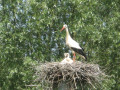
The stork has become the marsh’s iconic symbol: when the young stork takes flight from its family nest, it discovers this unspoilt natural landscape as it circles this ancient circular bend of the Seine, nestled within a vast amphitheatre of greenery. With its wet meadows stretching as far as the eye can see and its pretty thatched cottages, the Marais Vernier offers a landscape unique in Normandy that invites you to take a stroll, particularly in spring when the apple trees are in bloom.

Details

4148161
Creation:
Last update:
Last review:
  • Touring/Gravel
    Activity: Touring/Gravel
  • ↔
    Distance: 20.30 km
  • ◔
    Duration according to the author: 1.5 hrs 
  • ▲
    Difficulty: Easy

  • ⚐
    Back to start: Yes
  • ↗
    Ascent: + 20 m
  • ↘
    Descent: - 20 m

  • ▲
    Highest point: 24 m
  • ▼
    Lowest point: 2 m
  • ⚐ Country: France
  • ⚐ District: Marais-Vernier (27680)
  • ⚑
    Start/End: N 49.418083° / E 0.455537°
  • ❏
    IGN map(s): Ref. 1811OT

  • ◶
    Type of surface:
  •  
     
     98% Road  2% Byway
  • Hour-by-hour weather

Photos

Description of the route

Start from the car park in the village centre of Marais-Vernier, in front of the town hall or the church.

(S) With your back to the town hall, head to the right then, immediately to the left, go down the street running alongside the tennis courts. At the bottom, turn right onto Chemin du Roy towards Sainte-Opportune-la-Mare. Continue straight on to the end of this street, following the “Seine à vélo” route.

(1) At the end of Chemin du Roy, turn left and follow the “Seine à vélo” route along Route des Chaumières, which runs alongside the courtils – those long, narrow meadows stretching into the heart of the marsh.

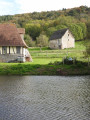
(2) When you reach the small pond known as “le Vivier”, it’s worth stopping to admire the medieval manor house on the hill to your right, next to a pretty thatched cottage on a stilt. Then, at the bottom of Route de la Côte Pelée, continue straight on towards Saint-Aubin-sur-Quillebeuf.

(3) At Chemin de la Vallée, keep going straight on. The Route des Chaumières reveals its charms with its orchards and authentic thatched cottages.

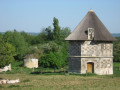
(4) Take a quick look to the left to see the pretty Renaissance dovecote and the entrance towers of the ruined castle (private property, not open to visitors).

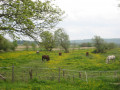
(5) A stop is a must at La Grand’Mare to admire this unspoilt natural area by climbing up to the viewpoint set up by the Hunters’ Federation. Then continue along the road known as Chemin du Quai de Forge or Ancienne Route de Quillebeuf.

(6) Take a look to the left at a group of exceptionally well-preserved thatched buildings: a wine press, barn, cart shed, stable and a 17th-century manor house built for the Dutch engineers who drained the marshes under Henry IV.

(7) At the fork, keep left to stay in the marshes and leave the “Seine à vélo” signposting.

(8) At the Grand Saint-Aubin crossroads, turn left onto the D103 via the Route du Pont des Tiquets. Cross the Pont des Tiquets over the Canal de Saint-Aubin.

(9) At the end of this road, take the D103 to the left and continue straight on until you reach the village of Marais Vernier. The road marks the boundary between the wet marshland meadows on the left and the drained and cultivated marshland on the right.

(10) Stop briefly to observe a local feature: the Croix de la Devise stands in the grass just to the left of the crossroads, then continue on your way. At the next junction with the Route du Pont de Tancarville, carry straight on towards the village of Marais-Vernier.

(11) At the “Route du Marais” sign, a short detour down the cul-de-sac on the right takes you to the Digue des Hollandais in its original earthen embankment state (a footpath has been laid out here, accessible only to pedestrians) with a lovely view over the pastures.

(11) Then, rejoin the D103 and follow it to the village of Marais-Vernier. It is from this road that you can best appreciate the view of the hill, the dovecote and the castle’s pretty outbuildings.

(12) At the entrance to the village, ignore the Chemin du Roy and continue straight on. Then, at the foot of the château, follow the road to the left and pass in front of a pretty wayside shrine. Finally, pass in front of the church and the inn to reach the town hall of Le Marais-Vernier (S/E).


Waypoints

  1. S/E : km 0 - alt. 16 m - Marais-Vernier Town Hall
  2. 1 : km 3.41 - alt. 4 m - Straight on to Bout d'Amont
  3. 2 : km 5.4 - alt. 5 m - Le Vivier and the medieval manor house
  4. 3 : km 6.06 - alt. 7 m - Straight on along the Route des Chaumières
  5. 4 : km 7.31 - alt. 13 m - Renaissance dovecote
  6. 5 : km 7.9 - alt. 9 m - La Grand Mare observation point
  7. 6 : km 8.31 - alt. 10 m - Exceptional collection of thatched cottages
  8. 7 : km 8.77 - alt. 13 m - Turn left at the fork
  9. 8 : km 11.22 - alt. 10 m - Route du Pont des Tiquets
  10. 9 : km 13.16 - alt. 5 m - D103 to the left
  11. 10 : km 15.18 - alt. 4 m - Croix de la Devise
  12. 11 : km 17.17 - alt. 4 m - Dead end on the walking route
  13. 12 : km 18.85 - alt. 4 m - On the left, beneath the old castle
  14. S/E : km 20.3 - alt. 16 m - Marais Vernier Town Hall

Notes

At the start: picnic tables, Auberge de l'Étampage restaurant 100 m away

At La Grand Mare: picnic table and observation point.
Farm produce and guest rooms at La Grand Mare in Sainte-Opportune-la-Mare.

Guest rooms and bike hire: Les Cigognes du Marais Vernier.

Lodge of the Donkeys in Clairval, with the option of donkey treks.

Worth a visit

The Marais Vernier is a 4,500-hectare natural area situated in a former meander of the Seine valley; this marsh extends well beyond the commune of Marais Vernier, which is one of the five communes that share the marsh. Home to Europe’s largest peat bog (1,800 hectares) and a dense network of waterways, the marsh features a typical, well-preserved bocage landscape within the Boucles de la Seine Normande Regional Nature Park. It is home to a rich variety of flora and fauna, including numerous protected species such as the white stork.

The Route des Chaumières is a themed route created by the Boucles de la Seine Normande Regional Nature Park to highlight the traditional architecture of this region: the chaumière is a farmhouse built using local materials.
The cafoutin is a semi-underground structure used for storing market garden produce.

The courtils are long meadows stretching from the road that circles the marsh to its very heart. Several of these preserved courtils form part of the Courtils de Bouquelon Voluntary Regional Reserve.

The 12th-century medieval manor house at a place called Le Vivier is a stone and flint structure built on a cellar. It stands next to an elegant Norman thatched cottage, also built on a cellar perpendicular to the slope, known as a ‘cafoutin’ in the local dialect.

La Grand Mare: this natural body of water is fed by the marsh’s drainage channels. Owned by the Hunting Federation, it is classified as a hunting reserve and is therefore off-limits to hunting. It provides a safe haven for large numbers of migratory birds.

The Saint-Aubin Canal connects the Grand Mare to the Seine: it drains excess water from the marsh, but at high tide the sea could flow back into the marsh, which is why a dam was built at Quillebeuf to prevent salt water from flowing back into the freshwater body at high tide.

The Dutch Dike: built on the orders of Henry IV by engineers from Holland, this dike represents the first attempt to separate the marsh from the Seine. Still visible, particularly along the footpath starting from the village of Marais Vernier, it separates the wet, peaty marsh from the drained and cultivated marshland along the banks of the Seine

The Tancarville Bridge, in service since 1959, was at the time the largest suspension bridge in Europe and still holds the French record for the longest central span (608 metres). The pylons stand 123 metres high and the ‘clearance’ (navigable height) is 50 metres.

The Croix de la Devise: a small wayside cross marking the boundaries of the land at the junction of four parishes, as well as the associated rights, such as fishing rights.

The dovecote and the charming outbuildings of the Château du Marais Vernier date back to the 14th century and have thatched roofs. They have served as the setting for several television films adapting Maupassant’s short stories.

The Church of Saint Laurent, built in the 12th century and embellished in the 14th and 16th centuries, is listed as a Historic Monument. The Auberge de l’Étampage has retained its authentic character: ‘étampage’ is an ancient practice whereby oxen were branded with a hot iron (stamped) before being released onto the communal pastures in spring.

Reviews and comments

4.7 / 5
Based on 5 reviews

Reliability of the description
5 / 5
Ease of following the route
5 / 5
Route interest
4.2 / 5
User 21505609

Overall rating : 4.7 / 5

Date of your route : Apr 26, 2026
Reliability of the description : ★★★★★ Very good
Ease of following the route : ★★★★★ Very good
Route interest : ★★★★☆ Good
Very busy route : No

A lovely route around the marsh. Suitable and easy to cycle, a bit monotonous but pleasant!

Machine-translated

Randohautchemin
Randohautchemin

Overall rating : 4.7 / 5

Date of your route : Sep 01, 2025
Reliability of the description : ★★★★★ Very good
Ease of following the route : ★★★★★ Very good
Route interest : ★★★★☆ Good
Very busy route : No

No difficulty doing it by bicycle.

Machine-translated

Capture
Capture

Overall rating : 4.7 / 5

Date of your route : Oct 01, 2023
Reliability of the description : ★★★★★ Very good
Ease of following the route : ★★★★★ Very good
Route interest : ★★★★☆ Good
Very busy route : No

A lovely bike ride – we’ve never seen so many thatched cottages in such a small area. The setting is idyllic and peaceful. We preferred to park in the lower car park on Chemin du Roy, as there was more space there with our bike rack. It’s worth noting that the Digue aux Hollandais and the other walking trails are closed from October to April; we weren’t aware of this.

Machine-translated

cdlr27
cdlr27

Hello, as a local resident, this route caught my interest, but I think there’s a mistake in the details.
20.3 km and an hour and a half’s walk.
At what pace do you walk, or is this route designed for mountain bikes?
Kind regards
Marcel
My apologies, I’d missed the ‘cycling’ mention. I understand better now.
Marcel

Machine-translated

guydo
guydo

Overall rating : 5 / 5

Date of your route : Jan 11, 2021
Reliability of the description : ★★★★★ Very good
Ease of following the route : ★★★★★ Very good
Route interest : ★★★★★ Very good
Very busy route : No

a great walk for young and old alike

Machine-translated

Dominique Louis
Dominique Louis

Hello,
This route is entirely on roads, so it’s designed for cycling.
My other routes on Visorando, however, are walking routes because they use footpaths. I’ll be publishing a new one on La Haye de Routot this week: this afternoon, I retraced it in the intended direction to describe it properly; the paths are truly superb when the light is like it is today.

If you’d prefer to walk, there are also officially signposted routes in Bouquelon or St Samson de la Roque and all around Pont-Audemer (the Marais-Vernier route is closed until April due to hunting and flooding in the marshes)
Wishing you lovely walks, best regards.

Dominique

Machine-translated

FLOCH
FLOCH ★

This route is well signposted for cyclists.

Machine-translated

cdlr27
cdlr27

Overall rating : 4 / 5

Date of your route : Jan 09, 2021
Reliability of the description : Not used / Not applicable
Ease of following the route : Not used / Not applicable
Route interest : ★★★★☆ Good
Very busy route : No

Hello, as a local resident, this route caught my interest, but I think there’s a mistake in the details.
20.3 km and an hour and a half’s walk.
At what pace do you walk, or is this route designed for mountain bikes?
Kind regards
Marcel

Machine-translated

For more walks, use our search engine .

The GPS track and description are the property of this route's author. Please do not copy them without permission.