


Refine your search for walks in Eglise Notre-Dame des Champs (Paris)
Eglise Notre-Dame des Champs (Paris) walks


 The wildlife of Montparnasse, Plaisance and Denfert
 Visorando Member
 4.78 mi
 +52 ft
 -16 ft
 2h 15
2h 15
 Easy
Easy
 Departure from Paris
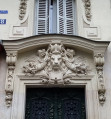
From Montparnasse Station to the Lion of Belfort, from Montparnasse Cemetery to the Catacombs of Paris, via the Jardin des Grands Explorateurs and the little house at the end of Impasse Florimont where Georges Brassens lived for 22 years, this route sets out to discover the animal representations of the 6th and 14th arrondissements.
Walks near Eglise Notre-Dame des Champs (Paris)
A visit to Montparnasse Cemetery
 2.21 mi
+23 ft
-7 ft
1h 00
Easy
Departure from Paris
2.21 mi
+23 ft
-7 ft
1h 00
Easy
Departure from Paris
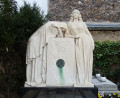
Less well-known and smaller than Père Lachaise Cemetery, Montparnasse Cemetery is the second largest cemetery within the city limits of Paris. It is the final resting place of many prominent figures, particularly from the worlds of the arts, publishing and politics. This route offers a stroll through this place of contemplation, discovering around fifty of these figures and several works of art scattered throughout the grounds.
From Montparnasse to Porte de Vanves via the green corridor
 2.54 mi
+39 ft
-7 ft
1h 10
Easy
Departure from Paris
2.54 mi
+39 ft
-7 ft
1h 10
Easy
Departure from Paris
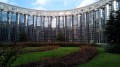
The South Paris Green Corridor is a series of green spaces that have been developed near or above the Atlantic TGV railway lines. This short walk, limited to central Paris, follows the green corridor at its beginning, while taking a few liberties to stroll through secret corners of the 14th arrondissement.
The Southern Paris Green Corridor
 74.51 mi
+4,485 ft
-4,508 ft
14 days
74.51 mi
+4,485 ft
-4,508 ft
14 days
 Moderate
Departure from Paris
Moderate
Departure from Paris
The Southern Paris Green Corridor is a series of green spaces that have been developed alongside or above the TGV Atlantique railway lines. The first two stages of this route follow this corridor from Montparnasse station to Massy. The subsequent stages extend the corridor into the Yvette Valley and across the Saclay Plateau.
In the footsteps of Georges Brassens: Montparnasse, Plaisance and Brancion
 4.19 mi
+66 ft
-98 ft
2h 00
Easy
Departure from Paris
4.19 mi
+66 ft
-98 ft
2h 00
Easy
Departure from Paris
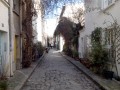
This fourth and final section of our walk dedicated to Georges Brassens takes us to the main places where he lived in Paris, including the famous Impasse Florimont. We walk along a few cobbled and flower-lined passages, cross the public park that bears his name and finish with a section of the old Petite Ceinture railway line.
Symbols of Franco-American relations in Paris
 7.00 mi
+108 ft
-49 ft
3h 20
Moderate
Departure from Paris
7.00 mi
+108 ft
-49 ft
3h 20
Moderate
Departure from Paris
A walk through Paris taking in the iconic sites associated with Americans in Paris, whilst also passing by some of the city’s famous landmarks.
The route can be followed in either direction.
The bestiary of Les Invalides and the Faubourg Saint-Germain
 4.53 mi
+20 ft
-26 ft
2h 05
Easy
Departure from Paris
4.53 mi
+20 ft
-26 ft
2h 05
Easy
Departure from Paris
A near-circular walk in the heart of Paris’s 7th arrondissement, taking in numerous depictions of animals and including a brief stretch along the banks of the Seine.
Saint-Germain-des-Prés and Montagne Sainte-Geneviève
 3.84 mi
+79 ft
-105 ft
1h 50
Easy
Departure from Paris
3.84 mi
+79 ft
-105 ft
1h 50
Easy
Departure from Paris
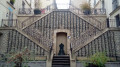
A journey into the medieval and even Gallo-Roman past of Paris, following in the footsteps of Sainte-Geneviève, whose namesake hill we climb, whose ancient sarcophagus can be seen in the church of Saint-Étienne-du-Mont, and whose statue can be seen in the Jardin du Luxembourg and on the Pont de la Tournelle. Among other sights, the itinerary follows a section of the old city wall built by Philippe Auguste and crosses the Arènes de Lutèce.
The bestiary of La Glacière, Faubourg Saint-Marcel and Les Gobelins
 3.57 mi
+79 ft
-95 ft
1h 45
Easy
Departure from Paris
3.57 mi
+79 ft
-95 ft
1h 45
Easy
Departure from Paris
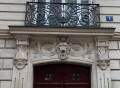
From Place Denfert-Rochereau to Place d’Italie, exploring depictions of animals. The route takes you through Faubourg Saint-Marcel in particular, where, until 1857, Paris’s great horse market was held, immortalised by the painter Rosa Bonheur.
In the footsteps of astronomers and artists between Denfert and Montparnasse
 3.93 mi
+23 ft
-62 ft
1h 50
Easy
Departure from Paris
3.93 mi
+23 ft
-62 ft
1h 50
Easy
Departure from Paris
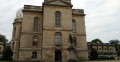
This urban walk takes you through a neighbourhood that was frequented by many artists in the first half of the 20th century. It is also where the Paris Observatory was first established, as evidenced by the names of the adjacent streets.
Denfert-Rochereau – Porte d’Auteuil
8.49 mi
+151 ft
-233 ft
4h 00
Moderate
Departure from Paris
First stage of the Paris ring route via theGR®75, with a few detours. This stage allows you to explore the south-western part of Paris whilst strolling through parks, squares and along the Petite Ceinture.