The Saint Ser black trail is closed by municipal order from 1 February to 15 July each year.


 Country:

 City:
City:




Access:
- Coming from Beaurecueil or Le Tholonet, drive through Saint-Antonin-sur-Bayon via the D17. Pass the Maison de Sainte-Victoire on leaving Saint-Antonin-sur-Bayon. Continue for about 5 km then park in the car park known as Saint-Ser on the left, just before the entrance to the Relais de Saint-Ser.
- From Puyloubier, head towards Saint-Antonin-sur-Bayon/Le Tholonet via the D17. Drive for about 2.5 km. Pass the entrance to the Relais de Saint-Ser, then park immediately in the car park on the right just after it.
(S/E) Directly from the car park, head west, following a wide track that initially runs alongside the D17. There are no signposts.
The track soon turns north, then opens out onto a clearing after about a hundred metres. Continue left along the well-marked path that crosses the grassy area.
Once out of the clearing, the route heads west along a slightly ascending path through “red earth”. Continue to the isolated farmhouse of Genty. Carry on westwards until you reach the track leading to the farmhouse, which opens out after 100m onto a small car park.
(1) Turn right to cross the car park completely, then take the path visible at the far end.
This is quite narrow (with dense low vegetation). Occasionally, a very rare, partially faded Point Violet marker is visible. Heading north for about 230m, the path then turns west.
Cross a path after about 300m, then continue to the left. The path then turns south-west onto a fairly flat section. Join a lovely path at a cairn after walking 250m.
(2) Take the path on the right. Red markings. Follow the red markings until you reach the Baudino Refuge. The path climbs all the way. At the Torque plateau marked by a cairn, continue to the right to reach the refuge after crossing some scree.
(3) At the Baudino refuge, nestled on a small wooded platform, look for the brown-marked path on the right. Go round the back of the refuge then cross a chaotic section consisting of huge limestone boulders. Pass through a narrow ‘triangular’ gap formed by two boulders.
After about 10m, a cairn-marked path starts on the left. Leave the brown-marked trail and head left. The slope rises quite steeply. Pass a large, clearly visible cairn, ideally situated on a rocky outcrop, and cross over to the other side (due north).
Once you reach the flat section of the path, follow it as it leads you to the upper part of a scree slope. To the left, just before the end of the Grand Couloir scree slope, the east-west-facing ledge appears.
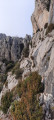
This ascending ledge is equipped with a cable serving as a handrail. The exit from the ledge is followed by two short vertical sections with chains. After these sections, continue along the cairned path through small scree and boxwood until you reach the ridge.
(4) On the ridge, you’ll come out onto theGR®9. Turn right towards the east. Follow theGR®9. White/red markings.
(5) After about 400m, pass through the Col de Suberoque leading to the Vallon Gentil. Continue along theGR®9, skirting the cliffs towards the east, and arrive at the Col de Vauvenargues, marked by a very large cairn.
(6) Begin the descent (see Practical Information 1). Black markings.
The descent begins by staying on the right-hand side. The path is well marked, with a few small slabs to cross in the upper section.
Reach a large scree slope, taking care not to slide down to the bottom as the path branches off to the left just before the end. Take the path, which is somewhat hidden by vegetation. Towards the end of the descent, the path widens. Finally reach the Brown-marked path running east to west across the massif.
(7) At the foot of the descent, turn left onto the path heading east. Brown markings. Continue for approximately 750m.
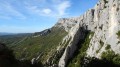
Shortly before reaching the Hermitage of Saint-Ser, the markings change to red after crossing the path coming from the south. You will reach the esplanade in front of the Chapel of Saint-Ser, offering a beautiful panorama of the surrounding cliffs, the Baou des Vespres and the Torque below the Baudino refuge.
(8) Pass under the stone porch below the chapel, then in front of the small, converted grotto of Saint-Ser beneath the chapel. You will then emerge onto the chapel terrace.
Walk south of the chapel, and behind it, rejoin the red markings. Climb over some rocks using the chain to help you along. The slope then rises very steeply to gain height.
You’ll emerge onto a small ridge and continue left towards the cliffs, following the red markings. There are a few rocky outcrops to cross, which are easy to navigate.
Reach a second short chain.
(9) On the cliff face directly ahead, you can make out the distinctive entrance to the Grotte aux Champignons, whose ochre colours stand out against the grey of the cliffs.
Leave the marked path and take the track towards the cave. Climb over a small ledge at the foot of the cliff face leading to the cave (see Practical Information 2). After visiting the cave, return to the red-marked path.
(9) Then turn right. The climb continues through a pile of stones and gravel. A few short sections require you to use your hands in places. You will soon reach a fork marked by a boulder bearing the trail markings: a red line on the left, a red dotted line on the right.
Continue to the left; the path passes through vegetation at times. Then follow the rock face and emerge onto the ridge at the Col de Saint-Ser.
(10) Follow theGR®9eastwards (to the right), skirting the ridge line and the Baou des Aigles for approximately 850m. White/red markings.
TheGR® follows the ridge line. Two sections are equipped with a small chain to aid the descent over limestone slabs (slippery when wet). Climb back up to reach the Pic des Mouches.
(11) The Pic des Mouches is marked by a signpost. From here, look towards the south face to see the path running beneath the ridge heading west.
Take the path running beneath the ridge through loose gravel. This path, which is fairly well marked, soon turns due south. After a fairly pleasant stretch through gravel, blue markings appear. Follow these.
The descent then alternates between small ledges, boulders and steep scree slopes. Whilst descending a scree slope, take care as the path turns sharply right (90°) to avoid a large limestone slab.
In a steep-sided valley, you will cross the green-marked path on the left. The blue markings disappear. Follow the green markings down the slope.
After about a hundred metres on a small scree slope, look for a Green Cross on the right marked on a boulder. Then leave the main marked path and take the track to cross the small scree slope and scree until you reach the vegetation. No markings.
The path runs along a small ledge to the right above a rocky outcrop. Reach the crack near the boulder, then descend beneath the ledge using the natural steps. After about fifty metres, the path reaches a sheer rock face which you must climb down using a long, heavy chain about ten metres long.
The path then descends steadily southwards until it crosses the green-marked trail.
(12) At the junction, continue to the left. Green markings.
The path begins through low vegetation and the terrain climbs from the very first few metres.
After about 200m, the path leaves the vegetation and heads sharply northwards, emerging onto a more open stretch.
When the path turns north-west, look out for a track on the right after about 50 m, heading east and running alongside the first foothills of the cliffs. No markings.
Proceed eastwards for about 300m through the vegetation. In places, the path is barely visible.
You will reach a scree slope and a scree field. The route then turns north and the slope becomes much steeper as you cross the scree fields and scree slopes, which are sometimes unstable.
After 250 m, the path veers westwards for about 100 metres across a slightly earthy area. You will then join the green-marked trail. Continue to the right.
The path then heads north again. During the ascent, you cross several small valleys, with occasional short downhill sections.
You will cross numerous scree slopes and gravel pits. After about 500 m, look for a cairn on the right near an area of vegetation.
(13) This marks the path leading to the Grotte du Marin.
Continue the ascent, following the green markings and cairns until you reach the ridge line and theGR®9again. At the summit, you emerge near the Garagaï de Cagoloup (chasm) and its wide opening.
(14) Head east, following theGR®9along the ridge. White/red markings.
(15) After about 600 m, you will pass a small stone wall and a cairn on your right. Continue along theGR®9until you reach the Malivert Oratory after 1.1 km, which is the easternmost point of the massif.
(16) Turn back along theGR®9and head towards the cairn and low stone wall on the left.
(15) Follow the path until you reach two cairns. Pass between them to cross over to the south face.
This section of the route requires a good sense of direction and the ability to read the terrain.
(17) Pass quickly past the entrance to the Cheminée cave (actually more of a chasm, a hole in the ground opening onto a shaft, then a horizontal chamber; see Practical Information 3). The path then passes the Batail chasm.
The path, which is fairly well marked overall, descends into a scree slope, with brown markings appearing intermittently. Generally follow the few cairns present.
Look out for a brown cross during the descent. Continue to the right and cross the few metres of vegetation to emerge onto a scree slope.
Descend due south across the numerous scree slopes. Numerous cairns indicate the direction to follow, which is fairly straightforward. There are several limestone slabs to descend. The descent ends when you reach an area of undergrowth.
(18) Look for the start of a faint path on the right. No markings.
This heads due west. The path is then fairly well marked. Continue for about 550m.
The path then turns south. Continue the descent until you come to a track leading to a private property (house on the left).
(19) Continue to the right along the track to descend. After 80m, take the path on the right which climbs slightly. Continue westwards until you reach a circular concrete basin.
(20) At the basin, take the first path on the right to follow the vineyard. Go round it. After 50m, heading south, take the path on the right to go round a second field, ignoring the tracks on the right.
After 50m heading south, turn right again onto the track and after 200m you will reach the botanical trail.
Continue left to descend and reach the Saint-Ser car park (S/E).


 Visorando Member
 Very difficult
 Easy
Easy 
 Difficult