Country:

 City:
City:


Park your car at Place Michelet (paid parking after half an hour, except on Sundays).
(S/E) With your back to the theatre, cross Boulevard Maréchal-Fayolle and turn left. After the café-brasserie Le Palais, turn right into Rue Porte Aiguière and you will come out onto Place Martouret.
(1) This square was the site of executions during the Revolution. The square is bordered on the left by the Town Hall, a Louis XV-style building with a classical façade, built in 1766.
Head towards the Town Hall, then on to Place du Clauzel, where the flea market takes place on Saturday mornings. Until 1654, this was a cemetery where the poor from the Hôtel-Dieu were buried (the Tourist Office is on your right).
Turn left onto Rue Courrerie to reach Place du Plot, adorned by the ‘La Bidoire’ fountain, dating from 1426 (this is the oldest fountain in the town). On Saturday mornings, this is the market square for farm produce (cold meats, lentils, mushrooms, cheeses including the local ‘Les Artisons’ cheese).
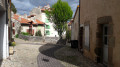
Leave Place du Plot on your left and head down the gently sloping alleyway of Chènebouterie. Several houses are worth a look for their architecture. Then turn left onto Rue Raphaël, once home to bourgeois families and the town’s leading figures. Follow it until you see the “Choriste” fountain on your right. It was dedicated in the 15th century to the memory of a young chorister who sang carols in the streets of this district of Le Puy during the Christmas festivities.
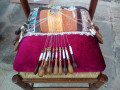
Then take Rue des Tables, lined with old houses, which leads to the foot of the cathedral’s grand staircase. The street is so named because, in days gone by, on religious feast days, the town’s merchants would set up their ‘tables’ on its slope to sell their wares to pilgrims. Along this street, there are shops specialising in verbena and lace. In summer, you can watch lace-makers at work.
After walking up Rue des Tables, you find yourself at the foot of the grand staircase (134 steps) leading up to the entrance of the cathedral (listed as a UNESCO World Heritage Site since 1998). Built in the Romanesque style, the cathedral displays various influences from the East and Moorish Spain.
(2) Head up towards the cathedral to enter via the internal staircase (open in summer only) located beneath the nave. On the 18th-century High Altar stands the current Black Madonna, which replaced the one that was burned during the Revolution. She is carried in procession every year on 15 August, the Feast of the Assumption. Of note: the organ and the pulpit. In the north aisle: painting depicting the plague vow of 1630.
Once your visit is over, retrace your steps down the stairs. You can also visit the Hôtel-Dieu, the entrance to which is halfway down the stairs leading to the cathedral. This building, a UNESCO World Heritage Site, was founded in the 12th century to care for the poorest of the sick. Following extensive renovation work, since summer 2010 the building has housed a visitor centre and tourist information point.
At the bottom of the stairs, with your back to the cathedral, turn right into Ruelle Becdelièvre, then left, to pass in front of the entrance porch of the Hôtel du Département. This was the former General Hospital in the 17th century. Then turn right onto Ruelle Roger Gouteyron (superb view of the rock and the Chapelle Saint-Michel d’Aiguilhe).
Walk down the street. After the Chapelle Sainte-Claire, turn right onto Rue du Rocher. You will arrive at the entrance to the Saint-Michel dyke. Standing 82 metres high, this is the vent of an ancient volcano, on top of which a chapel has been built. Take the staircase to climb the 268 steps leading to the summit, visit the small Romanesque chapel built in 961 (with numerous frescoes inside) and enjoy the panoramic view of the town from the walkway.
(3) Once you’ve finished your visit, head back down the way you came to the entrance of the Departmental Council, retracing your steps up the Gouteyron slope. Enter the main courtyard of the Departmental Council. Take the staircase to the right of the flowerbed. At the top of the stairs, turn right to exit. Then turn left into the uphill alley. Follow the street, keeping to the right. You will arrive at Rue du Cloître.
Turn left to head for Rocher Corneille (757 m above sea level), at the summit of which stands the monumental statue of Notre-Dame de France, erected in 1860. It is 22 metres high (including the pedestal) and weighs a total of 835 tonnes. It was cast from the metal of 213 cannons captured from the Russians during the Crimean War and donated by Napoleon III. From up there, you can enjoy a beautiful, unique 360° panoramic view of Le Puy.
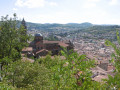
(4) Head back down, passing the 12th-century cloister (which you can visit). Take Rue de la Manecanterie and make a short detour via Place du For to admire the view of the town and the bell tower (56m high). Retrace your steps to return to Rue Saint-Georges and reach Rue Cardinal de Polignac. Turn left and then right into Rue de Derrière-l’Ancien-Musée.
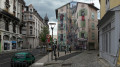
Turn left, passing the youth hostel, and walk down Rue du Général Lafayette for 100 metres. Take Rue Sous Sainte-Marie, then turn left onto Rue Droite to reach Place du Faubourg Saint-Jean. Look up at the mural on the gable of a building in the neighbourhood. This trompe-l’œil depicts key local themes: the pilgrimage to Santiago de Compostela, lace-makers, the King of the Bird, and green lentils and verbena.
Walk up Faubourg Saint-Jean towards Place Cadelade, then head towards Place du Pallet and continue straight on along Rue Chèvrerie. Turn into Rue Chaussade, then turn left onto Rue Crozatier to arrive in front of the theatre (the starting point of this route).
Turn right, cross Place du Breuil, passing the Crozatier fountain. The Prefecture, the Courthouse and the Theatre surround the square. Then enter the Jardin Henri-Vinay, a green oasis in the heart of the city. Walk around it, passing the Musée Crozatier, built in 1868 (where you can explore its fine collections: prehistory, architecture, local arts, lace, and numerous paintings and works of art), and exit onto Place Michelet (S/E).


 Visorando Member
 Moderate
 Difficult