Slieve Gullion Trail - Meigh

A mountain walk exploring the Slieve Gullion Special Area of Conservation and the Ring of Gullion Area of Outstanding Natural Beauty (AONB) using mountain paths, forest trails and country roads.

Technical sheet

31594184
Creation:
Last update:
Last review:
  • Walking
    Activity: Walking
  • ↔
    Distance: 13.99 km
  • ◔
    Average duration: 5h 25 
  • ▲
    Difficulty: Moderate

  • ⚐
    Return to departure point: Yes
  • ↗
    Vertical gain: + 486 m
  • ↘
    Vertical drop: - 484 m

  • ▲
    Highest point: 568 m
  • ▼
    Lowest point: 104 m

Photos

Description of the walk

Start : Slieve Gullion car park adjacent to the Slieve Gullion Courtyard Centre in Slieve Gullion Forest Park. (BT35 8LN) Grid ref. GRJ 042 196.

(S/E) Follow the path uphill from the car park (West) along the Forest Drive, passing the children's play area on your left. The path continues uphill through deciduous woodland for about 1 Km until arriving at a log bench opposite a Ring of Gullion Way marker post.

Turn right on to the forest drive and continue uphill through a stand of mature beech trees for 800m. Turn right on to a short section of forest track until the upper forest drive is reached.

(1) Turn left on the forest drive and continue along the southern slopes of Slieve Gullion for about 2 Km until an upper car parking area is reached on the left-hand side (A).

(2) Walk past this upper parking.

(3) Turn right 50 metres beyond the parking area up an initially steep mountain path. Continue on over a stile until a stone shelter is reached. (B) Passing to the right of the stone shelter the path becomes steeper, traversing areas of peaty and rocky ground.

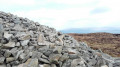
(4) After 500m the path arrives at the summit of Slieve Gullion and the Neolithic South Cairn Passage Grave. The tomb can be entered from just below the summit. Panoramic views from the summit take in the Mourne Mountains, Carlingford Lough, The Cooley Peninsula, the Armagh Drumlins and beyond. The path continues North-West along the summit plateau arriving at Calliagh Berras Lough after 800m.

(5) Continue past the lough to the North Cairn which is also a Bronze Age burial chamber.

(6) Veer right after passing the North Cairn and continue on the path. Descend for about 2 Km down the North side of the mountain until reaching the Ballard Road.

(7) Turn right (East) along the country lane and follow it as it undulates through the countryside.

(8) Keep right after 2 Km where the road forks and continue to Killevy Old Churches an ancient convent dating from the 5th Century. St Moninna is buried in the churchyard. St Bline’s Holy Well is on the hillside above. Continue along the country lane, past Clonlum South Cairn Portal Tomb on the left and Killevy Castle on the right for a further 2 Km.

(9) Turn right (West) at a cross roads. Continue through gateposts on to the exit drive from the courtyard centre and the car park. (S/E)

Waypoints

  1. S/E : km 0 - alt. 139 m - Slieve Gullion Courtyard
  2. 1 : km 0.55 - alt. 216 m - Forest Drive
  3. 2 : km 3.84 - alt. 359 m - Upper Parking
  4. 3 : km 3.98 - alt. 366 m - Right turn - Steep mountain path
  5. 4 : km 5.25 - alt. 568 m - Summit of Slieve Gullion
  6. 5 : km 5.98 - alt. 541 m - Calliagh Berras Lough
  7. 6 : km 6.47 - alt. 511 m - North Cairn
  8. 7 : km 8.53 - alt. 272 m - Country lane
  9. 8 : km 10.89 - alt. 161 m - Fork - Right turn
  10. 9 : km 13.2 - alt. 107 m - Crossroad - Right turn
  11. S/E : km 13.98 - alt. 139 m - Slieve Gullion Courtyard

Practical information

Start & Parking : Slieve Gullion car park adjacent to the Slieve Gullion Courtyard Centre in Slieve Gullion Forest Park. (BT35 8LN) Grid ref. GRJ 042 196.

Driving to start : From Newry take the Dublin Road until the Cloghoge Roundabout (2 Km). Travel on the B113 towards Forkhill, for approximately 5 Km past Meigh until the sign for Slieve Gullion Forest Park on the right hand side of the road just before Drumintee. Follow the drive past the Courtyard Centre to the car park which is the start and finish of the walk (GRJ042196).

Terrain : Minor road and forest tracks

Public Transport : Translink

Facilities : Village shops in Meigh, Drumintee and Forkhill sell supplies for taking on the walk and for having a picnic. Good food can be had in the restaurant or bar at Murphys in Meigh.

Dog Policy : Dogs must be kept under close control

Note : Please note that this walk is in an upland environment, where it may not be appropriate to install waymarkers. Walkers should come prepared with an OSNI map and compass, as visibiliy in all weathers cannot be guaranteed at the top of the mountain. These walks are situated in a working forest environment and may be subject to diversion and closure from time to time.

Find more information and walk ideas at Walk NI here.

In the nearby area

The walk is located within the Ring of Gullion Area of Outstanding Natural Beauty (AONB). The AONB is an area of national landscape importance and is centred on the craggy heather covered hills of a circular ring dyke volcano that erupted over 50 million years ago. The Ring of Gullion is the most famous ring dyke in the world having featured in geological debate and theory over the past 160 years.

(A) This section of the trail has magnificent views of the Ring of Gullion peaks of Croslieve, Slievebrack and Mullaghbane Mountain. In the upper parking area are interpretation panels that explain the geology of the area and provide further walking information on the Ring of Gullion Way.

(B) The views in this section expand to include the peaks of Slievenacapple and the Ring of Gullion to the North. An interpretation panel at the stone shelter illustrates the legends associated with the area and the legendary Finn McCool.

Slieve Gullion rising to 573m is the centrepiece of the volcanic landscape and is a Special Area of Conservation (SAC) which recognises the importance of the geology and the upland heather moorland. The purples of the heather contrast with the yellow of dwarf gorse and orange of the bracken to create rich mosaics of colours which contrast with the many greens of the agricultural ladder farm landscape.
At the base of the mountains are a network of lowland loughs associated with a diversity of fen, bog and wetland vegetation including bulrush, cotton grass, bilberry and deciduous woodland
People have lived in the Ring of Gullion for over 6,000 years. The area is renowned for the wealth of Megalithic and early Christian monuments including over twenty large stone tombs. Also close by is the Dorsey, dating from the Iron Age period. This is a massive earth embankment and rampart which sits astride an ancient routeway to Eamhain Macha, the ancient capital of Ulster.

The Ring of Gullion and Slieve Gullion, in particular, have rich associations with Irish legends and myths. In one tale, Finn McCool was bewitched by Miluchra on the summit of Slieve Gullion at the Lough of the Calliagh Bhirra. To this day the superstition survives that if you bathe in the lough your hair will turn white.

Other walks in the area

For more walks, use our search engine .

The GPS track and description are the property of the author. Do not copy them without permission.