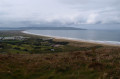
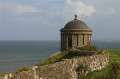
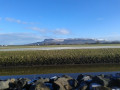
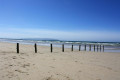
Magilligan Point guards the mouth of Lough Foyle and is home to Lough Foyle Ferry and Martello Tower. This short beach walk through a National Nature Reserve provides opportunities for visitors to explore the beach or spot birdlife and sealife.
Start : Car park adjacent to the boundary of Magilligan Nature Reserve opposite Point Bar. (BT49 0LP)
(S/E) From the car park, then pass through the kissing gate to view the Martello Tower straight ahead. (A)
(1) Pass to the right of the Tower through the dune land and walk for around 500 m to meet with the beach near a military sangar.
(2) Turn left (West) and continue along the beach as you round the Point with Lough Foyle opening up and the Ferry slipway coming into view. Retrace your steps along the beach and then return to the kissing gate via the Martello Tower at waypoint (1) and the car park. (S/E)
2 : mi 0.39 - alt. 3 ft - Beach (turn to the left)
S/E : mi 0.77 - alt. 16 ft - Magilligan Point
Notes
Start & parking: Car park adjacent to the boundary of Magilligan Nature Reserve opposite Point Bar. (BT49 0LP) Arriving at Magilligan Point follow the road past the Point Bar leading to a car park adjacent to the boundary of Magilligan Nature Reserve. Park on the left hand side of the road.
Driving to start : The beach is located at the end of Point Rd. Follow signs from the A2 for Lough Ferry. Use the car park opposite the Ferry Terminal or at Martello Tower. Access beach via steps adjacent to the Point Bar.
(A) Martello Tower – built to stop French Invasion : Martello towers, sometimes known simply as Martellos, are small defensive forts that were built across the British Empire during the 19th century, from the time of the French Revolutionary Wars onwards. Most were coastal forts.
They stand up to 40 feet (12 m) high (with two floors) and typically had a garrison of one officer and 15–25 men. Their round structure and thick walls of solid masonry made them resistant to cannon fire, while their height made them an ideal platform for a single heavy artillery piece, mounted on the flat roof and able to traverse, and hence fire, over a complete 360° circle. A few towers had moats or other batteries and works attached for extra defence.
The Martello towers were used during the first half of the 19th century, but became obsolete with the introduction of powerful rifled artillery. Many have survived to the present day, often preserved as historic monuments.
To open this route on your smartphone, you must have the Visorando app installed. If not, got to the Apple Store (iPhone) or Google Play Store (Android) to download the app.



 Country:


 Tourist office