Gade Valley Nature Walk

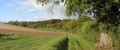
Gordon Beningfield was an artist with an international reputation for his beautiful depictions of the natural world. He spent many happy hours walking through the countryside with his close friend, naturalist and broadcaster Dennis Furnell. This walk, one of their favourites, is described by Dennis.

Details

62661165
Creation:
Last update:
Last review:
  • Walking
    Activity: Walking
  • ↔
    Distance: 6.29 km
  • ◔
    Average duration: 2h 10 
  • ▲
    Difficulty: Easy

  • ⚐
    Back to start: Yes
  • ↗
    Ascent: + 142 m
  • ↘
    Descent: - 142 m

  • ▲
    Highest point: 164 m
  • ▼
    Lowest point: 107 m

Photos

Description of the walk

Start: St John the Baptist Church, Pipers Hill, Great Gaddesden (HP1 3BY). Grid ref: TL 029 112

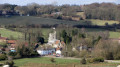
(S/E) From the lychgate entrance to St John's Church, walk down the lane and bear right to the road T-junction. Turn right for a few metres and cross the road. Continue along a driveway signed Sybden House. The path passes between a field hedge and garden fence, then opens out into a field. Continue straight along the field edge to the corner. Take the gate on the left to visit the (A) Water meadow and then retrace your steps.

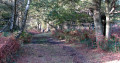
(1) Now take the path on the right. Continue to climb up into (B) High Park Wood__. Ignore the path on the left and stay straight ahead to a path junction next to a deep pit.

(2) From the pit, bear left to stay inside the wood and walk along for 150m to the next junction. Ignore the exit from the wood on the right, turn left as the path descends to another junction and bear right out of the wood. On leaving the wood, follow the path down the middle of the field to (C) Nettleden Road. Cross the road to the path opposite. Walk along the right-hand field edge to a path junction at the end.

(3) Turn left along the edge of the same field for 110m and follow the path round to the right between hedges. Stay on this path as it climbs up between field and hedgerow (D). Continue up through a disused gate, through the next one, after 100m, and climb up a few metres to a path on the right.

(4) Turn right along the path following the line of the overhead power cables to a road. Stay straight ahead along the road to a path on the right at the left-hand bend. Turn right downhill to a T-junction at the bottom (E). Turn right along the wide path to a road, Nettleden Road.

(5) Turn right along Nettleden Road and take the first left, towards Frithsden and Ashridge House, as far as The Alford Arms. Turn immediately right after the pub down the lane and straight on at the bottom. This is often referred to as the (F) ‘Roman Road’ or ‘Spooky Lane’. Climb past the vineyard to the top of the steep hill and stay straight ahead, as the lane becomes a track. Drop drop down under ‘The Devils Bridge’ to meet a road at the bottom in Nettleden. Turn left along the road for a few metres to a path on the right signposted to St Margaret’s.

(6) Take this path towards St Margaret's, walk past the barriers and climb up the hill following the right-hand field edge (G). Stay on the path for nearly 1km until it reaches a road.

(7) Turn left along the road past the entrance to Amaravati Buddhist Monastery and turn right through a gate to a path signposted to Great Gaddesden (H). Go through the next gate into a field and follow the path down past a copse to pass through a gate to the left of an electricity pole.

(8) Bear half-right down the field. Pass under the overhead cables to a gate in the bottom right-hand corner. Go through, follow the wall on the left for a few metres then go left through a gate in the wall into the churchyard.  Follow the path past the St John the Baptist and out through the lychgate to finish the walk.(S/E)

"Our special thanks go to Dennis and Ann Furnell for their enthusiastic support in producing this walk. We hope you have enjoyed your walk. Please remember to rate the walk and add comments. We are interested in how we could improve the instructions or the route and would like to hear about any issues with paths on the walk."

Waypoints

  1. S/E : km 0 - alt. 109 m - St John the Baptist Church
  2. 1 : km 0.56 - alt. 107 m - Right turn
  3. 2 : km 1.14 - alt. 152 m - Deep pit
  4. 3 : km 1.91 - alt. 117 m - Turn left
  5. 4 : km 2.45 - alt. 150 m - Path on right
  6. 5 : km 3.45 - alt. 130 m - Nettleden Road
  7. 6 : km 4.49 - alt. 115 m - Path to St. Margarets
  8. 7 : km 5.4 - alt. 162 m - Road
  9. 8 : km 5.95 - alt. 131 m - Half-right down field
  10. S/E : km 6.29 - alt. 109 m - St John the Baptist Church

Notes

Start & Finish: St John the Baptist Church, Pipers Hill, Great Gaddesden (HP1 3BY). Grid ref: TL 029 112

Parking: Church Meadow, Great Gaddesden HP1 3BT. Grid ref: TL 029 112

Local transport: Bus Services are subject to change so please consult www.travelinesoutheast.org.uk.

Terrain: An easy walk on good path surfaces and quiet lanes. Four climbs, one stile and a number of gates

Food & Drink: The Alford Arms, Frithsden HP1 3DD and the cafe close to the start/finish at the Hemel Hempstead Garden Centre, Pipers Hill, Great Gaddesden, Hemel Hempstead HP1 3BY

This walk was created for the book "More Great Walks in the Chilterns" available from the Chiltern Society or from Amazon.

Worth a visit

(A) Water meadow: Here the River Gade meanders through a veritable paradise for wildlife. It rises from springs further along the valley and creates a valuable habitat all year round. It’s one of the few chalk streams suitable as a spawning ‘redd’ for rainbow trout. Our native species, the brown trout, also thrives here, and a six-pounder was once caught by comedian Eric Morecambe. The quality of this mineral-rich water encourages large shoals of minnows and sticklebacks, food for kingfishers, grey herons and little egrets. It supports frogs and newts too, and a host of insects in summer, including the beautiful demoiselle; dragonflies include chaser, hawker and various migrant species. In the meadow the unsprayed grassland is alive with grasshoppers and crickets in summer, and the ever-changing flowering plants and grasses provide habitats for meadow brown, gatekeeper and ringlet butterflies, while marbled whites broadcast their eggs over the grasses that are their larval food plants. During June and July hawthorn hedges along the margin are a festival of bramble flowers, nectar for colourful red admirals, peacocks, comma, small tortoiseshell and sometimes the beautiful, fast-flying migrant painted lady butterfly – these beautiful insects were subjects for Gordon’s superb paintings. Often, we got no further than this insect-rich hedgerow. In winter heavy rain can turn the meadow into a flood plain supporting duck, grey wagtail and some waders. You might disturb a snipe feeding on water shrimps at the stream’s edge.

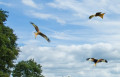
(B) High Park Wood: Let your eyes rest on the gently folded land, the oaks and willows, framing the sky and the red kites. These elegant, fork-tailed birds seemingly float over the fields, searching for carrion and large insects. Numbers have increased since their introduction some years ago. Primary scavengers, they will share territory, and it’s not uncommon for several pairs to nest together. Buzzards, round-winged predatory birds of prey, need a large territory and drive out interlopers.

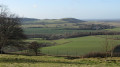
(C) Open fields by Nettleden Road: In late July, the ripening crops give the land a golden hue. Gordon wasn’t a fan of monoculture, but he enjoyed the subtle colours against the green and lilac tones of the distant hill. The open nature of Chiltern woodland allows for some beautiful views. Woodland was a favourite with Gordon and in spring these woods are rich with flowering ground cover like bluebells, primroses, yellow archangel, bramble and dog’s mercury – each an indicator of ancient woodland. Hazel and hornbeam coppice stools show where felled trees grow new shoots. Cut on a rotation of seven to ten years, the poles were a source of natural materials for over 1,000 years for sheep hurdles and fence panels. Hornbeam charcoal was ground for gunpowder. Beech, ash, oak, yew and the late-lamented elm were used for furniture.

(D) Hedgerow towards Potten End – The footpath is bordered by an ancient bank where badgers and foxes have dug setts and earths. The land has been grazed for many years, which can be seen in the anthills of yellow meadow ants. Gordon painted a green woodpecker investigating these anthills. In winter you might see migrant redwings and fieldfares. In spring and early summer the bank is a picture, with wild dog rose and the ground cover dominated by garlic mustard, so-called for its scent. It’s the larval food plant of orange tip butterflies – look for the females whose wings are tipped with black; both sexes have a lacy pattern on the underwings a little like lichen. She lays an individual yellow egg and when the caterpillar hatches it imitates the developing green pods. You should see these remarkably camouflaged larvae in June and July.

(E) Path from Potten End to Nettleden Road: 20 years ago you wouldn’t have seen the silver-washed fritillary here. One of Gordon’s favourites, he would be thrilled to know that they’re flying around the honey-scented buddleia. This bronze-coloured, fast-flying insect is a member of the same family as peacock and red admiral. In early spring the first butterfly is the brimstone, the butter-coloured-fly that gives its name to the worldwide butterfly family. It can be seen flying in every month of the year. The male’s sulphur-coloured wings are quite startling. Brimstones hibernate in thick ivy in winter but come out when the sun is warm. Buckthorn is their sole larval food plant; it produces long straight twigs that were burned to make artists’ charcoal. Blackthorn was used to make stock-proof hedges – a vegetable barbed wire! It also provides nest sites for migrant songbirds, blackcaps, garden warblers, whitethroats and willow warblers, as well as being the larval food plant for the rare black hairstreak butterfly. In winter you may see a hunting sparrowhawk. Our progress through the countryside was always a leisurely affair, and dependent on the wildlife we came across. In autumn it was often fungi. These fascinating organisms are neither plant nor animal, but have characteristics of both. Without their abilities as natural composters and recyclers our world would be uninhabitable.

(F) Roman Road: Past The Alford Arms the fields have been managed sensitively, and a pair of barn owls hunt at dawn and dusk. Talk now is of climate change, but a natural cycle of warm and cool periods has been with us for millennia, although the delicate natural balance is being tipped. The Romans once grew vines in the Gade Valley.

(G) Path to St. Margaret’s – This hedge is obviously very old; it has a rich mixture of native shrubs, one of which is the seemingly delicate spindleberry. It’s becoming rare, because the spindles for spinning wheels are no longer needed. In winter it’s decorated with bright, almost plastic-looking poisonous pink berries on greenish yellow twigs. Further up, a considerable growth of wild honeysuckle winds round the hazel. Honeysuckle is the larval food plant and hibernaculum for white admiral butterflies. Monoculture has driven them out of this area – they haven’t been seen since the 1950s – but perhaps with agriculture becoming less intensive this beautiful insect will return.

(H) Path from St. Margaret’s to Great Gaddesden: Where you descend to the churchyard buddleia grows in the hedge and, when in flower, is full of the butterflies Gordon loved to paint. Churchyards themselves are peaceful places for wildlife and contemplation, and for listening to the winter song of wrens and robins.

Other walks in the area

For more walks, use our search engine .

The GPS track and description are the property of this route's author. Please do not copy them without permission.